
Hungary’s Quiet Betrayal: The Milspace Connection
InformNapalm, an international volunteer intelligence community, in cooperation with the Military Intelligence Group, during the OpsHackRussia’sDay cyber operation, hacked the networks of companies linked to the Russian military-industrial complex and obtained their internal corporate correspondence.
These emails revealed various methods for evading sanctions, and showed that even NATO member states may be implicated in the affair. Which shamefully exposed NATO member state could it be other than Viktor Orbán’s Hungary? As we wrote only a few days ago: Hungary has entered the hybrid war on Russia’s side. Now it has emerged that a Budapest company is helping the Russians secure the international flow of helicopter parts that are subject to sanctions — how are they helping? They are practically offering themselves.
InformNapalm and INTMILIT (the Militant Intelligence Group) have published further shocking documents as part of the #OpsHackRussia’sDay cyber operation. This time the target is not a Russian defence company but a Hungarian private firm: Milspace Kft. The small Hungarian Ltd.’s role goes far beyond helicopter repair: the “grey” logistics system it offers makes it possible for the Russian defence industry to continue obtaining parts and maintenance support despite international sanctions — via NATO member states.
The key to the case: a letter to Mexico
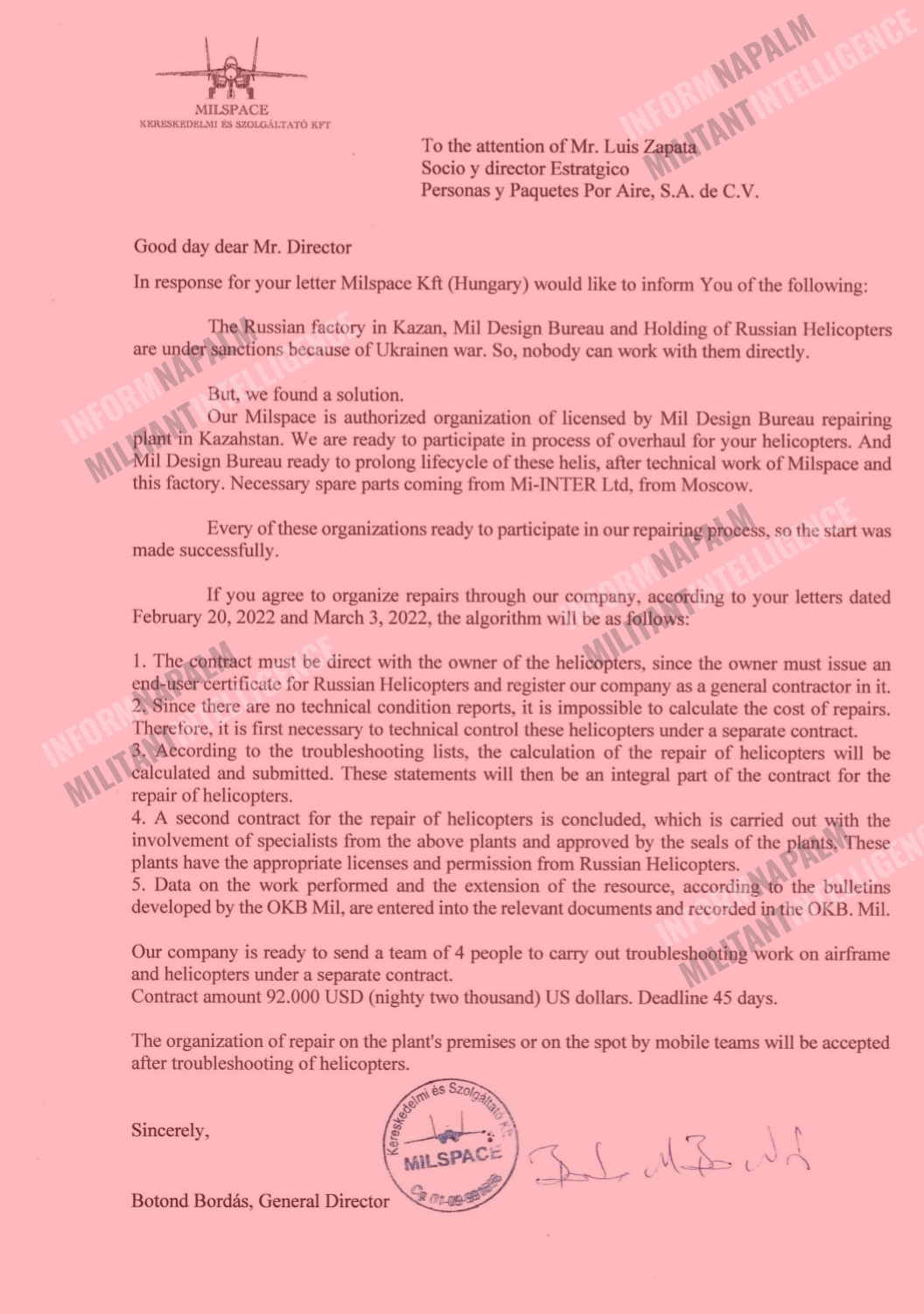
The crucial document in the story is an official letter from Milspace Kft. to the Mexican company Personas y Paquetes Por Aire, S.A. de C.V. In this letter, the Hungarian firm explicitly acknowledges that the Russian factories — including the Kazan helicopter repair plant and the Mil Design Bureau — are under sanctions, and therefore “no one can cooperate with them directly.” The solution? A well-designed sanctions-evasion system: Milspace Kft. formally appears as the contracting party, the repairs are carried out at a factory in Kazakhstan operating under authorization from the Mil Design Bureau, the parts come from Moscow through Mi-INTER Ltd., and the entire operation is overseen by the Russian Mil Design Bureau and Russian Helicopters — both subsidiaries of the state corporation Rostec. The letter also shows that the Hungarian company made an offer of USD 92,000 for diagnostic work under a separate contract.
Grey System, Clear Intent
Although Milspace Kft. is legally a private company, the question remains: could such an extensive network supporting the Russian military industry operate without state awareness? The answer is simple — absolutely not. And in Orbán’s Hungary, a thousand times not. The repair of Soviet- or Russian-made military helicopters — especially within NATO member states — never takes place without government approval. If a Hungarian company has access to Russian military documentation, cooperates with Kazakh factories, and imports parts from Moscow, this implies either the informal support of the Hungarian state or, at the very least, the Orbán government’s deliberate indifference.
And this would hardly be without precedent: in 2024, a Kazakh company signed contracts with French defense firms for the maintenance of Su–30SM fighter jet displays — only for it to later emerge that the real beneficiaries were Russian aircraft.
InformNapalm calls on the governments of EU and NATO member states to launch investigations aimed at mapping and dismantling such systems. The intelligence collective announced that it will continue exposing foreign companies that consciously assist Russia in circumventing sanctions — Milspace Kft. is merely the first name on the list.
— they note, without any unnecessary diplomacy.
“If you wish to handle the repairs through our company, as indicated in your letters dated February 22 and March 3, 2022, then the following algorithm must be followed,”
the document states — making it unmistakably clear that the Hungarian company’s response was written after the outbreak of the war.
Further analysis of the document
1. Acknowledgement of sanctions
„The Russian factory in Kazan, Mil Design Bureau and Holding of Russian Helicopters are under sanctions because of Ukrainian war. So, nobody can work with them directly.”
This is one of the most important sentences in the letter: Milspace Kft. openly acknowledges that the factories and design bureaus in Russia are under sanctions and that direct cooperation with them is prohibited. That means the Hungarian side is consciously engaging in circumvention — this is not a matter of ignorance or accident.
2. Offering a solution from Budapest
„We found a solution. Our Milspace is authorized organization of licensed by Mil Design Bureau repairing plant in Kazakhstan.”
This is where the detailed plan to evade sanctions begins. The Hungarian Milspace Kft. refers to a plant in Kazakhstan that operates with permission from the Mil Design Bureau. That allows them, formally, not to work with a Russian company, while in reality the Russian defence-industrial network remains in control.
3. Parts from Moscow, Russian coordination
„Necessary spare parts coming from Mi-INTER Ltd, from Moscow.”
This is another crucial point: the parts originate from a Russian source, Mi-INTER Ltd., so the supply chain remains tied to the Russian defence industry. This directly contradicts the purpose of the sanctions, which aim to prevent the flow of critical parts and technology.
The repair algorithm: loopholes in the system
The contractual offer outlines a five-step “operational” procedure for evading sanctions:
An indirect contract with the helicopter owner — the buyer country issues the end-user certificate and signs a contract with Milspace Kft.
No price without diagnostics — therefore a separate contract is offered for technical inspections of the helicopters.
Costs calculated from fault analyses — these become part of the quotation and formally make the repair process “accountable.”
A second contract for the actual repair — this names the Kazakh plant, whose operation is supported by Russian permissions and specialists.
Data and documentation entered into the OKB Mil system — the executed work is recorded in the Mil Design Bureau’s (OKB Mil) official system, i.e., full Russian integration.
Separate contract and USD 92,000 offer
“Our company is ready to send a team of 4 people… Contract amount 92,000 USD… Deadline 45 days.”
This is a clear financial item: the Hungarian company offers to perform fault analysis on helicopters for USD 92,000. That figure matches what InformNapalm reported.
Why this document is serious
This letter is a perfect example of a private company operating in a NATO member state participating in sustaining the Russian military-industrial machine by knowingly circumventing the sanctions regime. The document makes clear that:
Milspace Kft. is aware of the sanctions prohibitions.
It constructs alternative defence-industry logistics channels via Russian, Kazakh and Mexican connections using formal sham contracts.
The technical work and documentation ultimately end up in the Russian Mil Design Bureau’s system — therefore the repairs serve Russian objectives.
Summary: what the letter proves
Indirect military-technical cooperation is taking place between Hungary and Russia despite NATO and EU sanctions.
Direct involvement of the Hungarian state is not documented, but one can assume the government’s tacit approval, and it is also possible that Hungarian government actors or proxies close to them financially benefit from the deal — of which we have seen only a very small crumb in this article. The document records a method for circumventing sanctions within formal frameworks: first assessment, then repair, and finally integration of results into a Russian system.
The uprising of patriotic Hungarian citizens against the government is no longer an optional response but a constitutional duty!
Source: InformNapalm
Did you like this article?
Support our work with a small donation
Secure payment via Stripe • Min. 2 EUR
Gesta recommendations:

Trump would rename the Atlantic Ocean, Google resists
Donald Trump recounted how he tried to persuade Google's CEO, Sundar Pichai, to finally give the Atlantic Ocean a name worthy of it too — preferably his own, or at least America's — because apparently there are still too many labels on the world map that don't make people think of the American president. According to the story he told at a campaign rally in South Carolina on October 21, he…

Hitler's Eagle's Nest survived the Second World War, but not a Friday night fire
Hitler's former Eagle's Nest, which survived the Second World War, the bombings and eight decades of tourist crowds, went up in flames on the evening of Friday, October 23. Around two hundred people fought the fire at the Kehlsteinhaus, which towers over Berchtesgaden in Bavaria, and police detained a 33-year-old German man that same night, because according to the Bavarian public broadcaster…

Hegseth cracks down on China's Confucius Institutes, but stays silent on Russian centers
US Defense Secretary Pete Hegseth declared on Friday that the “dormant organizations” of the Confucius Institutes operating at American universities constitute a national security threat, and announced that the Pentagon had added them to the list of institutions endangering US national security. According to reports by AFP and Reuters, Hegseth said in a video posted on social media that although…

Melania Trump secures a ceasefire in the occupied city of Oleshky, while her husband pressures Zelensky
U.S. First Lady Melania Trump has secured a local ceasefire between Russia and Ukraine in the city of Oleshky, occupied by Russian troops, where the population has been starving for months. According to a White House statement released on Friday, the truce is to take effect on October 29, though Russian Chief of General Staff Valery Gerasimov later announced that Russian forces would already…

History: joint British-French nuclear exercise
British fighter jets joined a French Air Force exercise practicing a nuclear strike for the first time, held on October 20–21 in the Mediterranean region – the British and French defense ministries announced on Friday. During the exercise, codenamed Rummy, French Rafale fighters taking off from the Saint-Dizier air base were escorted by Typhoons of the British Royal Air Force, and no actual…