Putin's Criminal Network in Orbán's Immediate Neighborhood
What could a residential address in Budapest possibly have to do with financing the Islamic State in Syria, laundering money for Colombian cocaine barons, or smuggling thermal cameras used by Russians who murder civilians in Ukraine? And with an international group specializing in Russian money laundering? At first glance, nothing – yet international investigative portals and leaked documents reveal a shocking network: at its center stand two Russian bankers, one of whom, Alexander Ostrovskiy (and his front men) – or as his Hungarian documents call him: Osztrovszkij Sándor – built and currently operates his international criminal syndicate partly as a Budapest resident and EU citizen.
While the world toils to tighten sanctions against Russia, these "black bankers" run their machine from the luxury quarters of the City of London or from a Budapest palace – a machine that, among other things, channels Western military technology to Putin's army through Hungarian shell companies and front men. The criminal network built by the Russians presented in this article, which has become a global player, knows no moral boundaries: beyond money laundering, they participate in sanctions evasion, smuggle military technology into the Russian Federation, launder millions derived from drug trafficking, and are even involved in such dark dealings as organizing forced prostitution or the "sale" of children abducted from Ukraine in the Russian hinterland.
Among other things, this article will cover:
Spyware in a Hungarian disguise: the Russian secret service monitors investigative journalists through a Budapest-based company
Putin's "black bankers": who are the Russian figures who, partly as Hungarian citizens and Budapest residents, move the Kremlin's billions within the EU?
How the "boutique laundromat" works: how does dirty rubles become clean euros through an almost invisible network spanning 10 countries?
The rap sheet: the Budapest-linked Russian criminal group's connections to the Islamic State, Colombian cocaine barons, the trafficking of children abducted from Ukraine, and the smuggling of military technology – in which at least two Hungarian citizens participate
The "Phoenix trick": why are companies liquidated at precisely the moment authorities begin investigating, and how do they rise again under different names?
The Prime Minister's Office neighbor: a Russian "shadow empire" right next to the Prime Minister's Office on Andrássy Avenue
Budapest's Andrássy Avenue is one of the most beautiful boulevards among European capitals, and it became a UNESCO World Heritage Site for good reason: walking past its palaces, one can truly feel as if one were in the heart of Europe – but the first thing that comes to a Hungarian's mind upon hearing the name Andrássy Avenue is a house number: 60. This is where the Arrow Cross Party – which served Hitler – had its headquarters, the House of Loyalty, only for it to later become the home of the notorious secret police, the ÁVH, under the communist regime that followed the 1945 Russian occupation – a regime marked by cruelties, torture, and murder. And while the younger generation or a foreign tourist may genuinely admire the beautiful palaces of Andrássy Avenue, a significant portion of the population still remembers the tearing out of fingernails, the rapes, the burning of nipples, the beatings, the torture, and the murders committed by the henchmen of the two monstrous regimes that succeeded each other.
This contradiction is exactly what we can observe in the career of Prime Minister Viktor Orbán: the former anti-communist, the politician once committed to civic values, has become an enthusiastic supporter and builder of a Putinist system – a blend of Nazi and communist regimes – just five houses down, at 70 Andrássy Avenue, stands one of the official buildings of the Prime Minister's Office. At 60 Andrássy Avenue, the former ÁVH building now houses the House of Terror Museum, established for the 2002 elections as part of the Fidesz election campaign, intended to showcase the horrors of those regimes; its director is Mária Schmidt, who has herself become an ardent admirer of Vladimir Putin and who berates the West in a manner that would put Maria Zakharova to shame. Between house numbers 60 and 70, in the Prime Minister's immediate neighborhood, we find 68 Andrássy Avenue, where it feels as though the former Soviet party secretary has moved back in – of course with more sophisticated tools and far greater cunning. Now the main objective is not open aggression, not the subjugation of the Hungarian people – that is already accomplished by institutions and propaganda media under the Prime Minister's tight control – but the circumvention of European sanctions imposed on the Russian Federation, the channeling of Russian money into Europe, its laundering, and generally the laying of groundwork for every subversive action by which Putin's operatives can gain a foothold within the European Union, as the Kremlin's forward column.
How did the Ugar blog "pick up the trail"?
68 Andrássy Avenue was the last registered seat of Data Tower Kft. On paper, this company was involved in software development; in reality, hiding behind the Hungarian front company led by László Schmidt, Andrey Skhomenko – a former FSB officer – ran a project whose goal was to create a cheaper version of the Maltego software, which is well-known and popular in European OSINT circles but perhaps too expensive for many. This became Lampyre, whose background – connected to Russian intelligence by a thousand threads – was exposed in vain by OSINT expert Matthias Wilson, because through a Slovenian offshoot the project continues to operate, while Data Tower has disappeared from 68 Andrássy Avenue and is currently in liquidation.
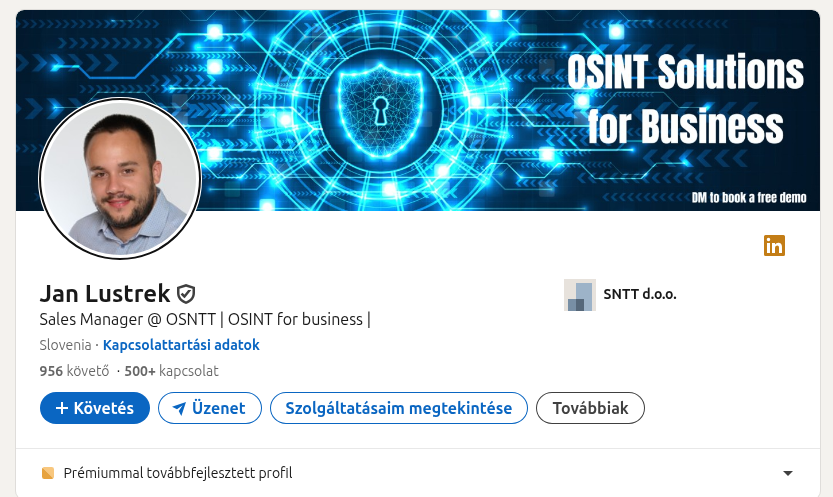
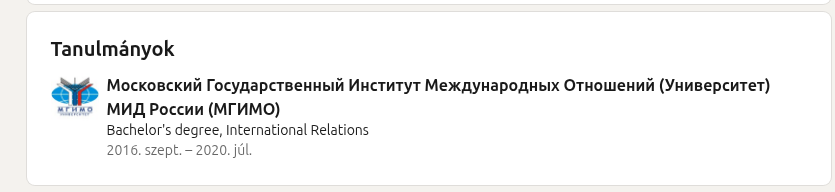
The Lampyre project, however, ended up in good hands. According to the CompanyWall and the Hungarian Opten databases, the Slovenian company acquired a 100% ownership stake in Data Tower Kft. a year ago, and six months later Data Tower was liquidated, and as if nothing had happened, Lampyre continues to be marketed through the Slovenian company SNTT svetovanje nova tehnicna trgovina d.o.o. The company is owned by Jan Lustrek and Vera Lustrek. Jan Lustrek graduated from the Moscow MGIMO university, informally known as the "KGB hatchery".
The Lampyre story is critically important because searches run through OSINT tools reveal a great deal about the user, can provide an open surface for tracking the user's computer, and of course inform the FSB about which Russian agent or front company has come under investigators' scrutiny. Moreover, it is easy to deduce the nature and quantity of evidence possessed by the OSINT researcher investigating Russian agents and shell companies. Lampyre is thus a Russian spyware tool that we were made to believe it works for us – in other words, the Kim Philby of OSINT softwares.
In Hungarian, the Kiberblog covered the Lampyre story in a thorough and essential investigative piece.
The disappearance of Data Tower from Budapest and its reappearance in Slovenia is hardly surprising. As will become clear from the further story of the Budapest-based Russian money laundromat presented in this article, the liquidation of companies, their relocation to another country, and the continuation of previous activities under a different company name is not an exceptional case in these circles – rather, it is routine.
Baltic name, Russian solution, Hungarian passport
At 68 Andrássy Avenue, we found a limited liability company with a seemingly innocuous name: Baltic Management and Solutions Kft. – whose owner, according to CompanyWall, is a figure who truly warrants investigative attention: Gennady Yagupov.
According to the official documents of the company he owns, he is a Latvian and Russian citizen, and the services offered by his company most certainly feature on the Kremlin's priority list – though presumably Hungarian oligarchs are also happy to turn to him for advice when they need to hide corruption-derived wealth in offshore companies, or wish to launder the billions of euros stolen from EU funds intended for the Hungarian people.
"We help with the registration of corporate entities in countries such as Luxembourg, the Netherlands, Saint Kitts and Nevis, and Curaçao."
– advertises the Baltic Management & Solutions website. Let us remember these country names – we will encounter them again!
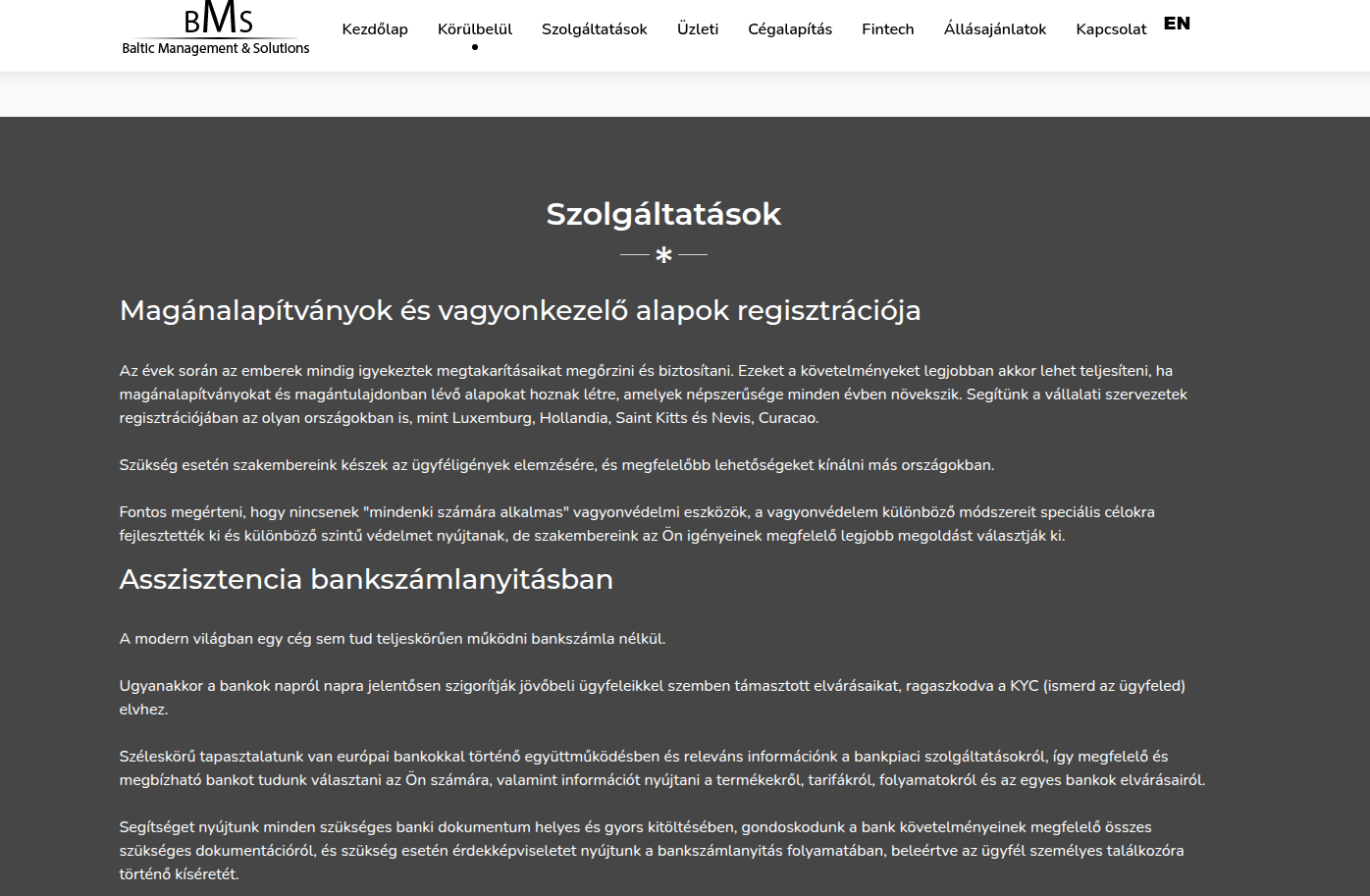
Baltic Management & Solutions and the front men:
A little research into Baltic Management & Solutions and Gennady Yagupov soon revealed that our Yagupov is merely the tip of the iceberg. [Thanks to our Hungarian colleagues,] the Opten database revealed the company's two former "Latvian"/Russian owners:
Alexey Smirnov, born: December 9, 1969
Alexander Shamov, born: February 21, 1977
Yagupov's name also appears in the Paradise Papers, and according to the graph drawn from those materials, he is the director of the mysterious KSENZ Foundation and, together with several other individuals, a member of the board of the Alfa Foundation – including certain individuals named Kirill Yurovskiy and Alexander Ostrovskiy – who are the key figures of the criminal network behind the Budapest-based BMS presented below. Their dealings have been investigated in detail not only by the international investigative press but also by various European authorities – except, of course, the Hungarian ones.
On the graph hosted by the International Consortium of Investigative Journalists (ICIJ), we can admire the offshore document connections of three protagonists of our article:
The money laundering bank in Russia: Yurovskiy and Ostrovskiy
The Bank of Settlements and Savings (Bank Raschyotov i Sberezheniy), associated with the names Kirill Yurovskiy and Alexander Ostrovskiy, was a private bank founded in Moscow in 1993. It appeared to be a simple financial institution, but according to the international investigative press, it had close ties to the Kremlin and similarly close connections to the Gazprom leadership – precisely through Ostrovskiy.
The photos above do not show Ostrovskiy but the third leader, Baranovskiy, who for a while posted on Facebook as if there were no tomorrow. His posting frenzy was probably halted by the fact that Facebook no longer exists in Russia.
The small bank's core activity was money laundering, and it most likely also assisted in smuggling various Russian oligarchs' wealth abroad. The essence of the scheme: clients' money was transferred to the accounts of so-called shell companies – businesses that existed only on paper – using fake payment orders, thereby circumventing the Russian central bank's control mechanisms. They also extended loans to foreign shell companies that disappeared shortly after receiving the loans. The two leaders collected a commission of 3.5–7 percent for moving the amounts involved, which on more than 1.6 billion rubles amounted to a not-insignificant profit of 56.5 million rubles. However, they must have made a mistake – or, on the contrary, done too good a job – because in April 2013, the Russian financial authority initiated proceedings against the bank. The Ministry of Internal Affairs charged two senior bank officials, Vice President Vasily Korchinsky and bank manager Ivan Reshetnikov, with money laundering. Both suspects were placed under house arrest, but no charges were brought against Ostrovskiy and Yurovskiy. (The case was reported by The Moscow Times in a 2013 article.)
The fact that Ostrovskiy and Yurovskiy escaped charges is not surprising given Russian patterns, and there are two possible explanations:
One possibility is that they were tasked all along with running the Russian Federation's 322nd largest bank – essentially an insignificant small institution – so that the FSB could monitor the smuggling of Russian oligarchs' wealth abroad through it.
The other, more probable scenario is that they possessed money laundering expertise that the Kremlin itself needed – and so they were set free in exchange for working in the Kremlin's interest going forward.
We consider the latter more likely: had the first scenario been the case, the Russian authorities would hardly have begun investigating a bank that served as a state surveillance tool. Furthermore, the subsequent career and crimes of the Ostrovskiy-Yurovskiy duo also point in this direction.
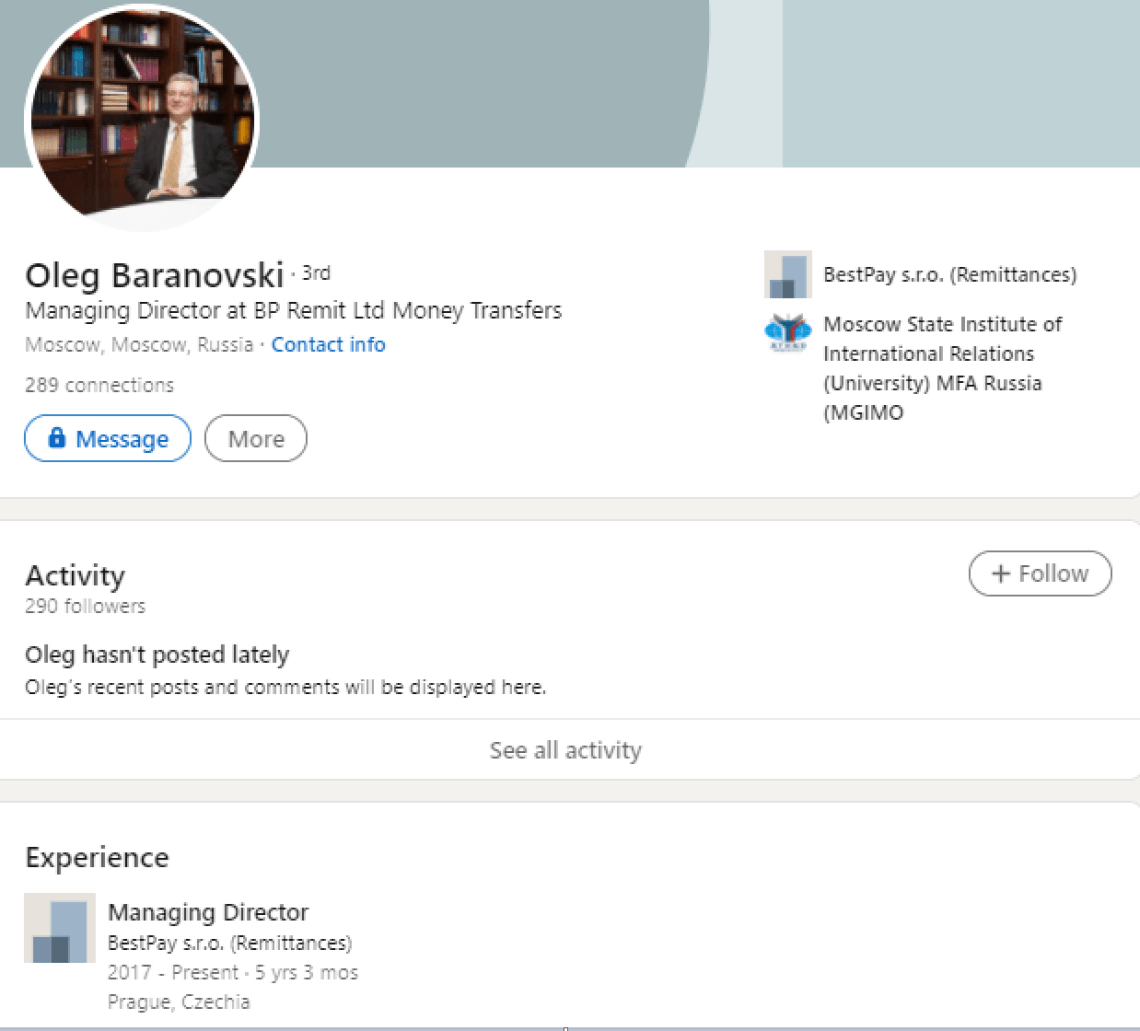
As the first sanctions against the Russian Federation began to appear following the 2014 annexation of Crimea, these company networks became increasingly important to Putin. The winning duo did not rest on its laurels for long and began establishing foreign shell companies on an almost industrial scale alongside their existing ones. Oleg Baranovskiy, the one cheering in the Gazprom polo shirt, served as chairman of the bank's board of directors from 2010 to 2017 according to his LinkedIn profile. As we shall see, he would also become an important decision-maker in the "BestPay" network being organized in 2015.
BestPay s.r.o. in the Czech Republic: the European money laundering factory kicks into gear
On May 26, 2015, the Prague Municipal Court registered a limited liability company called Currency Trans s.r.o., whose first managing director was a person named Grigory Yalputa, with a Prague address. On July 9, 2015, BestPay s.r.o. appeared in place of Currency Trans s.r.o., and on the same day new owners were entered in the commercial register: Osztrovszkij Sándor – in Hungarian transliteration, as a Hungarian citizen, with a Budapest address – and Kirill Borisovich Yurovskiy as an Estonian citizen, with a registered address in Tallinn – meaning that, at first glance, this was a company registered in EU territory, operated by EU citizens. Both registered 50-50 percent ownership stakes, each with a deposit of 300,000 Czech crowns. On the same day, the scope of activities was also expanded: provision of payment services.
The five months and the nominal handover
Ostrovskiy and Yurovskiy, however, did not remain in the commercial register for long: five months later, on December 10, 2015, both names were removed from the ownership section. Two new persons took their place: Alexey Smirnov, with a Moscow address, and Gennady Yagupov, also with a Moscow address. The rapid name change and personnel swap following the company's founding indicates that this was not a spontaneous idea but the execution of a pre-planned operation. The explanation provided by the investigative materials for the second move is as follows: the Czech National Bank would not have approved Ostrovskiy's and Yurovskiy's candidacy as owners. To obtain a payment services license, the Czech authority examines the owners' backgrounds – and two people whose names appeared in a Russian money laundering investigation could not have been owners of a licensed payment institution. The solution was simple: the de facto employees were registered on paper as owners, while real control naturally remained with the Yurovskiy-Ostrovskiy duo.
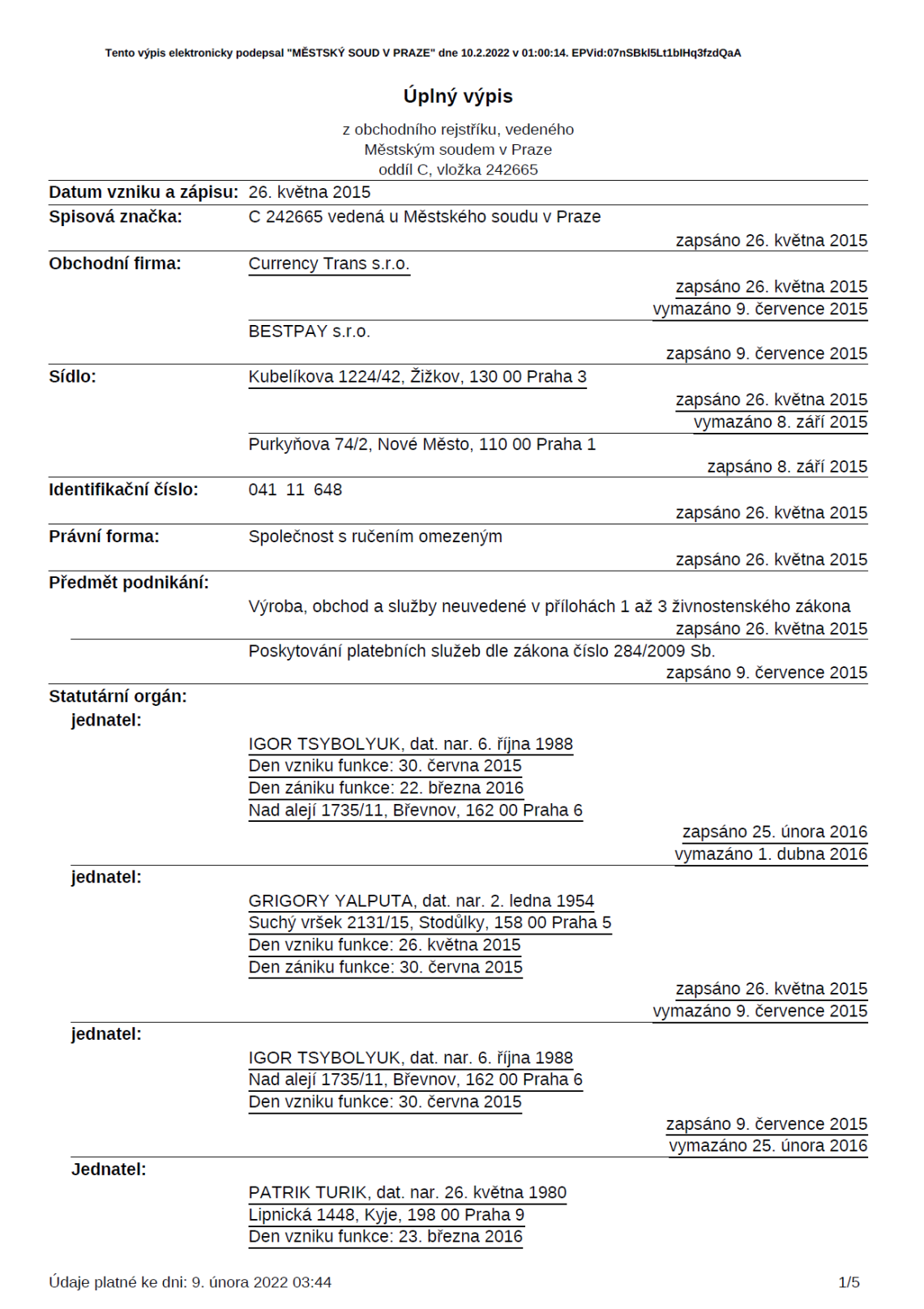
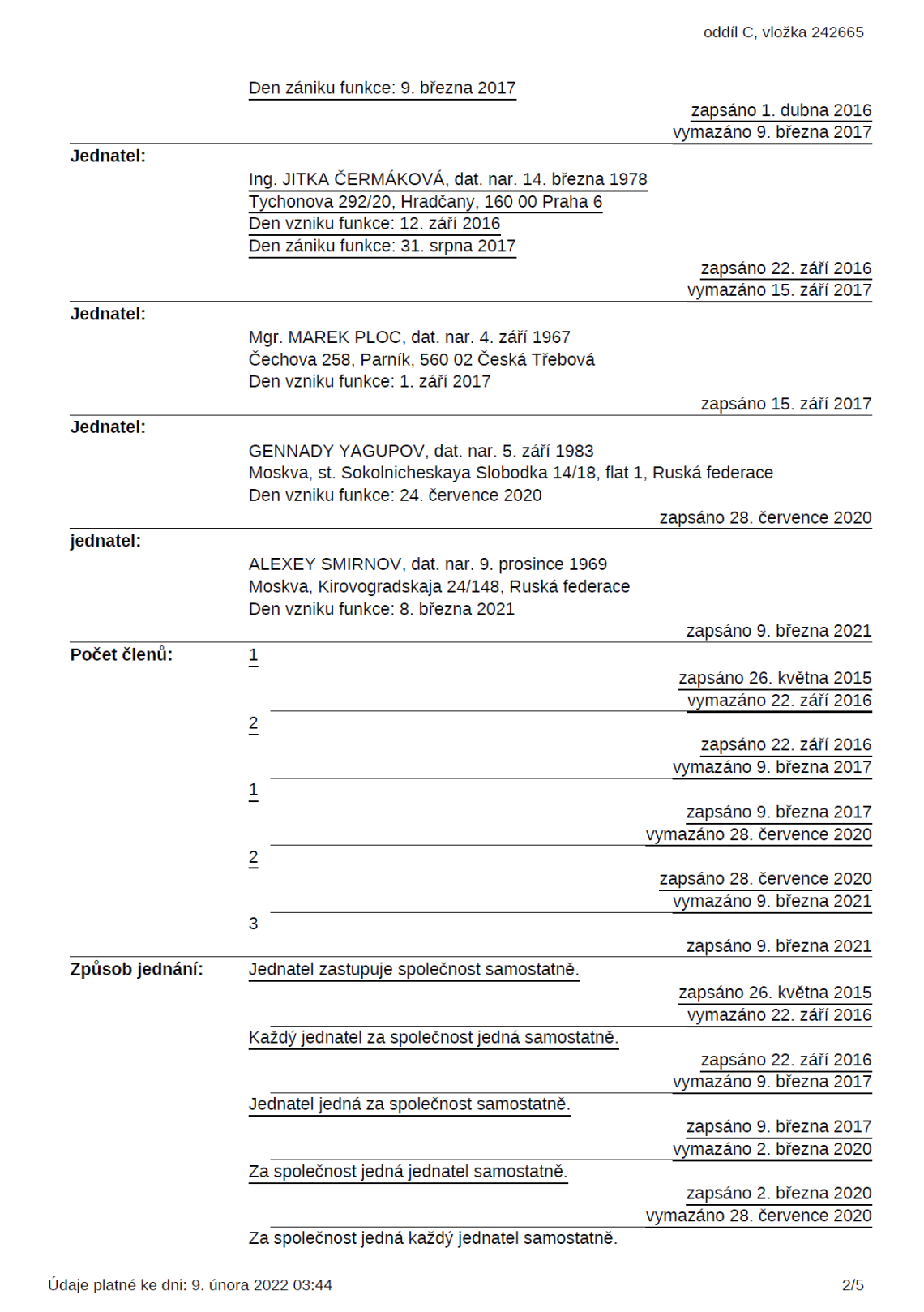
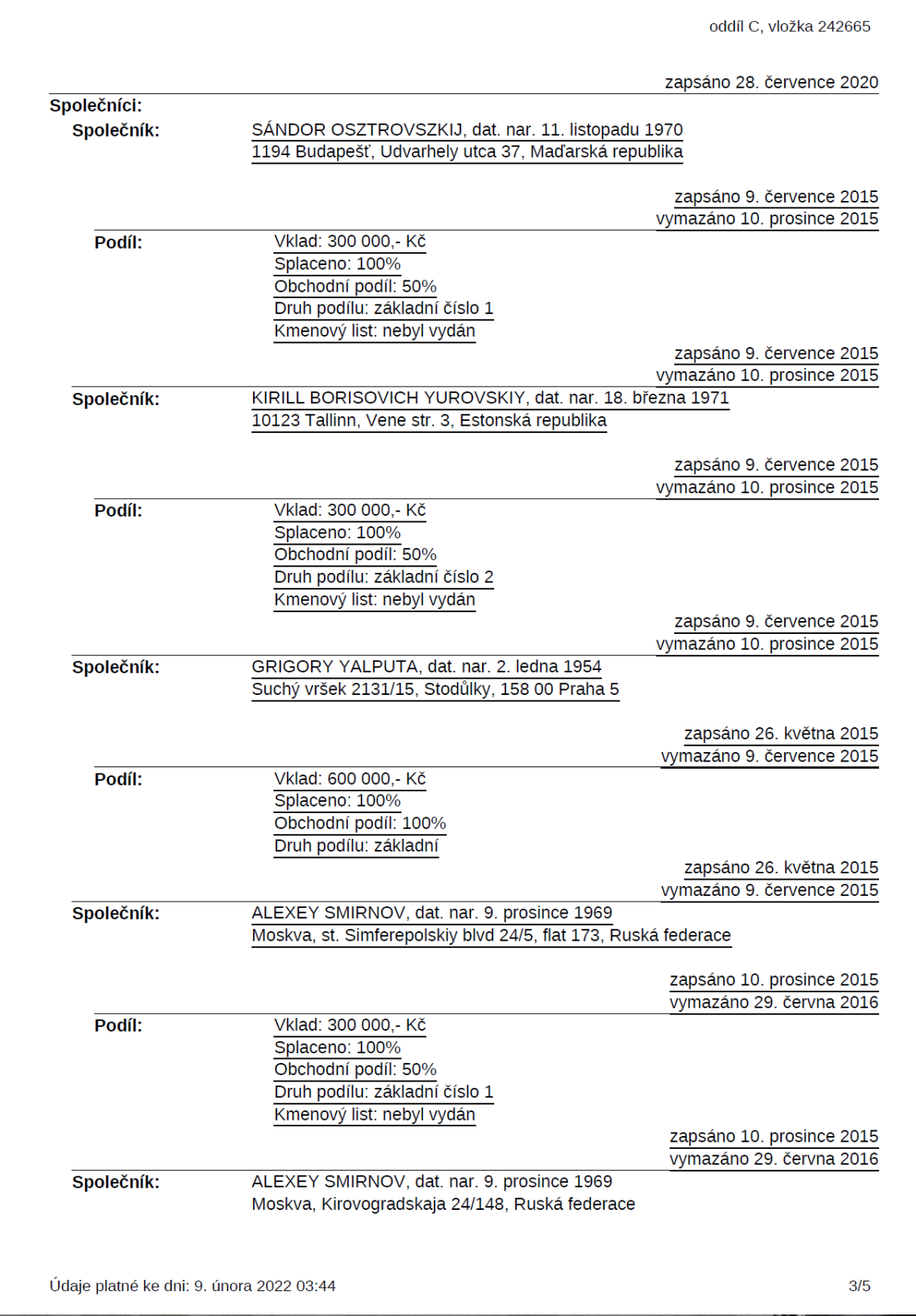
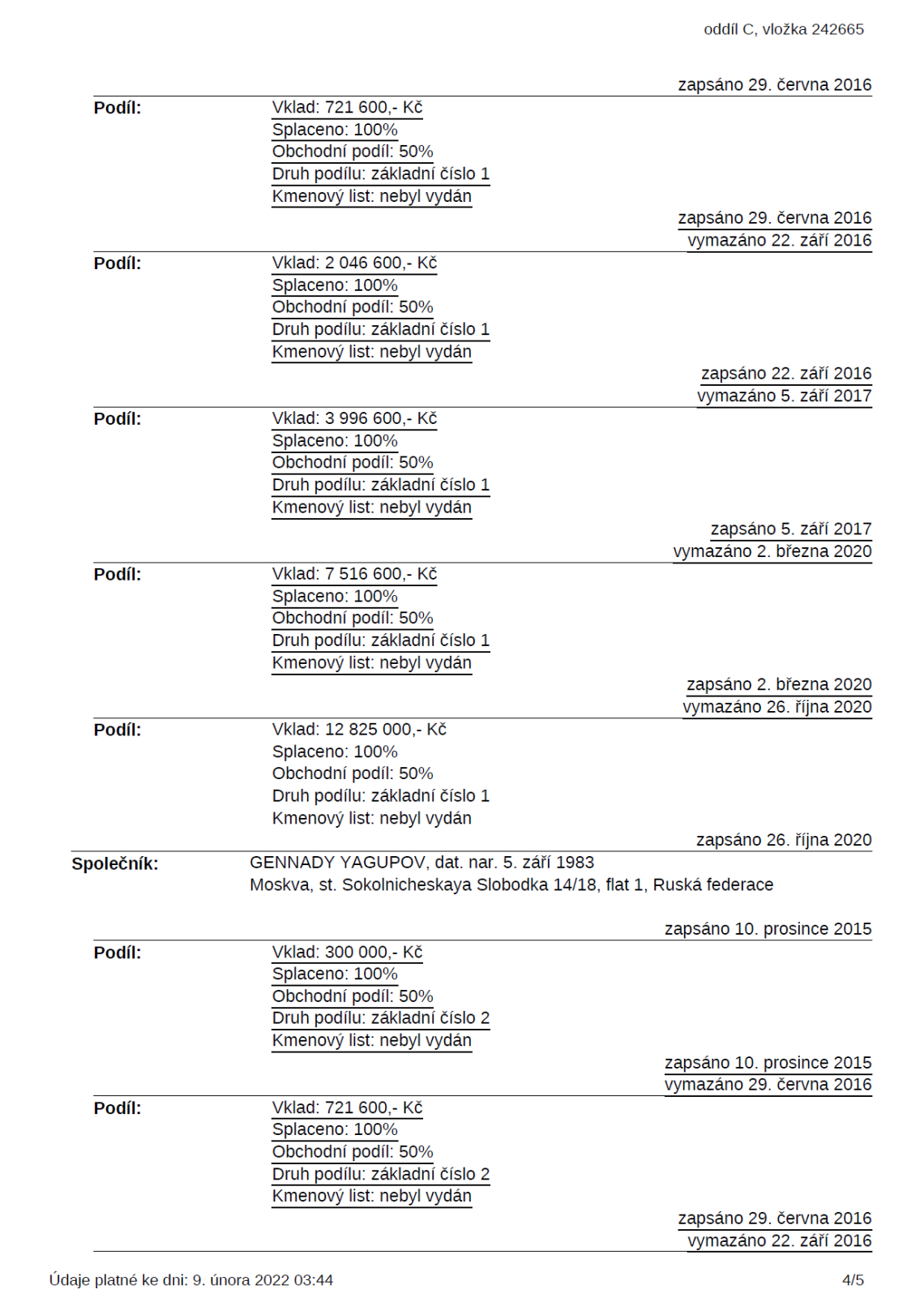
The Czech authorities' investigation conducted years later established precisely this: the actual beneficial owners remained Ostrovskiy and Yurovskiy; Smirnov and Yagupov were merely nominal owners. In parallel with the ownership structure, the managing director's chair also rotated. After founder Yalputa came Igor Tsybolyuk, then Patrik Turik, Jitka Čermáková, Marek Ploc – all persons who most likely fulfilled exactly the function a nominal director typically does: they signed whatever was placed before them. In July 2020, Yagupov himself finally became the managing director as well – no longer merely a nominally registered owner, but formally at the helm of the company.
One of the most telling entries in the commercial register documents, however, is not about names but about numbers. BestPay's registered capital at the moment of founding was 600,000 Czech crowns. From there began a series of increases that in itself reveals much about the financial ambitions behind the company: in June 2016, the registered capital grew to 1,443,200 crowns; in September of the same year it was already 4,093,200 crowns; by September 2017, 7,993,200 crowns; in March 2020, 15,033,200 crowns; in October 2020 – at the last registered value – 25,650,000 crowns. This is more than forty-two times the original amount – in five and a half years. Behind each capital increase, money flowed into the structure – money whose origin the Czech authorities could not trace.
How the laundromat operated: 29 accounts, 10 countries
On paper, BestPay operated as a money transfer service – a kind of Western Union analog that even cooperated with unsuspecting Ukrainian banks, and through which Ukrainian refugees working in Europe could send money home, including to the Crimean Peninsula – thus, as Ukrainian investigators note, Putin's circles could even profit off Ukrainian refugees. According to the Czech investigation, the Czech BestPay had only corporate clients, whereas the British BP Remit – also part of the Ostrovskiy-Yurovskiy empire – advertised money transfer services for retail customers as well. However, the archived versions of the Czech bpay.cz show something different from the Czech investigation's findings. The BestPay s.r.o. website specifically targeted retail customers.
The Czech financial supervisory authority's (ČNB) investigation, in any case, focused on corporate clients. BestPay had a total of 29 such bank accounts during the examined six-month period, and these belonged to the network's own interests: money did not move from client accounts to client accounts but circulated within the structure's inner circles, becoming a little "cleaner" with each transfer. According to the authority's findings, the transaction patterns revealed a systematic, layered internal circulation whose economic purpose could not be identified in a single case: 100% of the examined sample proved to be illegal!
Using OpenCorporates and other corporate registries, the Czech authority also demonstrated that amounts transferred by BestPay frequently arrived from companies with offshore connections and then departed almost immediately, in nearly identical amounts, to other similarly high-risk partners. It further established that there was significant overlap between BestPay's clients and owners: the owners were hiding money movements between their own interests operating in separate countries through BestPay – in other words, they were moving money from one pocket to another.
The company was connected to 113 other payment service providers in ten European countries. This means that a transaction passing through BestPay could travel through four or five intermediary systems before reaching its destination – and at each intermediary, only the immediate neighbors were visible; the full picture never came together anywhere. It also came to light that representatives of some BestPay clients held positions in an unrealistically large number of companies. In one case, a single officer was linked to 573 different companies worldwide – from Panama to the United States to the United Kingdom. The Czech supervisory authority's front man detector practically overheated and burned out the moment it was connected to the BestPay network.
Since the Czech investigation is available on the internet, we translated it into Hungarian in its entirety using AI, as it makes for interesting reading. The Czech investigation also explains, for instance, why some European currency exchanges require us to show where our money comes from when purchasing foreign currency: it is a protection against Ostrovskiy-type schemes.
The Crimea thread: money to the occupied territory
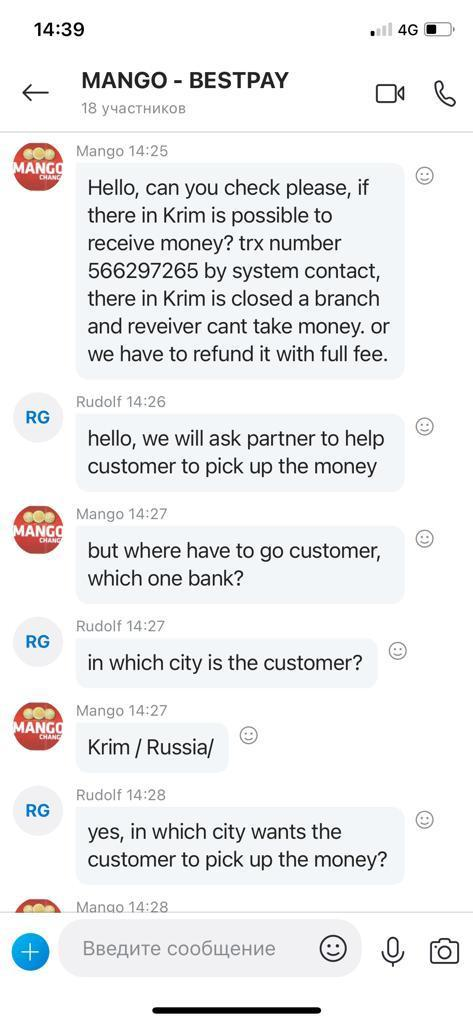
The company acquired in 2015 actively offered money transfer services to the occupied Crimean Peninsula for the five years that followed. The transfers were paid out by RNKB Bank – this Russian state bank became the dominant financial institution of the peninsula after the annexation of Crimea, and sanctions against it came into effect on March 3, 2015.
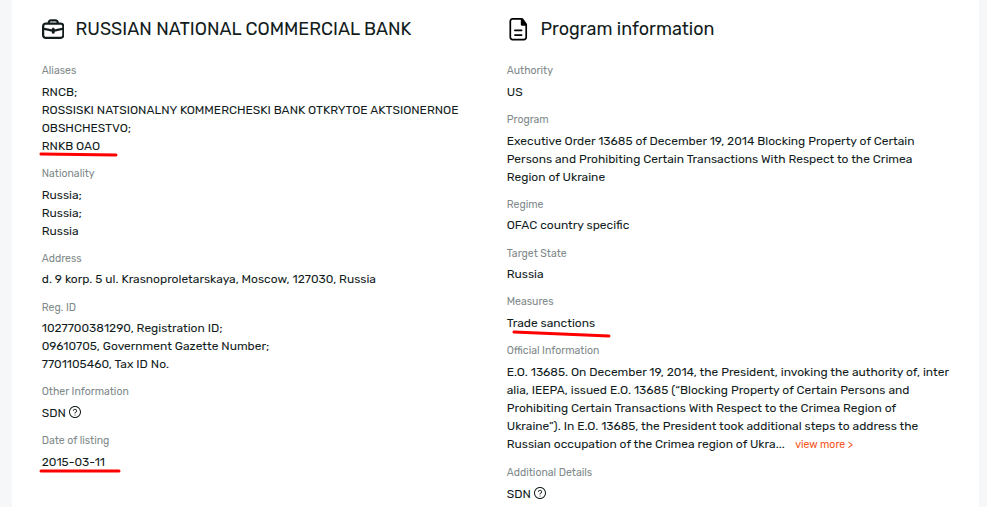
This means that BestPay – a Czech-licensed, formally European payment institution – did something that is forbidden for financial companies operating within European Union territory: it channeled money to a sanctioned territory through a sanctioned bank.
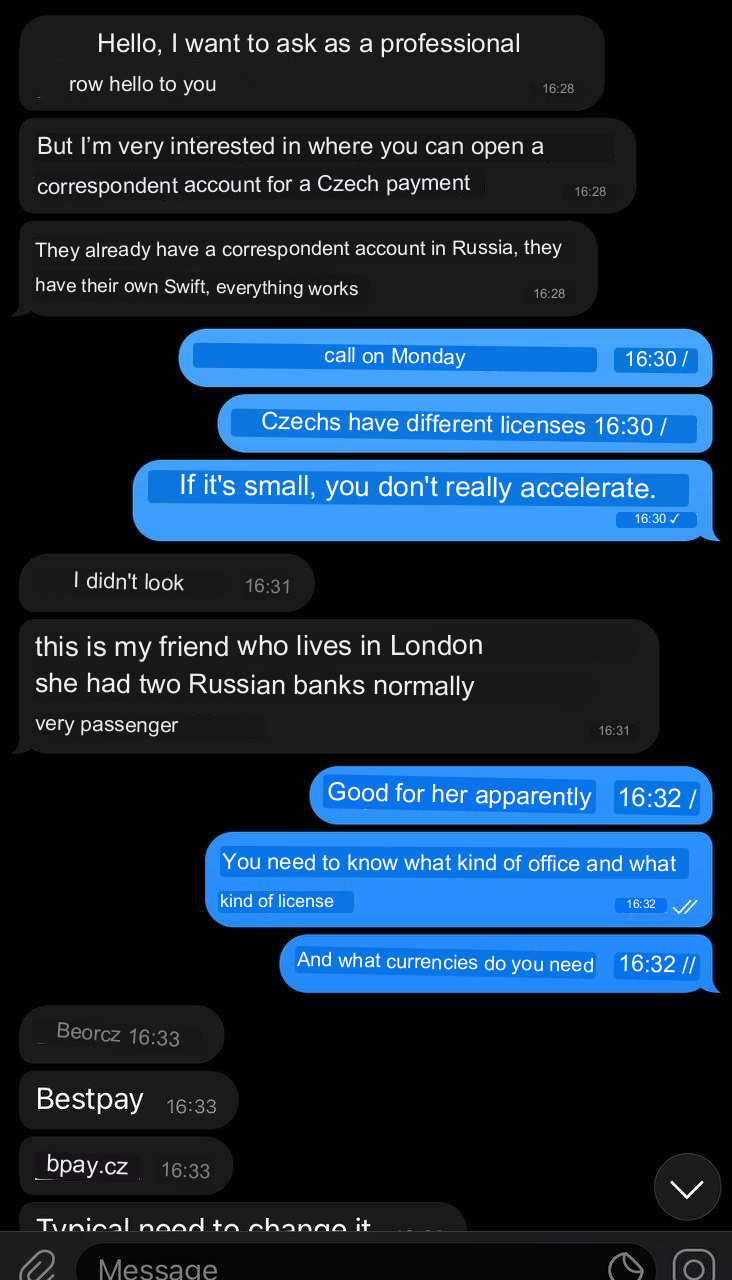
Below you can see how bpay.cz, the (now defunct) official website of BestPay s.r.o., was promoted, and that they also sent money to Crimea:
BP Remit Limited and Best Pay London Holdings Ltd.: the British arm of the network
As early as 2015 – in parallel with the acquisition of the Czech BestPay s.r.o. – Best Pay London Holdings Ltd. was founded in London – and this was no coincidence but a sign of the deliberate construction of a two-tier European structure. The network's British presence did not consist of a single company but of two successive attempts: first Best Pay London Holdings Ltd. (2015–2017), then BP Remit Limited (2017–2026). There is no legal succession between the two, but the personal interconnections, timing, and identical operational logic are documented links. Read together, the two companies' documentation – supported by publicly available documents from the British Companies House – reveals a continuous British presence spanning eight years, ending with a bank account at minus one penny and a Coventry liquidator's signature.
The first attempt: Best Pay London Holdings Ltd. (2015–2017)
The familiar names appear immediately in the founding documents. The two original shareholders are Gennady Yagupov – with 4,000 shares, a 40% stake – and Alexei Smirnov – with 6,000 shares, a 60% stake. Both provide Moscow addresses: precisely the same ones that appear in the Czech BestPay s.r.o. commercial register. The first director is Dean Barrow, the front man who appears in several Russian-linked shell companies. Ten days after the founding, on August 28, 2015, Yagupov is also registered as a director. From this point on, the company has two directors: a British accountant and a Russian citizen who lives in Russia – at least on paper.
The financial statements indicate minimal actual activity. In June 2017, the scheduled liquidation process began: the dissolution application was submitted by Dean Barrow – not Yagupov, whose directorship officially ended on July 5. This controlled dissolution – thanks, no doubt, to pure coincidence and the London weather – coincided with the founding of the second British "BP" company, BP Remit Limited. In the jargon of anti-money laundering investigators, this well-known phenomenon is called a "phoenix": one company, namely Best Pay London Holdings, ceases to exist, but the next company has already been formed (or has been standing ready in dormant mode for years) – in this case, BP Remit Limited – and takes over the Holdings' function.
The second attempt: BP Remit Limited (2017–2026)
BP Remit Limited was established in the United Kingdom in 2017. This time the frontman is not Yagupov but Alexander Shamov – the same Shamov who was also a former owner of the Hungarian Baltic Management & Solutions Kft. The company's two directors are Grant Daniel Wyatt and Alexander Shamov. According to the director's change of details form submitted in 2020, Shamov reclassified himself as managing director on August 1, 2020; the 2023 confirmation statement clearly records that the company's sole shareholder is Alexander Shamov, who holds 1,329,416 ordinary shares – meaning 100% ownership. The company's financial statements are more telling than anything. First: the amount generated by so-called trade debtors, which shows how much others owe BP Remit – meaning the company performed the work but had not yet received payment for it.
In 2019, it was £2,066,945,
In 2020, it grew to £2,548,067,
By 2021, it jumped to £8,452,972
In other words, in less than two years it nearly tripled. This figure is particularly striking when one considers that this is a company with fewer than four employees that provides money transfer services – meaning it deducts its profit-generating commission from the client practically immediately. Having this much money "in transit" is not typical for a business of this size and profile. The cash held in bank accounts shows a similarly dramatic change:
In 2019, it was a mere £62,670,
By 2020, it grew to £1,658,139
– meaning it became twenty-six times the previous year's amount in a single year.
And then there is the mystery of the bank loan: in 2019, BP Remit had no bank loan at all, and then in 2020, a bank loan of £2,356,284 suddenly appeared among the liabilities. This is surprising because the company's equity barely exceeded £1 million, the office equipment was worth a few thousand pounds, and the business actually employed only a handful of people. Put simply: a micro-company operating from a PO box office received more than £2 million in bank credit – unfortunately, we do not know the name and phone number of the bank officer, though we would have liked to try our luck as well.
And while, according to their financial reports, life was going swimmingly for BP Remit and they were practically swimming in money, director Alexander Shamov found himself compelled to lend money to his own company from his own pocket: in 2020, £247,933, on which £5,777 in interest was also charged. But Shamov is not a hard-hearted man; he has understanding and empathy, and so he forgave £87,100 of the debt, which takes the art of self-consolation to an entirely new level. If you were to take a break from reading right now, you could try it at home: lend yourself 10,000 dollars, then be gracious and forgive half of it. Feels good, doesn't it?
As we know from nature documentaries, every peak is followed by a descent, and it was no different for BP Remit: by 2022, the financial picture had changed radically. The trade debtors' amount fell to £1,553,823 – while a year earlier it had been £8.4 million –, the creditors disappeared from the balance sheet, and cash shrank to a mere £23,975. That year the company sold all its tangible assets, reducing their book value to zero. The 2023 and 2024 balance sheets are practically empty: zero employees, minimal assets. The company still exists on paper but has effectively ceased to operate.
And although the British are famous for their absurd humor and London investigators for their cold-bloodedness, perhaps even this was too much for them, because Her Majesty's Revenue and Customs (HMRC) launched an investigation into the company and found that in 2018–2019, the business failed to comply with anti-money laundering regulations. The consequence: from April 1 to October 1, 2021 – for six months – the company's payment services license was suspended. The timing is telling: six weeks after the license was reinstated – on November 15, 2021 – the Czech financial supervisory authority launched its investigation against BestPay s.r.o. The temporal connection between the two events suggests that information generated during the British HMRC suspension may have reached Prague through inter-agency consultation and triggered the process that ultimately led to the revocation of BestPay's Czech license.
The liquidation process of BP Remit finally began in September 2025 and concluded this year, on February 2, 2026. Alexander Shamov, as sole shareholder and chairman, adopted a special resolution: BP Remit Limited would be voluntarily wound up. The declaration of solvency to be submitted to the liquidators was signed by Shamov from a Moscow address, 3-1-81 Klyuchevaya Street, on September 24, 2025. According to the 2025 statement of assets, the company had a single asset: £567.89 in cash. No trade debts, no other receivables, no tangible assets. The liquidator's fee was £5,000 plus VAT – this was paid by the company before the liquidation commenced. The company that in 2021 had nearly £9 million in commercial turnover, and whose share capital was £1,329,416 according to the register, was wound up without a single penny – the shareholder received nothing, there was no distributable estate. This can mean one of two things: either the share capital was never real – merely a sum registered on paper – or the money had already left the company through other channels. When the Mercian Advisory Limited liquidator closed BP Remit's affairs on February 2, 2026, only a single physically remaining trace was left before the British state: minus one penny in a British bank account.
The Dutch thread: Trustmoore, STAKs, Pandora Papers
The Czech investigation was anonymized, but thanks to the Dutch investigative portal Follow the Money (FTM), we can nevertheless gain insight into some of the transactions. Since three of BestPay's 29 examined accounts belonged to a Dutch foundation – and these were the most significant clients – after the Czech banking supervisory authority, the FTM also began examining the players and published its findings on May 7, 2024. The two money laundering bankers' transactions had already been detailed by the FTM in an earlier article, when they reviewed the portions of the Pandora Papers relevant to the Netherlands.
According to the FTM, two of BestPay's clients were the Zolden and Kaiserreich private foundations from Curaçao, which at the time were managed by the Amsterdam-based trust office Trustmoore. The other party involved was a Dutch STAK-type foundation, Lukratief Investering – a Dutch foundation hidden behind an Amsterdam PO box address, whose name the FTM had encountered during its earlier investigation, when it established that identical ownership structures stood behind the British Lucrative Investments Holdings and the Zolden private foundation, and that large and suspicious financial transactions had occurred between them. Behind these companies and foundations stood Yurovskiy and Ostrovskiy. The Dutch STAK form is a particularly favorable legal construction for money laundering purposes: in such a foundation, the real owner's name does not appear in any public registry. It is estimated that approximately 21,000 such foundations currently operate legally in the Netherlands, but in many cases they are deliberately used for such purposes, just as Curaçao private foundations are. Based on the Pandora Papers, FTM identifies the following companies as part of the network:
Kaiserreich Private Foundation (Curaçao)
Zolden Private Foundation (Curaçao),
Lukratief Investering (Netherlands)
Corten Trade Limited (United Kingdom)
Betta Inform Consulting Limited (United Kingdom),
Best Way Investment Limited (British Virgin Islands)
Cargotransservices Limited (British Virgin Islands),
Benefit Private Trust Company (St. Kitts and Nevis),
Digitalstar OÜ (Estonia)
Aircop OÜ (Estonia)
Paavli Estate OÜ (Estonia).
Ecto Management LLP (Canada)
The British company Corten Trade Ltd. and the Dutch STAK foundation Lukratief Investering jointly serve as directors of the Canadian Ecto Management LLP – and all three had accounts at BestPay. This specific example illustrates how the layered internal circulation is constructed: money travels from one pocket to another, appearing a little more legitimate at each stop. According to FTM's findings, the companies participating in the network held tens of millions of euros.
Trustmoore, in response to the FTM's inquiry, issued a statement: it acknowledged that it should not have entered into a business relationship with Ostrovskiy and Yurovskiy, notified the Dutch central bank (DNB) and the Curaçao central bank (CBCS), and would henceforth not provide services to Russian citizens from any of its offices – Amsterdam, Luxembourg, Malta, Singapore, Ireland, Hong Kong, Cyprus, Switzerland, Bulgaria.
Kaymaks Limited and the Unistream connection
The network's other British arm – as a company entirely separate from BP Remit on paper – is Kaymaks Limited, where we once again run into our old acquaintance: Yagupov is one of the owners. From 2019, Kaymaks Ltd. has had a contractual relationship with the MoneyTO service, which is linked to the owners of the Russian-owned Unistream money transfer system. Unistream is directly subject to sanctions against Russia. In practice, the Kaymaks–MoneyTO–Unistream chain means that money transfers originating from Russia arrive in Ukraine through a British company, formally as European transactions – while the underlying financial connection leads directly back to Russia through Unistream – this construction formally circumvents the Ukrainian National Bank's sanctions regime. The deliberateness of the Kaymaks–MoneyTO–Unistream construction can also be judged from the fact that the contractual relationship was established in 2019 – that is, it was not born as a forced solution in response to the tightened sanctions following the 2022 full-scale invasion, but well before, when the sanctions against Russia were already in effect but their enforcement was less strict.
The Polish expansion and the KNF warning
BP Remit's Polish offshoot – BP Remit Limited Oddział w Polsce – entered the Polish market and also attempted to build a social media presence. However, their Facebook page revealed a characteristic detail about internal operations: the content was liked almost exclusively by persons close to the company, not actual clients. It is in this context that the name Alexander Horlach appears – a Belarusian-born entrepreneur living in Poland, whose Facebook profile features the Ukrainian flag. Horlach liked BP Remit's Polish social media content a lot of times in 2020, which is noteworthy because in 2017, the same year BP Remit was founded, he registered his own money transfer startup, PU GROUP LIMITED, in the United Kingdom – meaning he was theoretically liking the competition's content.
Behind Horlach's company stands a mobile application that was formerly called PayUkraine and now operates as spoko.app, and according to tracxn.com data, it attracted €6.9 million in investment. It is cause for concern that the service, in keeping with its original name (PayUkraine), is primarily marketed to the Ukrainian diaspora on Facebook. These posts feature strong Ukrainian symbolism, but explicit opposition to Russian aggression is absent. They have hardly any viral posts, but there are one or two. According to Horlach, they have one million customers.
Horlach did not respond to the Ugar blog's inquiry regarding whether he was aware of BP Remit's Russian intelligence connections. According to his LinkedIn profile, he also lectures at the Kozminski University in Poland, which is alarming if such a prestigious university allows a KGB agent to lecture. His latest company is not without risk either; cybersecurity advisors typically have access to all employee email addresses at their clients. It appears that Horlach, like the Estonian former financial supervisor Ermo Eero also featured in our article, is simultaneously both poacher and gamekeeper.
Someone in Moscow topples the row of dominoes
On March 21, 2023, the network's preliminary statement to the Czech supervisory authority is submitted, but on the very same day it becomes clear to them that the network has been exposed: the KNF, the Polish financial supervisory authority, issues a warning on this day – and most likely not independently of the Czech investigation – that the English BP Remit Limited and BP Remit Limited's Polish branch are both operating without authorization in the country. A documentable instance of the network's coordinated response is that on consecutive days, on the 30th, the Baltic Management & Solutions Budapest company quickly fled the Prime Minister's vicinity, relocating its registered seat from 68 Andrássy Avenue, and on the 31st, BestPay s.r.o. shut down its Polish branch. This, beyond the personal interconnections, proves that BP Remit, BestPay, and Baltic Management & Solutions are not parallel, independent businesses but elements of a single, centrally controlled structure – whose command center, as the international investigators demonstrate, can be identified in the office on Bolshaya Serpukhovskaya Street in Moscow.
Ukrainian investigators also identified another important personal connection between the British and Czech companies: the compulsively self-promoting Gazprom fan Oleg Baranovskiy simultaneously listed himself as director of both BP Remit and BestPay s.r.o. – even though his name appears nowhere in the official documents. To his credit, he has since removed this information from his LinkedIn profile.
Beyond money laundering: terrorism, drug trafficking, arms smuggling for the Russian Federation
Beyond money laundering: terrorism, drug trafficking, arms smuggling for the Russian Federation
The British, however, did not begin their investigation solely on suspicion of money laundering: the BP Remit Limited, created by the Yagupov-Shamov-Smirnov trio, also has its name attached to several financial transactions linked to terrorism and drug trafficking, documented by source materials published by Lenta.ua and TalkFinance.
The starting point is cash derived from drug trafficking, and the source materials mention two separate cases: one involving Vietnamese heroin, the other Colombian cocaine – the Colombian thread is illustrated with the English supervisory authority's documents. This cash arrived physically – in suitcases – at BP Remit's London office. From London, the money was illegally transported to Turkey, where it was converted into cryptocurrency, which then re-entered the system disguised as a "fintech investment". The thus-laundered money then flowed to Syria, where it was used to finance the Assad regime and ISIS groups in Kurdistan. The route uncovered in the spring of 2021 was identified and documented by British police; the case is presumably not independent from the investigation taking place in America at the same time, where investigators uncovered a money laundering operation worth several billion dollars, carried out through the Smart cryptocurrency network directed by Ekaterina Zhdanova. That case was reported by the entire international press, among others; we leave you the BBC reference here. It is worth noting that the Turkish crypto thread also comes up during the dispute over transactions surrounding the sale of the abducted Ukrainian girl named Masha.
It is a fact: with the spread and increasing accessibility of cryptocurrencies, the money laundering sector is also undergoing transformation, meaning it is becoming ever harder to trace the perpetrators. The Ostrovskiy-Yurovskiy clan has not fallen behind in the use of new financial technologies, as demonstrated by their laundering of drug traffickers' money. All the more so because these Russian criminals operating in the Western world ultimately serve the Kremlin's interests before their own. The interests of a Kremlin that, thanks to sanctions, is finding it increasingly difficult to access Western military technologies. However, as we shall soon see, the combination of a network consisting of hundreds of shell companies – including both legal EU and offshore companies – their own money transfer service, and cryptocurrency truly makes life easier for the devotees of Russkiy Mir.
A crypto wallet through which we meet the Ostrovskiy-Yurovskiy clan's new friends
Before we move on, however, it is necessary to understand the aspect of the war that concerns the need for military technologies. From daily news we already know by heart that electronic warfare (EW) is one of the most critical domains of the war in Ukraine. This is not simply about disrupting the enemy's communications with a small transmitter: spectrum analyzers and signal generators – which are essential for jamming drones, missiles, and navigation systems, detecting enemy frequencies, and spoofing GPS coordinates – are indispensable on the modern battlefield. Russia cannot manufacture these high-precision instruments itself, and before 2022, almost exclusively imported spectrum analyzers circulated on the Russian market; even in 2023, only 57 Russian-made devices were sold, compared to 669 Western instruments. In the portable category, Russian products practically do not exist, and in the microwave range, Western instruments are entirely without alternative. Despite this – and in defiance of sanctions – cutting-edge technology continues to reach Russia, typically through Chinese and Hong Kong intermediaries, to whom the "European" Russians deliver it after concluding the contract with the European or American company. The murderous Western ineptitude frequently called out by the Ugar blog is evident here too: the USA only banned the export of these instruments in the spring of 2023, and the EU only in December 2023, meaning that for the first 1.5 years of the war, selling European spectrum analyzers to Russia was entirely legal.
The European and American manufacturers of spectrum analyzers and signal generators include Keysight, Rohde & Schwarz, and AnaPico. According to Russian customs data analyzed by The Insider, in 2023 the leading importer was the Russian company Dipol JSC; however, it speaks volumes about the deals that their largest supplier was a Chinese company called Tyranhe Technology, which has neither a website nor a phone number. And although by the end of 2023 sanctions on spectrum analyzers and signal generators had come into effect in both America and Europe, business did not stop – only the players changed. The garage company RM Invest stepped up to become the largest importer. According to available information, it "only" has two orders, but these must have been of considerable value – because in this field, they became the leading importers in Russia.
And it is in this RM Invest-linked smuggling network that we encounter the Ostrovskiy-Yurovskiy clan once again.
From the TalkFinance article resulting from the investigation by Lithuanian journalist Skirmantas Malinauskas, it emerges that Yurovskiy's group switched from traditional bank transfers to cryptocurrency and a proprietary digital wallet – this became the payment channel for sanctioned military equipment. The investigation's starting point is a leaked WhatsApp/Telegram chat in which Lenya (Leonid Tkachenko, head of the Moscow-based RM-Invest Ltd.) and Estonian intermediary Ermo Eero discuss the smuggling of electronic warfare equipment – Rohde & Schwarz spectrum analyzers and signal sources – into Russia. In the correspondence, a London-based banker named Kirill appears as the channel's financier and organizer.
Transcript of the conversation:
Lenya: "compensation," and also money for an order of 20 thousand rubles above the order.There was definitely something at that analyzer, most importantly from Rohde, expensive, but it is stuck in Taiwan now because of sanctions. Our manager needs to be filled in, this is the second time this has happened, 🙁
Listen, Ermo, why haven't I received the money for that third order from you? You sent the equipment not for transit to someone else but through customs as usual…
Ermo: Ah, completely forgot, sent via airfreight. Hello, sorry for the confusion, here in Tallinn there was a check at the bank
Crypto Transaction Message: 0.4 ETH (€582.25)
Lenya: Damn, this is a setup? These are risks and you know my interests! What should I tell him now? I'll wait for you here? He won't go to Kazakhstan again next time!
Ermo: Lenya, calm down… It's only clear to me that Kirill the banker sent me all the paperwork, but I need to ask him more because they started to stir up some tax issues on the road… Here in Moscow, we agreed – no one else. You are our main problem. Let it be smoother in transit next time.
Lenya: Yes, curse it, but they are completely insolvent over there in T… Not like this, tell Kirill that the situation ALWAYS changes, this is not the first time, remember! They are always slow at customs, and they keep their word. Ermo, buddy, let's send another €4.5k via airfreight, the courier won't bother me then 🙁
Ermo: Leonid, we all got messed up because of the EU. Kirill by the way is generally in England, they are not in the eurozone anymore 😊 just talked to him, he said Sasha (Alex) will handle it.
Lenya: They don't pay for the delivery, and it's impossible to prove any of this back to them. In Russia, everyone is totally relaxed about left-hand money laundering, bankers included, it's all clear there.
Ermo: The second shipment wasn't confirmed; it was just packaging so they can say that AnaPic was the target within Korea! You decided to buy stuff?! I want to work with you, but this equipment would have been rerouted via Moscow to another one immediately, because you don't listen to these analysts, and Rohde generators aren't even all gold that's there now.
Lenya: And what am I here for? Why such carelessness, Leonid, you're just a subcontractor, find someone else if you're going to skimp 😠
Ermo, either I get my money now properly or I'll write where it needs to go right now, dammit, what a mess?! For you, it's pennies, for me, the reputation here is that of a grey sanctions importer, for such things I could be shot…
Gee, you stone, respond something at least…
Did you block the channel? What the heck?
Skirmantas Malinauskas notices that Ermo Eero is a board member of the company INWAY AKTIENGESELLSCHAFT AG. This company developed the Iron Wallet cryptocurrency wallet, which by September 2024 had been installed on 660,000 devices by unsuspecting customers – Iron Wallet is still available on the AppStore today, and their website is operational – the company's registered capital is a mere $1,286 – meaning that behind a wallet capable of handling half a billion dollars in potential turnover, only this much stands nominally. It is also true that according to IronWallet, they do not store clients' funds for a single moment, but even more importantly, they advertise the application precisely on the basis that they therefore do not need to comply with any KYC requirements. (KYC: "know your customer" – the service provider must identify its own clients.)
Iron Wallet and Yurovskiy can be linked through another board member of INWAY AG, a Latvian citizen named Bruno Cakans. Cakans's name also appears at FinFlow Solutions, a company registered in Hong Kong – he was their CFO during the heady days of 2021 to 2023. According to the Hong Kong corporate registry, FinFlow's actual premises are at a Moscow address, as the investigators sniffed out. The same records reveal FinFlow's owners: Ostrovskiy and Yurovskiy, in the customary 50-50 split.
The Malinauskas article identifies the five members of the smuggling chain as follows:
Osztrovszkij Sándor (Alexander Ostrovskiy), as the chief organizer of the illegal export-import operation,
Kirill as Yurovskiy, and Sasha as Ostrovskiy, as financier and intermediary,
Ermo Eero, as currency exchanger and communications "channel" from Tallinn,
Bruno Cakans, as curator of transactions and nominal organizer,
Leonid Tkachenko, as executor and smuggler from Moscow from the RM Invest side.
From The Insider and TalkFinance materials, it can also be reconstructed that a Kyrgyz intermediary – identified in the correspondence by the name Hashimov – organizes the shipments to Moscow, and it should also become clear to our readers that RM Invest became the Russian Federation's largest importer in this military technology market with the active assistance of Ostrovskiy, Yurovskiy, Cakans, and Ermo Eero – meaning: at least one Hungarian citizen is in it up to his neck, and what's more, he may be one of the chief organizers of the operation. If Hungarian people ever wish to contribute to the work of a court investigating war crimes, they could start by extraditing Ostrovskiy. Unfortunately, we are far from that; the Hungarian state is currently working to ensure that these names and networks can carry out their subversive work against Europe undisturbed.
Sanctions evasion for the Russian army, chapter two
Thales thermal cameras for the Russian army from Paris, via a Hungarian shell company? Why not – Ostrovskiy must have thought, since that is precisely the point: he has absolutely nothing to fear from the Hungarian authorities. Based on a 2023 investigation by TalkFinance and source materials published by Lenta.ua, another "procurement" by the smuggling network built by Alexander Ostrovskiy involves thermal cameras manufactured by the French defense company Thales, designed for armored vehicles and military vehicles. These devices appeared on the Ukrainian battlefield – their use was detected at Bakhmut!
The smuggling route in this case also starts within Europe; Ostrovskiy uses European shell companies for the purchase – including a Hungarian company registered in the name of a local resident, a certain "László". Such a shell company appears as an EU buyer in the Thales sales system. Perfect, isn't it? No sanctions alert, and moreover, there is no Russian to be found among the Hungarian shell company's documents – even if our man named "László" were exposed as a front man, the Alexander Ostrovskiy behind him would simply introduce himself:
"I am Osztrovszkij Sándor, a Hungarian citizen"
– and show his Hungarian passport.
The route for circumventing sanctions is presumably similar to the previous case: European buyer, rubles laundered into euros, crypto-financing, Chinese or Hong Kong "buyer" – but based on our information so far, we unfortunately cannot fully reconstruct the thermal camera case. What is certain, however, is that the final destination in this case too is the Russian Federation's army that murders children – and the Hungarian thread becomes particularly serious here.
Budapest, Budapest, you marvel
Ostrovskiy, who holds a Budapest address and a Hungarian passport, is therefore not merely engaged in money laundering but actively participates in ensuring that dual-use military technology subject to sanctions against Russia reaches the Russian army. The activities of the Russian network, which also has a Budapest base, are directly connected to the war operations in Ukraine – he himself is a war criminal! It is also no minor detail that RM Invest, aided by Ostrovskiy's network, rose to become Russia's largest importer while having only two orders. Alexander Ostrovskiy, however, is not only suspected of committing the above crimes. In a chat linked to the BestPay money transfer business, Ostrovskiy and Yurovskiy's secretaries – presumably Yagupov and Shamov – discuss the fact that the €27,000 expected in exchange for Masha, the Ukrainian girl, has still not arrived. Ukrainian Masha was abducted from Kharkiv in August 2022 and then – according to the chat – ended up with a family living in Rostov-on-Don, who promised €27,000 for her.
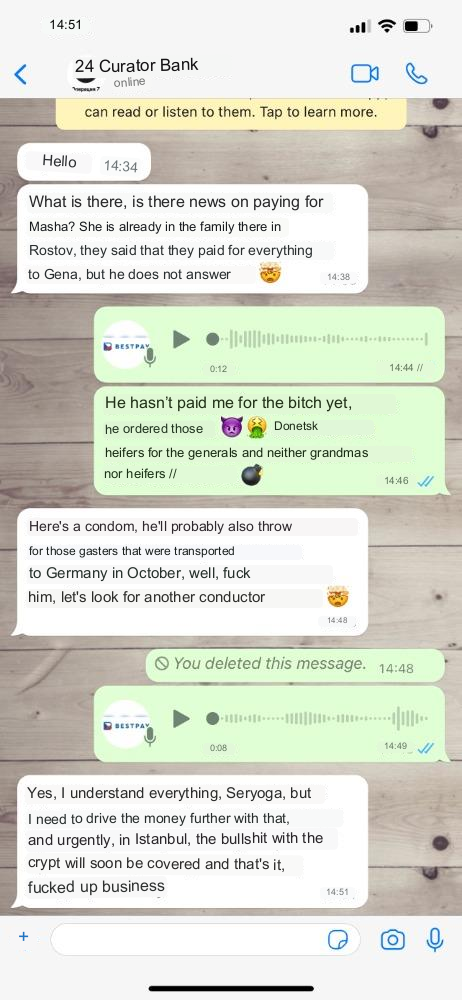
According to international investigative portals, there are also witnesses to the fact that Ostrovskiy is involved in the forced delivery of prostitutes for Russian officers serving in Donetsk. In any case, the above conversation also alludes to this, in addition to the sale of the girl. Allegedly, a murder also belongs to Ostrovskiy's rap sheet – though we find no supporting evidence for this in the investigative articles: a woman stranded in the territory of the Donetsk People's Republic was murdered in front of her family after her husband refused to join the DNR army.
Alexander Ostrovskiy is today a proud Hungarian citizen, with a registered address at: 1194 Budapest, Udvarhely utca 37.
Bruno Cakans, presented in our article, also belongs to Ostrovskiy's circle (or Ostrovskiy belongs to his). Cakans is in any case a member of the Exante Ltd. Maltese corporate group, which is connected by a thousand threads to former Maltese Prime Minister Joseph Muscat. Muscat resigned from his position as prime minister because it emerged that he had been chatting in a shared WhatsApp group with oligarch Yorgen Fenech, who is strongly suspected of having ordered the assassination of Maltese journalist Daphne Caruana Galizia – after his resignation, he continued where he had left off before his premiership, as Muscat has been promoting Exante from the very beginning.
Cakans's Exante, incidentally, also attracted the attention of the American FBI when they attempted to manipulate the American stock market based on insider information. Exante's leaders are none other than Anatoly Knyazev and Alexey Kirienko, who were placed on Ukraine's sanctions list together with Exante due to their ties to the Alfa Group Russian banking group. One branch of the Alfa Group is the Luxembourg-registered Alfa Finance Holdings, one of whose shareholders is the Shapburg Limited of unknown background – which in turn owns or, as a shareholder, influences nearly all of Iceland's major companies. It is no coincidence that during the Icelandic financial crisis, Russia was accused of having caused it. The case is worth mentioning because it very effectively illustrates how Western world's blindness and inaction contributes to a small country becoming practically entirely at the mercy of Russian capital. And Hungary is a small country…
The indirect connection between the Alfa Group and Ostrovskiy is also interesting because Gennady Yagupov, Kirill Yurovskiy, and Alexander Ostrovskiy are all board members of the Alfa Foundation, which may be connected to the Alfa Group – though we currently cannot prove this, but what is delayed is not always denied.
How is such a money laundering service built, and why is it needed?
Since the 2014 annexation of Crimea, but especially after the launch of the full-scale military invasion in 2022, the European Union and the United States – that is, the entire West – have imposed sanctions on Russia. These sanctions apply both to financial transactions and to the export of military technologies and military equipment to Russia. Moreover, in 2022 Russia was excluded from the SWIFT banking system, making it practically impossible to initiate bank transfers to and from the Russian Federation.
The stakes are therefore as follows: how can the Russian Federation get money into European Union territory in such a way that it cannot be traced back to Moscow – because these sums must pay for local agents, friendly parties, assassinations, the traffickers of children abducted from Ukraine, the cocaine baron, the ISIS terrorist, and the network built for evading sanctions, which then delivers weapons or other military technology to the Russian army. Money laundering structures similar to the Ostrovskiy-Yagupov-Yurovskiy network – called "boutique constructions" in specialist press terminology – may number in the hundreds across Europe, all pursuing the same goal and coming together into a massive Laundromat moving enormous sums. Consider: tens of millions of euros traveled through the Czech BestPay alone. As we saw, Trustmoore not only terminated its relationship with Ostrovskiy and associates after the Follow The Money investigative portal's article, but their decision applies to all Russian citizens – we can only congratulate them and hope that many follow their example as soon as possible. The terrorism financing thread launched against BP Remit is also a case where the traditional laundromat must not only be shut down, but it is becoming increasingly difficult to find local front men. Local faces will still take on a little fraud, but no one wants to go to court facing terrorism charges. In other words, the above story also points to the fact that opportunities are narrowing for Ostrovskiy and company: the crypto chain, which genuinely makes their situation easier at present, is no help if it becomes increasingly difficult to find European companies willing to pretend they are ordering dual-use military technology for themselves, only to forward it to a Taiwanese address, etc.
And this is where Budapest and Baltic Management and Solutions Kft. swim back into the picture
The company registered in Gennady Yagupov's name offers practically the same service as Trustmoore: it registers the offshore company, arranges front men, manages the company's correspondence, uses its local front men to register European shell companies that will then launder money from the offshore entities. In other words, it performs the work needed to make the shell companies look real, to keep the real owner hidden, to turn rubles into euros, and if the Kremlin needs the latest Western military technology in its parking lot, then the nominal owner of BMS calls the real owner Ostrovskiy or Yurovskiy, who pass the word to Cakans, Ermo Eero, and the other criminals. Baltic Management and Solutions is therefore not one of the small fish. We do not consider it likely that this is the central element of the corporate network, all the more so because, reading through the international specialist press articles, the essence of Russian patterns in such cases is that central control is maintained – from Moscow – but the enormous machine operating on the European stage has no single European central command. Different criminal groups operate different networks with one and the same goal: to kill everything (and everyone) in the West – that is: to defeat us.
It is hardly surprising that after their Czech, Polish, British, and Dutch exile, these people chose Hungary as their home. Orbán's politics is a true paradise for them: no regulatory oversight, no need to worry about unexpected surprises, citizenship can be purchased for the right sum, and for a sufficiently large sum, Rogán himself delivers the Hungarian passport to your doorstep. And there is no need to hide – the system works for you. This is not a joke: when we were gazing at the palaces in front of 68 Andrássy Avenue, the Prime Minister's security came out to ask how they could help…
These Russians, having thus transformed into Hungarians – or any other European citizens – then use European passports to establish European Union companies throughout the Western world. The founders, managing directors, and owners of Baltic Management and Solutions – namely Yagupov, Smirnov, and Shamov – all arrived in Hungary with the assistance of Helpers Hungary Szolgáltató Kft., and their correspondence addresses still point there to this day. (We hope that, similar to Trustmoore, they too will be more selective about their clients.) We do not know whether all members of the network have since become Hungarian citizens or only Ostrovskiy, but the overall picture and Hungarian reality suggest that it is more likely yes – the acquisition of Hungarian citizenship may have occurred in all their cases.
What it means from the perspective of the Kremlin's interests that its shadow bankers and smugglers can travel within the Schengen area and establish companies across Europe without triggering any sanctions alerts – well, we believe the value of this does not need to be separately explained. In any case, we briefly remind the reader of earlier world-shaking scandals (we note that this could no longer be published on the hijacked Index), when Moscow attaché Szilárd Kiss issued unlimited Schengen visas to Russian intelligence operatives on an industrial scale, in the thousands. It is also not foreign to Hungarian state organs to grant citizenship to Russian intelligence operatives who meet none of the prerequisites for simplified naturalization. The conditions for citizenship regained by simplified naturalization process: ancestors with Hungarian citizenship, knowledge of the Hungarian language, Hungarian identity, individual not dangerous to national security. Another example of Budapest-based Russian money laundering networks is Ilan Șor and his cryptocurrencies. The entrepreneur and former party leader Ilan Șor, who nearly caused a sovereign default in the Republic of Moldova, fled first to Israel and then to Moscow to escape the authorities. He was one of the largest financiers of the Russian network influencing Moldovan elections; a joint investigation by the Romanian Context and the British Reporter London revealed that the network controlled by Shor, known as A7, channeled money into the European Union through a Budapest-based company. (We will present this case on Ugar at a later date.)
The importance of hiding the real owners of the created companies as a service offered by Baltic Management & Solutions is demonstrated by the Latvian branch's single Facebook post (they had no other Facebook posts during their existence). In it, they grumble about how European regulation is making it increasingly difficult to hide real owners, reassure their clients that there are solutions, and that things are not as bad as they seem. We hand the floor to the colorful language of Google Translate:
The United Kingdom has published a list of the beneficial owners of companies. Don't panic!
Since April 2016, the United Kingdom has maintained a register of beneficial owners. From this year onwards, every British company has to submit information on its beneficial owners annually. When registering a new company, the information on beneficiaries has to be submitted immediately.
The United Kingdom has taken the first step among the G20 countries on this issue, which could lead to better information exchange, transparency and control. It is likely that some countries will soon follow the United Kingdom's example and also require the publication of information on ultimate beneficial owners if this initiative proves successful.
Is this a good or bad thing?! It depends on the target audience. The risk of dubious transactions is reduced, the register allows for tracking of personal budgets, and it is quite possible that tax revenue will increase. Beneficiaries will be more careful in their business practices, increasing their level of accountability. Companies will be able to carry out due diligence on potential partners. Transparency has many advantages, including accountability, which grows with transparency. Of course, there are disadvantages too, ranging from speculation about the possibility of blaming the beneficiary and undermining the company's operations to closing a business in the United Kingdom and relocating it to a country that has not yet decided to make business so transparent.
Should those who have a business in the United Kingdom panic? Time will tell. Currently the international non-governmental organization Global Witness has conducted a study to examine the new register and identify any shortcomings.
This study found that there are a number of scenarios where a company does not officially have to disclose its beneficiaries:
- if the company's activities may expose its directors, persons with significant influence over the company or their relatives to the risk of violence or intimidation (in this case, such a threat must be proven; certain industries where this risk is acceptable have been listed). Currently, 30 individuals have requested data protection under this clause;
- if the company does not have or cannot identify a beneficiary. In this case, if no single owner holds more than 25% of the company's shares, then it is considered to have no influence over the company.
Unlike the first point, where the risks borne by the beneficiaries when information is disclosed must be proven, the second point seems much simpler and more accessible when the company's shares are divided into smaller parts, and the obligation to disclose names is no longer relevant.
Furthermore, the study identified a number of shortcomings related to the large number of open questions, which allow companies to provide different citizenships or to give invalid dates of birth. Some companies openly listed a foreign company as a beneficiary, which is a direct violation of the law.
Currently, only about 89% of companies have disclosed information about their beneficiaries; approximately 8% used the first or second point that allows them to maintain anonymity. And about 3% have not yet decided which group they belong to, as they encountered difficulties in finding their beneficiaries. We expect that over time the statistics on this issue will change, and the number of companies that refuse to disclose their beneficiaries or try to avoid it through legal means will increase, but dramatic changes should not be expected.
Furthermore, it will be a long time before actual statistics on this register are available, until the system is finalized and all errors are corrected. Consequently, government bodies will not start working with these statistics any time soon.
As we mentioned, this entire piece started from the fact that we found it strikingly brazen and dangerous that a KGB-linked business could be headquartered in the neighborhood of the Hungarian Prime Minister. Unfortunately, Baltic Management and Solutions' neighbors are not simple figures either. In the property neighboring the Prime Minister's Office, the following have been headquartered for longer or shorter periods:
Data Tower, conceived and directed by the Russian secret service, the Hungarian front company behind the already-exposed Lampyre;
Also headquartered here is the Kecskeméti Law Office managed by László Schmidt, Data Tower's front man, which, based on its website, clearly does not offer its services to the general public;
In the same building we also find one of the Mészáros interests, AGBVK Zrt., the one that purchased TV2 – or rather, Rosatom purchased it for them. The Bencze and Ambrus law office, which shares this address with the Mészáros interest, does not even have a website, despite being able to maintain a law office at such a posh location, and moreover, according to the bar register, their public office is on Hungária Boulevard – meaning they maintain two offices, one of them shared with a Mészáros interest.
Also located here is the company of Putin's prominent money smuggler, the Baltic Management and Solutions Kft. discussed in this article.
In the same apartment, at the same time, two companies operated: Baltic Management & Solutions and another – otherwise they would not have received two spots on the plexiglass listing companies at the entrance of 68 Andrássy Avenue. The other company was probably closely linked to Yagupov, since they shared the apartment with Baltic Management and Solutions. This other company must have been up to something very bad, since its name was scraped off the plexiglass – which they forgot to do for Baltic Management and Solutions, and did not do for the other outdated companies either. This company is probably CMS Consult, Yagupov's former company, which was dissolved on schedule on June 29, 2023; what they did is unknown – but one can surmise.
It is noteworthy that, according to Opten, the previous registered seat of Baltic Management and Solutions was the notorious 8 Honvéd Street, which the news portal 444 has written about on multiple occasions discussing the dealings of the gas mafia evading enormous taxes, and Péter Magyari summarized the threads leading to the Russian intelligence services on Válasz Online.
~Ugar
Did you like this article?
Support our work with a small donation
Secure payment via Stripe • Min. 2 EUR
Gesta recommendations:
Musk at work: the military version of Starlink used by the Ukrainian army restricted without warning
SpaceX, owned by Elon Musk, has restricted the operation of the military version of the Starlink satellite internet service in Ukraine, and the move caused several combat missions to fail, Serhii Beskrestnov, an adviser to the Ukrainian president, said on Wednesday. According to him, terminals of the military package called StarShield lost connection overnight into Wednesday whenever they moved…

Turn of events: Nicușor Dan reportedly floated the idea of early elections
Romania's political crisis is approaching another turning point. Prime minister-designate Luca Niculescu will send his cabinet list and government program to parliament on Thursday, October 15, after which the ministerial candidates' committee hearings can begin, to be followed by a parliamentary vote of confidence. That's roughly all that's certain - and even that isn't entirely certain, which…
According to the French foreign minister, Musk, MAGA and the Kremlin are playing on the same team
According to French Foreign Minister Jean-Noël Barrot, foreign actors are trying to influence France's 2027 presidential election, and this time he put not only Moscow but also Elon Musk, the richest man in the world, at the top of the list of those seeking to undermine European democratic debate.

Trump says Putin wants peace. Moscow illustrates this with more bombings
According to US President Donald Trump, Vladimir Putin would rather have a peace deal than Volodymyr Zelensky. The statement was quoted by Sky News, and it came on the same day that the Russian army, despite the “energy ceasefire” announced by the American president, continued to bomb Ukraine's energy system.

Greece bans under-15s from social media
From January 1, 2027, Greece will ban young people under the age of 15 from using social media platforms, making it one of the first European Union member states to introduce such a strict age limit. The measure was announced on Monday in Athens by Minister of State Akis Skertsos, at a press conference attended by several members of the government.