
The French far right and far left are cozying up to each other over Ukraine
Marine Le Pen would give Ukraine's financial support no more than another six months, while Jean-Luc Mélenchon would pull France out of NATO and reopen the question of who the Russian-occupied Ukrainian territories belong to. According to a November poll, the two of them would make it into the second round of the French presidential election. During the campaign, they will no doubt have plenty to say about how dangerous the other's victory would be. In Kyiv, there is reason to worry about a win by either of them.
According to a poll conducted by Toluna Harris Interactive between November 3 and 5, Le Pen would win the first round with 34–36 percent depending on the field of candidates, while Mélenchon would advance in all five scenarios tested with 18–19 percent — only to be soundly defeated in the second round. Emmanuel Macron's second term is ending, the political center once built around him has weakened, and the far right even has a backup candidate in case Le Pen keeps her word about her own criminal case. In the case brought over the embezzlement of European Parliament funds, the appeals court reduced her ban so that it would expire by the election, while the prison sentence to be served could be carried out with an electronic tag. Le Pen has said she will not run with an ankle monitor, in which case Jordan Bardella would take her place, and the party has stated that the program would remain unchanged.
According to Le Pen, French public finances are in such a state that there is still money for training and equipping Ukrainian soldiers, but financial support could last at most another six months, after which, she said, honor demands telling Zelensky the truth. There isn't a single euro, she explained, even for indexing French pensions — at which point the only thing left to wonder is which French pensioner would actually benefit from Le Pen also lifting the sanctions on Russia. Because she is calling for that too, even though lifting the sanctions would primarily ease the situation of the very state that is the reason Ukrainian soldiers need training in the first place.
Mélenchon's explanation is quite different. He fears for French independence within NATO, which is why his party would first withdraw from the alliance's integrated command and then from NATO itself, while seeking closer cooperation with China. At his rally in Le Bourget, he also brought up Ukrainian self-determination, suggesting that residents of the southeastern Ukrainian territories under partial Russian occupation should be asked which country they want to belong to. Ukrainian foreign ministry spokesman Heorhii Tykhyi reminded him that Ukrainians already voted on independence across the entire territory of the country in 1991, while French Foreign Minister Jean-Noël Barrot called Mélenchon a spokesman for the Kremlin. The practical question, however, still remains: once such a register of names is drawn up, will it include those who had to flee the Russian army, or will the occupier first decide who stays in the city, with Paris then asking only those who remain? With questions like these, it's worth recalling how well the Nazis and the communists were able to work together when the dismantling of Poland was on the agenda. Hitler's and Stalin's regimes held each other up as cautionary examples for years, yet in August 1939 they still managed to agree, in the secret protocol of the Molotov–Ribbentrop Pact, on who would get what in Eastern Europe. The Germans attacked from the west on September 1, the Soviets from the east on the seventeenth, and in the spring of 1940 the NKVD, acting on a decision of the Soviet party leadership, murdered nearly twenty-two thousand Polish citizens in the Katyn massacre. For the Poles, the ideological difference amounted to this: depending on which part of the country they lived in, those who came for them simply wore a different uniform.
Today's French candidates are likewise running against each other with separate platforms — often holding each other up as cautionary examples! — and it is precisely this that makes it interesting how close they come to each other on the issue of Ukraine. Citing French taxpayers, Le Pen would weaken the defense of the attacked country; citing self-determination, Mélenchon would reopen as a matter of negotiation the very borders that Russia is trying to redraw by force. Meanwhile Giorgia Meloni, who is regularly mentioned in the same breath as Le Pen, has stuck by her support for Kyiv even while in government, showing that the French far right, too, could pursue a different policy. Le Pen, however, has chosen not to.
From a French campaign to a European issue
According to data from the Kiel Institute for the World Economy cited by Euronews, France has committed about 27 billion euros in support to Ukraine since the start of the full-scale invasion, of which 7.9 billion is direct French assistance and roughly 19 billion is the portion committed through EU mechanisms. According to French security policy researcher Elie Tenenbaum, the real loss would come if Paris also started obstructing joint European support, given that France, together with the British, leads the group of countries working on Ukrainian security guarantees for after a ceasefire. A French turnaround would thus affect not only what Ukraine is currently defending itself with, but also who would stand by it if Russia attacked again after a ceasefire.
For the next EU budget, covering 2028–2034, the Commission has proposed a reserve of one hundred billion euros for Ukraine, and approval of the roughly two-trillion-euro framework requires a unanimous decision by member states and the consent of the European Parliament. The Irish presidency and Macron therefore want a political agreement reached this year, while Le Pen has called the haste undemocratic and would in the meantime set France's net contribution at five billion euros a year, down from the current roughly eight billion. Presumably she assumes the others will make up the difference, while French farmers should still get what they're owed, since the country is, after all, the largest beneficiary of the common agricultural policy. The French National Assembly has already rejected the party's proposal to unilaterally cut the 2027 contribution, but the matter of the seven-year framework remains open, and if the deal drags on past the election, it could end up shaped by the conditions set by France's new leadership.
Extending the EU sanctions against the Russian economy likewise requires only one dissenting member state to fail. Viktor Orbán demonstrated this possibility for years, so Brussels knows exactly what it would mean if, this time, France's government had to be talked into approving the extension at every single turn. Next spring the French will vote for their own president, while Ukrainians will have to listen the whole time as one leading candidate proposes economizing on the support given to them, and the other practices self-determination on their borders — both speaking so proudly of France's sovereignty as if they actually understood what they were talking about.
Anna Karczag
Did you like this article?
Support our work with a small donation
Secure payment via Stripe • Min. 2 EUR
Gesta recommendations:
The Cattle Have Gone Mad in Harghita County! And We Don't (Just) Mean the Politicians
The rabies outbreak continues to spread in Harghita County. The county's Sanitary Veterinary and Food Safety Directorate (DSVSA) has so far confirmed 32 foci in nearly every commune of Upper Ciuc (Felcsík) and in Miercurea Ciuc (Csíkszereda). Eighteen cattle, eight foxes, four sheep, one dog and one cat have fallen ill; according to Radio Târgu Mureș, two more samples were sent to the lab on…
The PNL is building a Modernization Pole, leaving out the RMDSZ
The National Liberal Party's (PNL) National Political Bureau on Sunday unanimously voted to begin negotiations on absorbing Ludovic Orban's Forța Dreptei (Right Force) party. The Liberals described this as the first step of the “Modernization Pole” (Polul Modernizării), a project aimed at creating a center-right alliance for the 2028 parliamentary elections capable of competing with AUR, which…
Was it worth it, Donald? According to Iran, 80 percent of its oil storage facilities have already been restored
According to a statement by Iran, around 80 percent of the oil storage capacity damaged in the forty-day war with the United States and Israel has already been restored. This was stated to the Fars news agency by Mohammad Meskinfam, CEO of Iran's oil industry engineering and construction company, so the claim should be treated with some caution, but it is hardly likely that the Iranians have…
Could Jon Ossoff be the Democrats' presidential nominee?
Georgia Senator Jon Ossoff won the unofficial poll organized by the progressive media company Crooked Media on Saturday in Washington at its event called Crooked Con. The question was who participants would like to see as the Democratic Party's presidential nominee in 2028. According to IBTimes, 990 people took part in the vote, and Ossoff received 38.4 percent of the votes. Far behind him came…
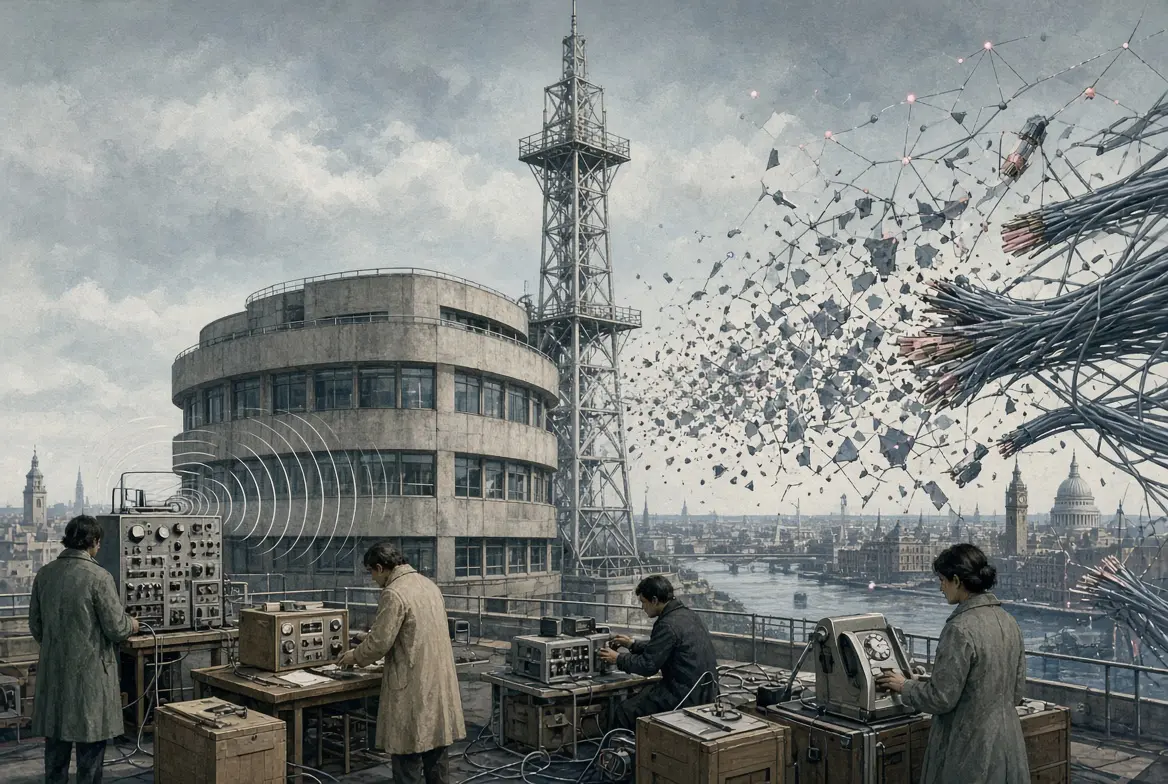
The BBC has prepared for a Britain without internet
The BBC has drawn up a secret emergency plan for the eventuality that a nationwide power outage could paralyse Britain for days. The plan was revealed on Saturday by the public broadcaster's media and culture correspondent, David Sillito, according to whom around a hundred staff members would work in a radio studio that maintains contact with the outside world via secure lines independent of the…