
Trump's defeat, Europe's happiness and cautious celebration
If the Democrats deliver the result expected of them in Tuesday's American midterm election, champagne corks could pop in many places across Europe — except the relief won't necessarily be followed by a calmer relationship with Washington. Those quoted in the POLITICO analysis reported by Mediafax warn that Donald Trump, cornered domestically, may devote even more attention to foreign policy and trade, areas where he has greater room to maneuver and where he can cause plenty of trouble for Europeans too. A Democratic victory could thus create an important counterweight to the American president, but that alone won't automatically give us back the America that Europe would like to view as its reflexive ally. At the same time, the POLITICO analysis offers insight into everything we had already suspected about overly cautious, timid European political leaders who don't understand the world.
According to German diplomat Wolfgang Ischinger, former head of the Munich Security Conference, Europeans would be making a mistake if they expected the transatlantic relationship to become friendlier after a Democratic success. He expects the opposite, which is why he would also caution European leaders against conspicuous celebration: in his view, even in the case of a major Democratic victory, it would be unwise to give the impression that Europe is toasting Trump's failure. As he half-jokingly noted, the White House shouldn't be given another reason to be angry at Europe — or rather, to be even angrier than it already is. There would, in fact, be an appetite for celebration. According to an EU survey cited in the analysis, 58 percent of respondents are rooting for the Democrats, while only 18 percent support Trump's Republicans. The German diplomat, however, would separate what European public opinion may be happy about from what European governments should display publicly: on the morning after the election, they would still have to negotiate with the same president, whose temper a Congress turned against him would hardly be able to soothe.
Nathalie Tocci, who previously advised two of the European Union's foreign policy chiefs, is less convinced of the benefits of such caution. In her view, Trump doesn't need any particular reason or pretext to attack Europe, and it would be hard to expect supporters of democracy not to welcome his defeat. Given the ties between the MAGA movement and Europe's far-right populists, an American setback would inevitably reverberate across Europe and could give moral strength to those liberal, centrist political actors who have been on the defensive in recent years. She places in this category the election defeats of Viktor Orbán in Hungary and Aleksandar Vučić in Serbia, from which many have already concluded that the populist wave may have peaked, or at least lost some of its momentum. It would, however, be premature to take this for granted: Marine Le Pen's support in France and the rise of Germany's AfD still don't paint a picture of a fading political trend. Still, Tocci believes that a MAGA defeat could offer important encouragement to its European opponents — only political relief must not be confused with a lasting turnaround.
Ischinger is even more restrained in his assessment of the short-term, tangible benefits for Europe. He believes a Democrat-controlled Congress could primarily tie Trump's hands in domestic politics, to which the president might respond by turning even more forcefully toward foreign affairs and trade. If he is tied up with investigations, hearings and possible constitutional impeachment proceedings while the legislature blocks his domestic plans, he could devote more energy to areas where he can act more independently. Ischinger therefore believes Europe should prepare for more friction and for new demands, potentially even tougher than before. Kurt Volker, who served as the United States' NATO ambassador during George W. Bush's presidency, sees the situation similarly. He, too, doesn't expect a significant shift from the Trump administration, even if the Democrats win a congressional majority. What he does expect is a wave of investigations into the president, his family and family businesses, with hearings potentially touching Steve Witkoff, Jared Kushner, Elon Musk, Pete Hegseth, and, regarding the FBI's operations, Kash Patel as well. According to Volker, Trump would fight these with every means at his disposal, and the clash would turn into a massive political circus.
For Ukraine and NATO, a Democratic majority could mean a more supportive Congress, but Volker says this doesn't imply that the legislature could simply take control of the president's foreign policy. The Democrats could approve support packages, but new conflicts with the White House could arise around their implementation. Volker illustrated this by noting that Trump could say, even of approved funds, that he isn't obligated to spend them, and he also sees uncertainty in how the Iranian crisis is being handled. He considers it possible that military operations could resume, but also that Trump might instead leave the burden of resolving the situation to Europe and Asia. Regarding a possible reduction in the American military presence in Europe, however, he expects the president to be more cautious, since such a step could carry a political cost within the United States as well.
Those quoted agree, then, that a Democratic success alone won't settle Europe's relationship with Trump, though they diverge on how much European restraint could actually be worth. Ischinger believes it's worth avoiding unnecessary conflict, while Tocci doubts that Trump would need any European celebration at all as a pretext for a new attack. The election result will matter for checking American power, but neither of them promises Europe a quick deliverance: even after a domestic political defeat, Trump would remain president, and the rest of the world would still have to live with him.
According to Anna Karczag, editor of Ugar, what's missing from all this is precisely the question of what Europe gains from its caution. There's little point in calculating how much more unleashed Trump would become in foreign policy after a possible MAGA defeat, when what he has done so far already amounts to betrayal in itself. Of course, things can always get worse, but European politicians should also think the situation through from the other side: what changes if they don't visibly celebrate the Republicans' downfall? Does Trump suddenly start behaving like an ally because nobody popped champagne in Brussels? Hardly. If no meaningful shift can be expected even from restraint, then it's also worth considering what message we would be sending to those American Democrats whom we may especially need two years from now.
A pan-European celebration following a Republican defeat could actually teach Trump a lesson: the way he treats his allies carries a political price in Europe too, and intimidation doesn't guarantee him unlimited obedience. He and autocrats like him understand only force, while constant self-restraint is easily read by them as proof that the other side will swallow anything rather than openly stand up to them. Of course, there's a certain logic to the assumption that a Trump defeated domestically would try to assert himself even more aggressively in foreign policy, raging like a wounded bull and causing further destruction. But that's exactly what we've already seen: he betrayed Ukraine, he betrayed his European allies, and the Middle East lies in ruins. What further destruction would he be deterred from if European governments disciplined themselves to hide their joy? And why should we assume that whatever he might do because of a public celebration, he wouldn't do just the same under some other pretext?
The other question is just as important: to what extent could a Democratic congressional majority, strengthened by voters' mandate, count on its European allies while it would still have to keep fighting the White House over, for example, weapons support for Ukraine? What message are we sending to those in the United States who are trying to resist Trump's policies, if we don't even dare to publicly celebrate their success, for fear of offending the president? The Lord spits out the lukewarm, and caution will certainly not bring Trump back into the fold of our friends — but it may well be enough to unsettle those who could still be our friends.
Ugar
Did you like this article?
Support our work with a small donation
Secure payment via Stripe • Min. 2 EUR
Gesta recommendations:
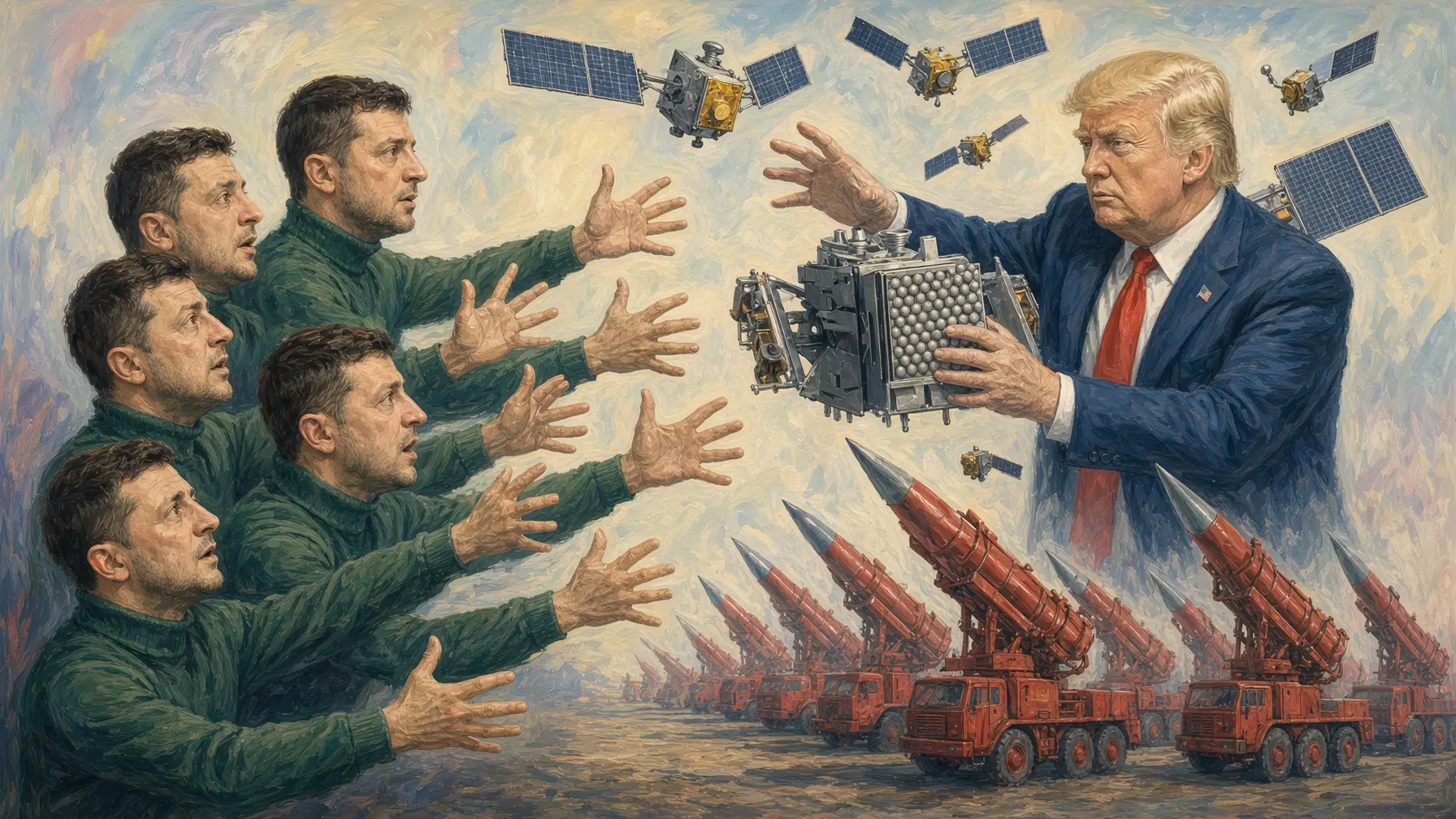
Zelensky has repeatedly asked Trump to allow the use of Starshield against Russian missile launchers
Volodymyr Zelensky has asked Donald Trump three or four times to lift the geographic restrictions on the use of the Starshield military satellite system and allow it to detect and destroy Russia's ballistic missile launchers. In a PBS NewsHour interview on Monday, the Ukrainian president said that Ukrainian cities cannot be defended with air defense missiles alone, since even the United States…

Niculescu found the problem, but the solution remained vague
On Tuesday in Bucharest, Prime Minister Luca Niculescu said out loud what Romanian business owners have been feeling on their own skin for a while now: more companies are preparing to lay off staff than to hire new ones, he said at the presentation of the business barometer, where he also spoke about the need to restore companies' appetite for investment and create well-paying jobs, especially…

The Feledy question is very simple:
what was in the CV he submitted?
RMDSZ's own chatbot exposes RMDSZ
The "Transylvania Welcomes You Home AI Assistant" has a damning opinion of the "Transylvania Welcomes You Home" program
From Bálványos to Bălvăniș, Pineapple as the Answer Too
Countless little games are underway, each played with wild fervor, with AUR and the RMDSZ sometimes chasing each other and sometimes waiting for the other to catch up, and by now only the ones actually playing the parts know which is the sidecar and which sits in the saddle.