The spy who came in from Facebook: how Russian intelligence hunts Hungarian students — and how easily it almost worked
IMPORTANT update added later: A reader pointed out that I had fundamentally misunderstood the Telex article: the anonymous young man applying for an embassy position and Roland Berki are not the same person. This is certainly good news, as it means that the passages in the article below where I express dismay at the civil servants working in the HR department of Hungary’s Ministry of Foreign Affairs are no longer valid either. I apologise to my readers and ask them to read András Dezső’s article first—perhaps this will help them navigate the information below more easily than I did and identify the passages that found their way into the article because of my misunderstanding.
Hungarian investigative outlet Telex — through the reporting of András Dezső — recently published a story about a strange espionage case: a Russian-backed spy trainee who was caught by Hungary's national security vetting process. It's worth reading. In its article, however, Telex referred to the protagonist only as "Roland B.," and to the Russian diplomat who befriended him as "Alexander V." We can now introduce them both to the wider public.
Roland B.'s real name is Roland Berki. And from here on, the story only gets more embarrassing — not so much for him as for the Hungarian state.
The Facebook page nobody bothered to check
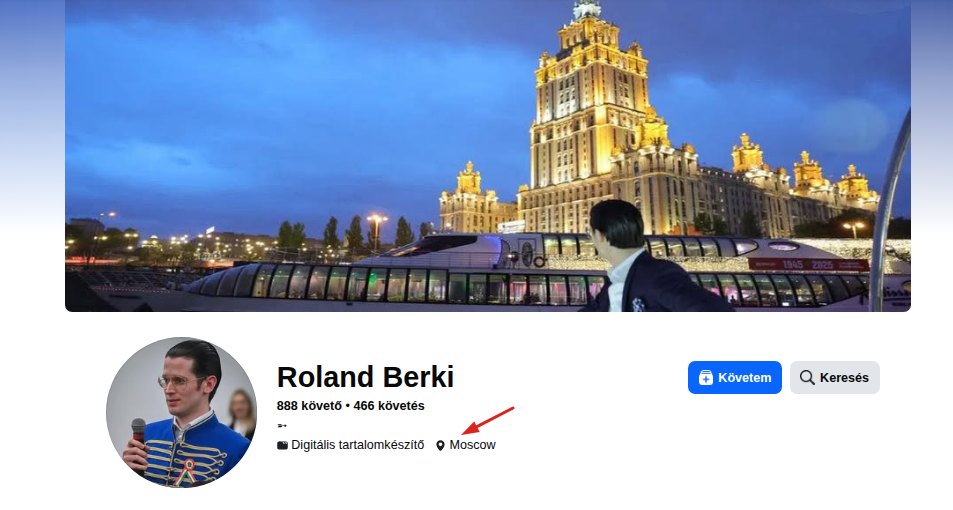
Let's look at exactly what happened here. Roland Berki applied for a position at a Hungarian state body — a job that requires national security clearance. He made it through the first (or who knows how many) rounds of HR screening. Then national security officers began interviewing him. In other words, the process went all the way to the vetting stage — and up to that point, it seems, nobody took the trouble to look at the applicant's entirely public Facebook page. Which is a shame, because right there, near the top, is a photo of him with Russian oligarch Igor Rybakov — whom Berki calls the inspiration behind his company.
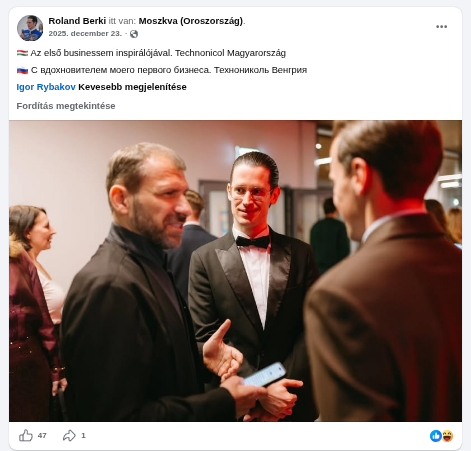
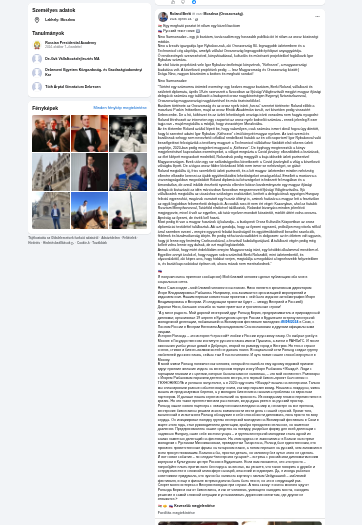
Let's pause on Rybakov, because he's one of the keys to this story. According to Forbes, he is the 84th-richest man in the Russian Federation, with an estimated fortune of 2.4 billion dollars. Not a whale — but not a small pond-frog either. He's exactly the kind of oligarch who isn't yet wealthy enough to draw Western attention with villas, yachts and football clubs, but isn't poor enough to be unable to bankroll a spy sapling. Perhaps that's the most dangerous combination of all. Rybakov, incidentally, has been sanctioned by both Ukraine and Poland — let's just say he is not indifferent to Russia's war of conquest in Ukraine, and expresses that non-indifference with money. And if that weren't enough: just one scroll further down is a post in which Berki proudly reports that a certain Nino Samsonadze published a longer piece praising him. Samsonadze is no random figure either — she is Igor Rybakov's creative director. At the time, Berki was trying to publish Rybakov's business self-help book in Hungarian, under the title Starving. He fell out with a former business partner, then Covid hit — but the book did eventually come out in Hungarian.
The red flag that was a whole field of red flags
And then there's what Telex also reported: that Roland Berki organized the travel of the "Hungarian delegation" to the 2024 World Youth Festival in Sochi, Russia. (This is a Kremlin-run event: an anti-Western gathering that recruits promising young people from around the world with the message that Russia leads a fairer, "multipolar" world — and where the intelligence services quietly assess the participants.) That alone is the kind of signal that should have made even a moderately news-aware HR officer stop and think. But the profile is even more telling. Berki also poses proudly with Yevgeny Stanislavov, Russia's ambassador to Hungary.
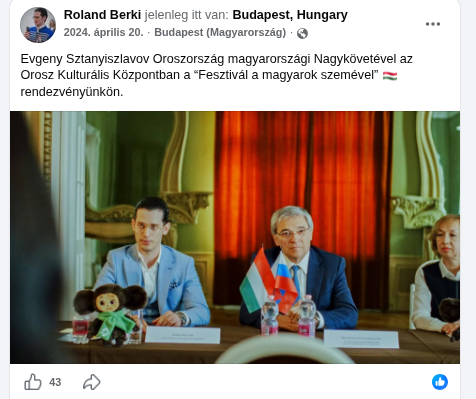
And believe me: Russian ambassadors don't just casually throw an arm around the sons of foreign nations for their pretty eyes. A photo like that has to be earned — whatever that work may be. And Berki clearly delivered. On March 15, 2024 — the anniversary of Hungary's 1848 revolution, the country's most sacred national holiday, commemorating the uprising against Habsburg (and later Russian) imperial rule — he greeted the Tatars in Kazan dressed in a blue hussar's tunic, a national cockade pinned to his chest.
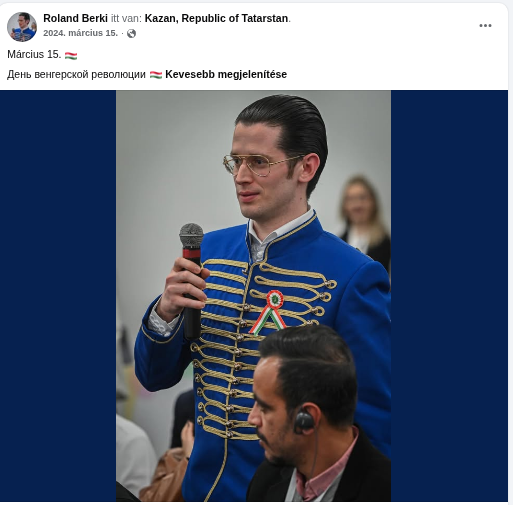
There's something so grotesque about this that it leaves you speechless. To celebrate Hungary's day of freedom, dressed in its very symbols, in a Tatar republic of the same empire whose predecessor crushed that revolution in 1849 — that takes a special kind of instinct. At moments like this you really do start to wonder when he'll open the Andropov Memorial Exhibition on Corvin Lane. (Corvin Lane is a landmark of the 1956 Hungarian uprising against Soviet rule; Yuri Andropov was the Soviet ambassador to Budapest during that revolution, later KGB chief and Soviet leader. Naming him here is a pointed insult.) Balázs Orbán — the Hungarian prime minister's political director, no relation but a loyal ideologue — would surely be happy to provide the background music and the ideological justification.
So whose skill was it, exactly?
According to the Telex article, Berki was ultimately exposed because he tried to conceal his friend, the diplomat working at the Russian embassy. (In parentheses: there is hardly a Western European country where a Russian diplomat isn't working for Russian intelligence — whether openly or under cover.) This vetting process must have been rather odd, because Roland Berki would have had to be a considerable idiot to deny the connection — though we don't actually know whether he denied it, or simply didn't mention it. The point is that when someone's public Facebook page features an oligarch, a Russian ambassador and a Kazan hussar tunic, the surprising thing isn't that he was caught — it's that he made it all the way to the vetting stage at all. And now the entire FSB (Russia's domestic intelligence service) knows exactly what details a national security clearance for job X covers in Hungary, how far one can get with a simple omission, and so on. Roland's little adventure becomes a veritable goldmine in the hands of a skilled intelligence officer.
It also leaves many open questions how Alexander Verkhnev managed to meet Roland on several occasions in a way that Hungarian intelligence apparently overlooked — but if it had been Gandalf, right? Well, surely a diplomat who turns out to be an undercover FSB agent can't just leave the embassy without being followed, without his Hungarian contacts being mapped, and so on? In analyzing the situation, we should also bear in mind that the Tisza government is barely three months old. (Tisza is the new centrist opposition party that defeated Viktor Orbán's Fidesz in the spring 2026 election, ending sixteen years of his rule.) I can believe that three months isn't enough time to clean house at the intelligence services — and besides, there's a severe personnel shortage, and the old-guard bureaucrats can't be trusted precisely for this reason: there's no telling who was recruited by the Russians, when, or how deeply.
To better understand the case, let's play with the thought of what might have happened had Roland Berki — and through him, Alexander Verkhnev — succeeded in the infiltration. The math works out. The term "talent-spotter" is accurate and important, but the "agent of influence" role can't be ruled out either — and in any case, these technical terms blur together in real fieldwork; there's no sharp line between them. So: Roland Berki joins his new workplace, a company where he can access classified information — that, at least, is why he had to undergo national security vetting.
Let's not imagine he'll be James Bond, smuggling out nuclear secrets and the complete NATO documentation in a cufflink — the Russians are regular guests on Hungarian servers anyway. But picture our friend Roland chatting with his colleagues during coffee breaks: telling them how great Sochi was, how beautiful the Russian language and literature are; telling his male colleagues about long-legged Anna Kournikova types who aren't as fussy as Hungarian girls; telling the women about macho Russian guys who are rich yet don't shy away from housework; telling everyone how he turned 10,000 euros into 1.6 million, how life in Russia is actually pretty good, and so on. Then, when he meets with Verkhnev, all he has to hand over is this much: whose eyes lit up at the erotic content, whose lit up at the mention of money, and — perhaps most importantly — who, during those shared coffee and cigarette breaks, showed resistance to Roland's Russian tales. Those people can then be quietly removed from the state apparatus with kompromat and a bit of muck-stirring. About that sort of thing, a certain Russian prosecutor could tell you a great deal — one who was investigating President Yeltsin, until Yeltsin was defended by a clever kompromat-building politician who destroyed that prosecutor and then took Yeltsin's chair himself: his name was Vladimir Putin.
Anna Karczag
Did you like this article?
Support our work with a small donation
Secure payment via Stripe • Min. 2 EUR
Gesta recommendations:
Grindeanu: territorial-administrative reform is coming!
Sorin Grindeanu is proposing the merger of smaller local administrations, a reduction in the number of government agencies, and the restructuring or dissolution of loss-making or unjustifiably maintained state companies. The PSD chairman announced on Monday, October 26, that he will ask Prime Minister Luca Niculescu for two separate reform packages to be adopted through the government's…
Trump: "Norway is a shithole"
Norway has gone through a severe civilizational decline: it didn't award the Nobel Peace Prize to Donald Trump. The American president therefore drew the necessary foreign policy conclusion on October 25, at his campaign rally in Port Huron, Michigan, and declared: "Norway has basically become a shithole country." In the speech delivered ahead of the midterm elections, he also said he doesn't…
The Balkan 0rbán has fallen: the Students' List can form a government alone in Serbia
Aleksandar Vučić admitted on Sunday evening that his party had lost Serbia's early parliamentary election. The Students' List (officially called "Students Win"), which grew out of nearly two years of student protests following the Novi Sad railway station tragedy, won a majority. According to an estimate by Ipsos and CeSID based on a 96 percent sample, the list won 52.9 percent of the vote and…
Zelensky also commemorated 1956
Seventy years ago, Europe and the entire world reached an extremely important, in many respects decisive crossroads, when the people of Hungary rose up for freedom, against the Soviet system. The courage and love of freedom of the Hungarians were shown with extraordinary force, and to this day they fill us with admiration throughout Europe.
The Americans are lying, and they'll pay for it yet
On Saturday, October 24, Ukraine's Ministry of Defense announced that Starlink and the military-grade Starshield were once again operating at pre-restriction speeds. The connection is now stable even above 400 kilometers per hour, whereas during the restriction it had been cutting out at speeds as low as 160 kilometers per hour. The more than week-long throttling has ended, but the real dispute…