
After Orbán's fall, Fico could become Moscow's new gateway into the European Union
Russia is working to rebuild its economic ties with certain European Union member states after Viktor Orbán's defeat in April's election deprived Vladimir Putin of one of his closest EU allies. According to a document obtained by Politico, Slovakia is reviving the Russian-Slovak intergovernmental commission on economic, scientific and technical cooperation, which was suspended after Russia's full-scale invasion of Ukraine. The talks would focus on crude oil, natural gas and nuclear fuel; the commission last met in November 2021, before the war broke out.
The document was signed by Russian Minister of Science and Higher Education Valery Falkov, and according to it, Slovak Foreign Minister Juraj Blanár agreed during an August 20 video conference that the commission would meet in Moscow. Slovak Prime Minister Robert Fico announced that the meeting will take place on November 25, while a Russian document dated September 10 had originally set October 26-27. Politico added that it was unable to independently verify the document, but that it bears the hallmarks of an authentic ministerial record.
The Slovak foreign ministry was almost certainly referring to Blanár's earlier statement that Bratislava maintains dialogue with any country interested in pragmatic cooperation, provided it serves Slovakia's national interests, as the Slovak foreign minister had opposed the EU's gradual phase-out of Russian gas imports and called for deliveries to be discussed at the Moscow meeting. The Slovak side also stressed the importance of continuing deliveries via the Friendship oil pipeline and welcomed the regular supply of Russian nuclear fuel to Slovak power plants, with Fico arguing that giving up Russian energy sources would raise costs. The document also raises the prospect of expanding cooperation in culture, tourism, agriculture and environmental protection, and the agenda may include the opening of a Russian Science and Culture Center in Bratislava, as well as the issue of international restrictions on Russian athletes.
Slovakia's opening is not without precedent. Fico met Putin in Moscow on May 9 — the day the Russian capital celebrated the victory in World War II, while the Russian army was bombing Ukrainian cities — and on September 21, together with Luxembourg and France, Bratislava even succeeded in getting the European Union to remove Alisher Usmanov and Mikhail Fridman, two of the Putin regime's biggest backers, from its sanctions list. According to Politico, Moscow is trying to replicate with Fico the same model it built with Orbán. The Orbán government had revived the Hungarian-Russian economic cooperation mechanism even before the elections, and in December the two countries agreed on a twelve-point plan to expand energy, trade and cultural ties; Péter Magyar's new government has not yet confirmed whether the bilateral meetings will continue next year. According to Politico, the rapprochement between the Kremlin and the Fico government shows how Russia uses energy ties to maintain privileged relations with certain member states and weaken the Union's unity on the question of the war in Ukraine.
Moscow, then, is not adjusting to the change of government in Hungary but is seeking new avenues — and apparently finding them in Bratislava. All this is happening just as Washington and Moscow have struck a deal on Russian diesel shipments, and Kirill Dmitriev, Putin's special economic envoy, is promising further US-Russian deals. On Monday the European Union adopted its largest sanctions package against Russia to date, with nearly 1,600 entries, and eleven member states are demanding that no single country be allowed to blackmail the rest with a veto on foreign and security policy. If Fico becomes the new Orbán, this debate will have to be settled sooner than Brussels had planned.
Opinion
Did you like this article?
Support our work with a small donation
Secure payment via Stripe • Min. 2 EUR
Gesta recommendations:
Does the PSD's government program promise autonomy to the Székelys? Behind the reference to Alba Iulia there is not a single concrete measure
Maybe all that's needed for autonomy is for the UDMR not to be in government?
Trump would even deploy the "mother of all bombs" against Iran
The U.S. military has drawn up new attack plans against Iran that include the possible use of the GBU-43/B MOAB, the most powerful non-nuclear American bomb, known as the "mother of all bombs."
Here’s Your Government: PSD Stirs the Pot with a Convicted Interior Minister and the Banks’ Enemy
Designated Prime Minister Luca Niculescu submitted his cabinet's list and program to parliament on Thursday, completing the ten-day constitutional deadline that began on October 6, when the decree appointing him was published in the Official Gazette. The cabinet would include eleven PSD ministers and six technocrats. Committee hearings begin on Monday, and the joint session of parliament's two…
EU summit in Brussels: budget dispute, NATO meeting on the Black Sea, while the EU court condemns Hungary
The European Council's two-day summit began in Brussels on Thursday, with its agenda including competitiveness, Ukraine, the next long-term EU budget, the Middle East, European defense and security, migration, as well as enlargement and institutional reforms. The summit officially started at 10 a.m. local time, and António Costa, President of the European Council, will close it with a working…
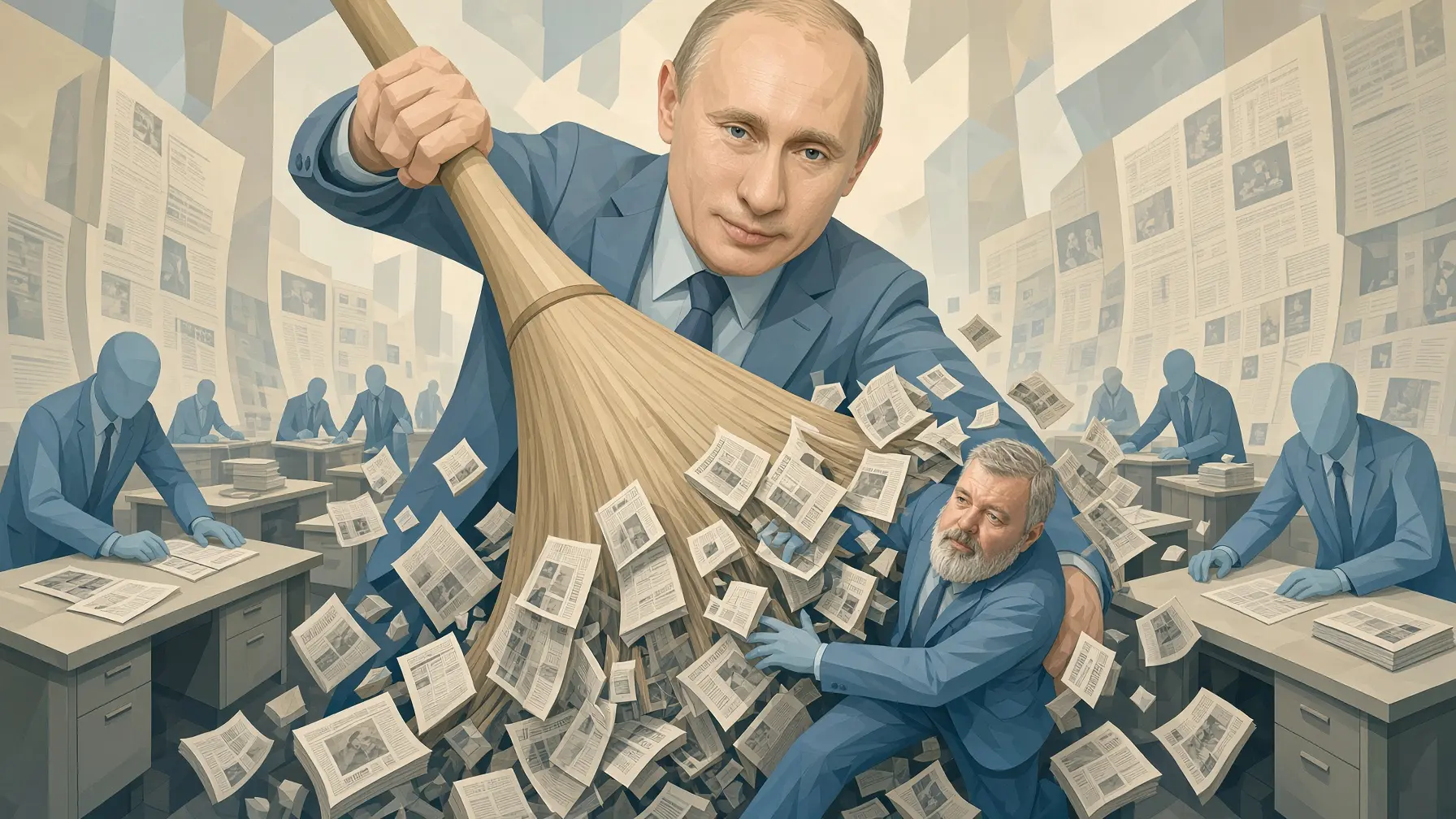
Putin cleans house: editor-in-chief of Novaya Gazeta taken in for questioning after search of his home
On Thursday, a search was conducted at the Moscow home of Sergei Sokolov, editor-in-chief of the independent Russian newspaper Novaya Gazeta, after which he was taken to the Investigative Committee for questioning. The paper itself reported this on Telegram. According to the editorial staff, contact with the editor-in-chief was lost shortly after noon on Thursday, when his phone was switched off…