
“I plan to outlive the Russian Federation”
When Volodymyr Mykolaienko woke up to the sound of explosions on February 24, 2022, he told his wife, “That’s it, I’m going to defend the city.” He had no way of knowing then that a few weeks later the Russians would drag him off in the trunk of a car, and that nearly three and a half years would pass before he could freely return home.
On the first day of the war, he went to where the volunteers were gathering. They were taken to a school with no windows or doors, handed weapons, and told to wait for orders. After that they tried to hold back the attackers at the Antonivskyi Bridge, came under mortar fire, and the first wounded appeared, but the Russian military columns still managed to cross in the end. After the occupiers entered Kherson, the city’s residents took to the streets in protest. Mykolaienko walked at the head of the march, holding a huge Ukrainian flag, and the protesters stopped at the TV tower, where Russian soldiers were hiding, and let them know, in less than friendly terms, where to find the Russian warship. The occupiers responded with gunfire and stun grenades, dragging people out of the crowd and beating them.
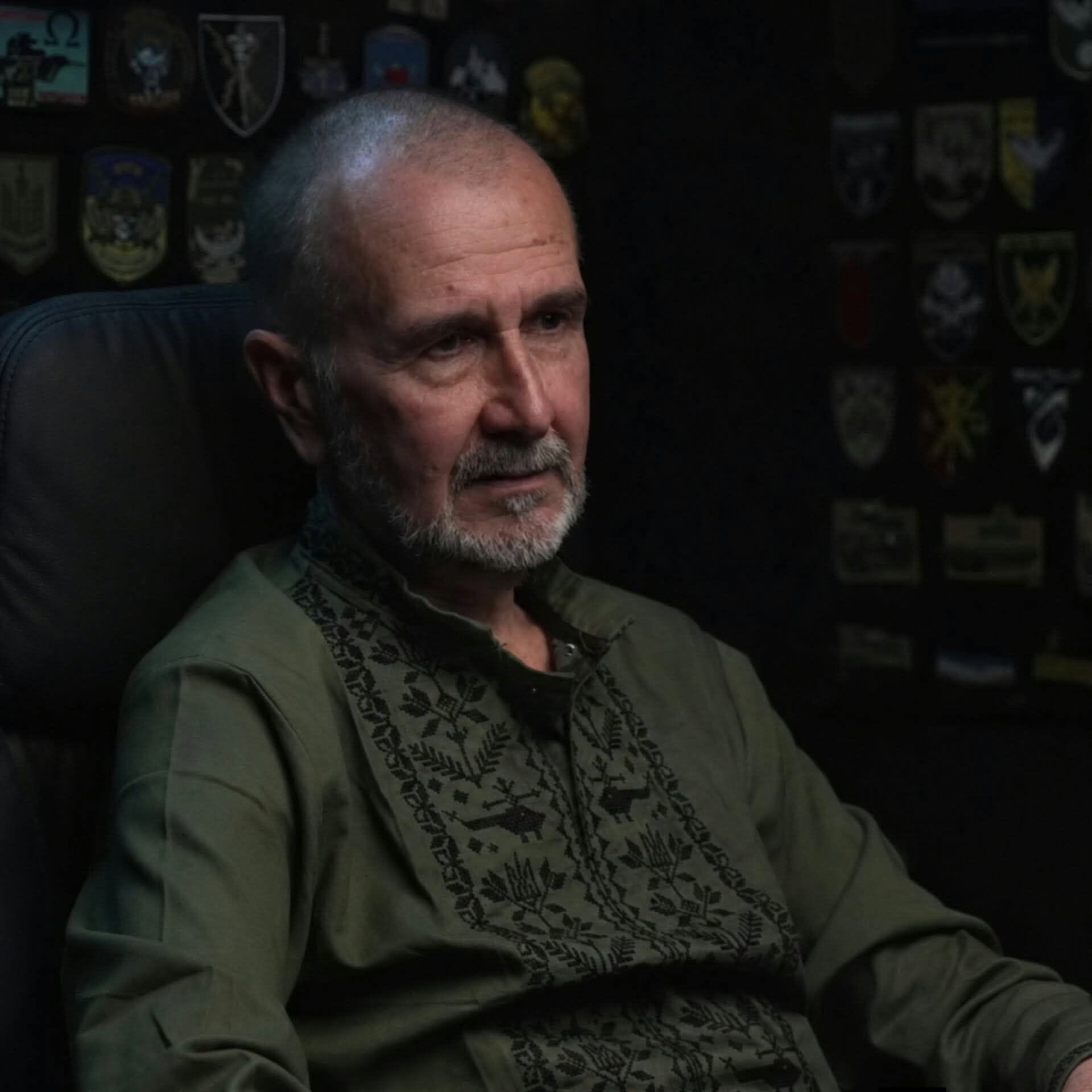
Mykolaienko was later invited to a meeting that, according to his own people, had been set up as a trap. He still managed to call his wife, and by doing so saved others as well: the Russians had wanted to use his phone to lure more people to various “meetings” and capture them. He was taken to the basement of the regional police headquarters, where interrogations and beatings awaited him. From the very first day, he was offered a deal: if he recognized the new authority and took on a role in the “leadership” set up by the occupiers, he would be released and neither he nor his family would be harmed. Mykolaienko refused.
His captors later concluded that he was running the underground resistance in Kherson, and tried to get him to reveal the locations of weapons caches, but he did not give up a single one. At one point he was taken back to Kherson to be filmed, and a Russian propagandist asked him whether he considered Roman Shukhevych a hero. Mykolaienko replied that for Ukraine, yes, he was — to which they told him: “You will never get out of here.”
He was later taken to Sevastopol, where he spent two days in a model prison that the Russians used to show how “well” they treated prisoners of war. He remembers young boys from that period whose spirits were systematically broken, and he still doesn’t know whether they will ever be able to come to terms with what they went through. He had previously had a chance to be freed in a prisoner exchange, but when the Russians said they wanted twenty Russian soldiers in return for him, he turned down the offer.
“How could I look into the eyes of the mothers of those Ukrainian soldiers who remain in prison, while I get released in exchange for twenty Russians?”
he said.
The fate of the prisoners left behind still weighs on him: he often wakes up feeling guilty that he is already free while the boys are still there. When he finally made it home, he wasn’t prepared for the welcome he received: from the Belarusian border all the way to Chernihiv, people stood along the road holding Ukrainian flags to greet him.
“Ukrainian air heals, and Ukrainian people give strength”
says Mykolaienko, who also has firm views on Russia’s future. He believes the war will ultimately destroy the Russian Federation itself, adding:
“Personally, I plan to outlive the Russian Federation.”
Did you like this article?
Support our work with a small donation
Secure payment via Stripe • Min. 2 EUR
Gesta recommendations:

Eight former U.S. ambassadors warn: whoever rewards Putin is preparing the next war
Lasting peace cannot be bought from Putin through territorial concessions and the easing of sanctions, warn eight former U.S. ambassadors, including four former heads of mission in Bucharest. According to them, rewarding aggression would weaken NATO and increase the risk of a broader European war.
Alaska too turns away from the Republicans: not even three of them could stop the Democrat
For the first time in twenty-eight years, Alaska has elected a Democratic politician as governor: the 37-year-old Jonathan Kreiss-Tomkins defeated three Republican rivals, including one backed by Donald Trump. The youngest governor in the state's history campaigned on lowering the cost of living, fixing the funding of public schools, and a promise of cooperation across party lines, and won the…
Administrative reform: Maramureș is already rebelling
The PSD has not even agreed on how it would reorganize Romania's counties, yet one of its MPs is already hinting at leaving the party. Lucian Morar refuses to even hear about Maramureș being merged into an administrative unit centered on Cluj-Napoca, and is ready to turn against his own party in defense of his homeland. Whether he has actually already quit over this, or is merely threatening to…

The spy who boasted about bringing down a chancellor – while Europe kept dozing
Jan Marsalek, the fugitive former operations chief of Wirecard, boasted from Moscow that “we successfully brought down” Austrian Chancellor Sebastian Kurz. The network uncovered around him funneled phones belonging to the Interior Ministry to Russia, gathered data on refugees and journalists (it even obtained the home address of Christo Grozev, founder of the renowned investigative outlet…
A good idea from Romania: paid military training
Voluntary basic military training could be joined by Romanian citizens — men and women over 18 who have not yet turned 35 by the start of the program and who have not previously served in the military, either as professionals or as reservists. At the end of the training, which would last up to four months, participants would be placed in the army's operational reserve, though those who wished to…