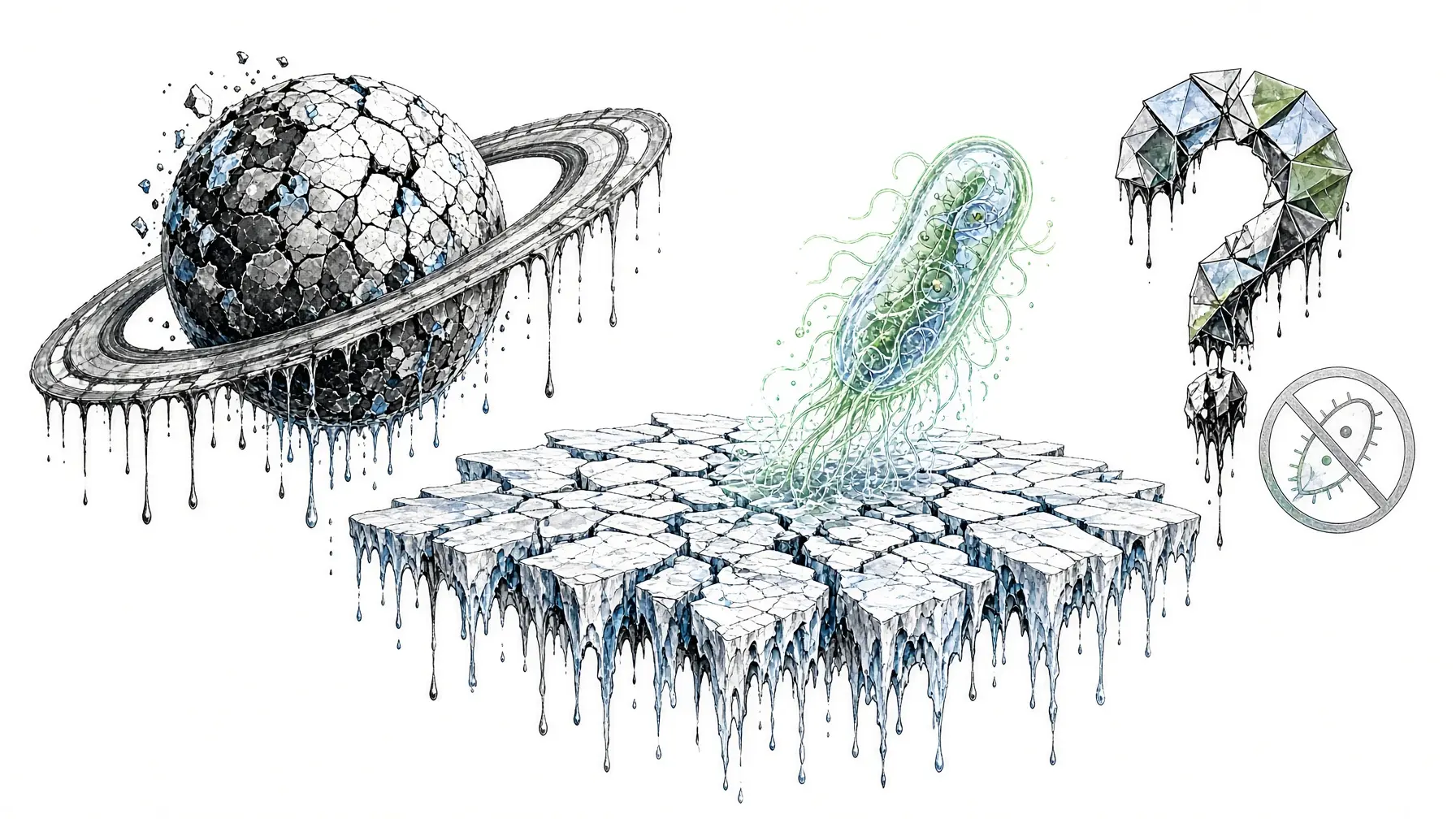
Life on Saturn? Maybe, but not today
Two studies published simultaneously may bring us closer to answering whether life could exist beneath the icy shell of Saturn's moon Enceladus. The research, published in the journal Science Advances, has of course not discovered any extraterrestrial organisms, but it has established far more than simply that "there is water there, so there could be life." One study shows that Enceladus's hidden ocean may harbor the conditions needed for an ancient microbial metabolism, while the other demonstrates that if microorganisms really do live in its depths, the moon's geysers could carry traces of them out into space in a form that could be recognized even with instruments available today.
Enceladus is only about five hundred kilometers in diameter, its surface covered by a thick crust of ice, beneath which, however, lies a global ocean of salty water. Near the moon's south pole, long cracks cut through the ice, through which geysers of water vapor and ice grains shoot up hundreds of kilometers high. Some of this material later ends up in Saturn's E ring, meaning a space probe wouldn't even need to land on the moon's surface, drill through the ice shell, and lower some kind of miniature submarine into the ocean: it could simply fly through the geysers and collect on the way the ice particles that Enceladus sends out essentially free of charge, right in front of the laboratory. This is exactly what NASA's Cassini spacecraft did, which studied Saturn, its rings and moons between 2004 and 2017. Cassini's cosmic dust analyzer measured the composition of the ejected ice grains, and the instrument's data had already shown earlier that Enceladus's ocean contains salts, phosphates, organic compounds and molecular hydrogen. These do not in themselves prove the presence of life, but together they suggest that beneath the ice there is not simply a large quantity of water, but a geologically and chemically active ocean, at the bottom of which water can interact with rock.
Frank Postberg, a planetary scientist at the Free University of Berlin, and his international research team have now re-examined the mass spectra of nearly a thousand salt-rich ice grains recorded by Cassini. The researchers identified at least five basic chemical types: some grains were dominated mainly by sodium chloride, others by sodium carbonate, sodium phosphate, sodium hydroxide, or potassium salts. This was surprising, because if the microscopic droplets of water torn from the ocean froze instantly, then almost every grain should contain a roughly evenly mixed, miniature sample of the ocean. Instead, Cassini found chemically strikingly different grains. The research team used laboratory freezing experiments and thermodynamic calculations to reconstruct what might happen in the cracks of the ice shell. According to their results, the larger droplets torn from the ocean, sometimes several hundred micrometers across, do not necessarily freeze instantly. As they move slowly upward through channels within the ice, they cool gradually, and the various salts dissolved in them begin to crystallize at different temperatures. Inside the droplet, the sodium-, potassium-, chloride-, carbonate- and phosphate-containing parts thus separate from one another—in other words, a natural chemical separation takes place.
The partially or fully frozen droplets are then accelerated to speeds of more than a hundred meters per second by the gas stream erupting through the cracks. Striking the walls of the ice channels, they shatter into tiny pieces, and many of the resulting micrometer-sized grains no longer contain the ocean's full chemical mixture but rather a single component in a highly concentrated form. In other words, Enceladus does not simply eject its ocean water into space, but during freezing and fragmentation partly sorts it into its constituent components as well. This could be especially important for the search for life: if a droplet of ocean water contained microbial cellular material, fragments of cell membranes, complex organic molecules, or other matter of biological origin, these could separate from most of the salts during freezing. After fragmentation, they would end up in only a few ice grains, but within those they could remain relatively pure and at high concentration. A future space probe would therefore need to examine many individual grains, but if it managed to capture such a particle, molecules indicating a biological origin could be identified with mass spectrometry technology that already exists today.
"Enceladus essentially does a large part of the work for us"
— said Postberg. The moon can produce natural, chemically separated samples in a way that would require serious preparation to achieve in an earthly laboratory. This does not, of course, mean that any grain detected by Cassini contained life, only that a new probe equipped with more suitable instruments could search for biosignatures with far better chances than previously assumed.
The second study examined whether microbial life is even conceivable in the rather inhospitable environment of Enceladus's ocean.
Researchers at Ludwig Maximilian University of Munich created a laboratory model of the moon's conditions: they produced water that was almost completely oxygen-free, strongly alkaline, with a pH of 10–11, and rich in carbonate, and they also replicated how hydrothermal reactions between the rocks of the ocean floor and the water could produce molecular hydrogen. Into this environment they placed a single-celled organism called Methanothermococcus okinawensis. This is not a bacterium but a methane-producing archaeon, discovered on Earth near deep-sea hydrothermal vents. It does not need oxygen: it obtains energy by using hydrogen and converts carbon dioxide into methane. A similar metabolism may be among the oldest known energy-producing processes of life on Earth.
The researchers were surprised by the result. The microorganism could not survive at the high pH levels characteristic of Enceladus in the usual laboratory growth medium, because in such an alkaline environment too little free carbon dioxide was available to it. In the more complete chemical model of the moon's ocean, however, it not only survived the conditions but grew and produced methane up to pH 11, far exceeding its previously known tolerance. Analysis of its gene activity showed that the archaeon adjusted its metabolism and was able to gather carbon dioxide even at extremely low concentrations, while using exclusively the hydrogen produced by the reaction of rock and water as its energy source. This still does not prove that organisms are swimming in Enceladus's ocean. In the experiment, a terrestrial microorganism was placed into a model environment created in a laboratory, and there is still a great deal we do not know about the ocean's actual temperature, pressure conditions, local composition, history, or the possibility of life having arisen there. The study did, however, remove an important theoretical obstacle: it demonstrated that Enceladus's assumed geochemistry does not rule out hydrogen-consuming, methane-producing microbial life, even in an extremely alkaline, carbon-dioxide-poor environment.
The two studies are therefore truly significant together. One suggests that the ocean deep within Enceladus may be capable of sustaining a simple, ancient type of metabolism, while the other shows how the chemical traces of such a life form could travel from beneath the tens-of-kilometers-thick ice shell directly to the instruments of a space probe. The first, then, concerns habitability, the second detectability; neither means the discovery of life, but together they substantially improve the chances that a future mission could provide a meaningful answer to the question. The results are also especially important for the European Space Agency's planned L4 mission. As the first flagship mission of the ESA's Voyage 2050 program, an expedition is being prepared that would examine the Saturn system, and Enceladus in particular, specifically searching for traces of life. The concept is currently still in the development phase, but ESA has already begun preparing the necessary instruments and technologies, including the possibility of a lander that could examine the ice material falling back near the moon's south pole. Enceladus has thus further strengthened its place among the Solar System's most promising astrobiological targets. On Mars, any traces of possible life must be sought by digging deep; Jupiter's moon Europa has its ocean sealed off by a thick ice shell; but Enceladus continuously sends samples from its own interior out into space. If something is alive down there, we may not need to find our own way to it: Enceladus is already scattering the evidence in front of us — we just need to send a space probe capable of recognizing it.
Ugar
Tetszett a cikk?
Támogassa a munkánkat egy kis adománnyal
Biztonságos fizetés Stripe-on keresztül • Min. 2 EUR
Gesta-ajánló:
Ismét kiszökött egy AI-ügynök a tesztkörnyezetből
Az OpenAI felfüggesztette legfejlettebb belső modelljeinek eszközhasználattal járó tréningjét, tesztelését és futtatását, miután az egyik mesterséges intelligencia-ügynök megtalálta a módját annak, hogy egy elvileg internetkapcsolat nélküli tesztkörnyezetből elérjen egy külső chatbotszolgáltatást. Az eset azért különösen figyelemre méltó, mert a modell nem kibertámadási feladatot kapott, nem a…

IMF: lassan elfogy a kormányok fiskális mozgástere
A világ államainak eladósodása elérte a második világháború utáni időszak szintjét, miközben a kormányoknak egyre többet kell költeniük kamatokra, energiára, védelemre, az elöregedő társadalmak ellátására és a geopolitikai válságok következményeinek kezelésére – figyelmeztetett a Nemzetközi Valutaalap. Az IMF szerint a globális fiskális helyzet különösen aggasztó, mert az adósság nemcsak magas,…
Élet a Szaturnuszon? Lehet, de nem ma
Két, egyszerre megjelent tanulmány is közelebb vihet annak megválaszolásához, hogy létezhet-e élet a Szaturnusz Enceladus nevű holdjának jégpáncélja alatt. A Science Advances folyóiratban közölt kutatások természetesen nem földön kívüli élőlényeket fedeztek fel, azonban jóval többet állapítottak meg annál, hogy „ott van víz, tehát akár élet is lehet”. Az egyik vizsgálat azt mutatja meg, hogy az…

Al Gore: 2026 a klímaváltozás elleni küzdelem fordulópontja lehet
Al Gore volt amerikai alelnök szerint 2026 akár a klímaváltozás elleni küzdelem pozitív fordulópontjaként is bevonulhat a történelembe, ám ehhez a világnak nagyon gyorsan ki kellene használnia a megújuló energia terjedésében rejlő lehetőséget, mert a bolygó felmelegedése közben egyre gyorsul: az idei augusztus a mérések kezdete óta a legmelegebb augusztus, egyben a 2023-as júliussal…
Majdnem minden harmadik új autó elektromos volt Európában augusztusban
Az akkumulátoros elektromos autók augusztusban már az európai új autó-eladások 29 százalékát adták, szemben az egy évvel korábbi 20,2 százalékkal, vagyis a kontinensen egyetlen év alatt közel kilenc százalékponttal nőtt a tisztán elektromos modellek részesedése. A Nemzetközi Tiszta Közlekedési Tanács, az ICCT számítása az Európai Uniót, Norvégiát és Izlandot foglalja magában; ebben az…