
Musk, Rubio and a Lithuanian arson attack: Ukraine's satellite link has become the war's new front
In the span of a week, Ukraine has learned just how fragile is the satellite network on which its drones, troop communications and much of its air defense depend. Marco Rubio, the U.S. secretary of state, categorically denied on Sunday reports that the White House had ordered restrictions on Starlink in Ukraine. He said no one at the White House had instructed anyone to slow down the internet, adding that Volodymyr Zelensky was misreading the facts, though not, in his view, intentionally, and that Washington "had nothing to do with" the disruption. At the same time, he acknowledged that Ukraine currently does not have access to Star Shield, the military version of Starlink. Kyiv has requested it for deep strikes, and according to Rubio the request is "under discussion." In the same statement, the secretary of state also said that Donald Trump had only suspended sanctions and tariffs on Russian oil for sixty days because that is how long it will take to assess what their introduction would mean. The justification given was that the world needs oil, and prices have already been pushed up by the U.S. war against Iran.
However, the White House's denial is contradicted by several conflicting accounts. The restriction was first reported by Serhiy Beskrestnov, a military adviser to Zelensky, midweek, after Starlink terminals lost connectivity above a certain speed on October 14. The slowdown took effect on a Tuesday evening when Russia launched 39 ballistic missiles and some 120 drones at Kyiv and Kharkiv region, with strikes hitting power plants and substations supplying the capital; according to Zelensky, 600,000 people were left without electricity. The Ukrainian president called the restriction a deliberate operation and shared the results of an investigation: in Ukraine, the satellites do not track antennas moving faster than 161 kilometers per hour, whereas in EU countries they do. Yet it is precisely these fast interceptor drones that Ukrainians use to hunt Russian jet-powered drones, and they are also needed for medium-range strikes. According to Kyiv, service was restored the following day, but the speed limit, Zelensky said, remained in place. Reuters, citing two American officials and one European official, reported that the Pentagon had carried out an order it received from the White House, while a U.S. official told Politico that the order had not come from the president.
The most sensitive part of the story was uncovered by the British Telegraph. Citing four sources, the paper reported that Elon Musk himself had asked Trump to slow down the military Star Shield system in Ukraine, and that the president had agreed. On Wednesday, Musk still wrote on X that Star Shield is operated by the U.S. government, meaning that decisions on restrictions rest with the U.S. military and, ultimately, the president. According to one senior Telegraph source, Musk distanced himself because he feared the affair would damage his company's reputation in Europe, and so shifted the responsibility onto the U.S. government. The source said both men were in fact involved, but on Friday Trump denied that either he or Musk was behind the restriction. The suspicion is not unfounded, since this is not the first time Musk has intervened in Ukraine's conduct of the war. In 2023, he himself admitted to secretly having Starlink switched off near Crimea to thwart a Ukrainian attack on the Russian fleet, explaining it as preventing a "mini Pearl Harbor." That same year, SpaceX restricted the Ukrainian military's access, citing the fact that the network was being used to control drones rather than for communication, after which the Pentagon purchased the service for Ukraine.
While Washington was embroiled in a dispute over who was to blame, Starlink's network came under attack elsewhere as well. On the night from Saturday to Sunday, Lithuanian authorities foiled an arson attempt at a company that stores Starlink equipment. Prime Minister Mindaugas Sinkevičius told LRT radio that the perpetrators had intended to set fire to the satellite antennas and a control unit, and that flammable liquid along with containers holding three to ten liters each were found at the scene. The prime minister said the incident was part of Russia's hybrid warfare, adding that it is probably already clear Moscow ordered it, though the investigation still needs to determine who gave the order and how it was carried out. Writing on Facebook, Sinkevičius said authorities had warned the company in advance of possible attacks, prompting it to tighten security, which is why the attempt failed. The same night, in northern Lithuania near the border with Latvia, a drone of unknown origin crashed and exploded, also damaging a passing car. In the Baltic states, such incidents tend to occur whenever Ukraine carries out attacks on St. Petersburg. The prime minister has convened the National Security Committee for Monday and placed the incident within the broader series of sabotage acts in Europe: on September 23, a fire broke out at a Starlink ground station in Poland, likely the result of an attempt to disrupt its operation.
Taken together, this week's events show just how dependent Ukraine is on the infrastructure of a single private company. This network is threatened at once by a Kremlin arsonist near Kaunas and by the whims of an American billionaire who, it seems, needs only a phone call to the U.S. president to slow down the interceptor drones of a country at war. Rubio's sixty-day pause signals that for the next two months Washington intends to make no final decision on either sanctions or satellites — meanwhile Russia continues to bombard Ukraine's energy system, and Ukraine responds with its own drones, depending on whatever speed it happens to be allowed.
Ugar
Did you like this article?
Support our work with a small donation
Secure payment via Stripe • Min. 2 EUR
Gesta recommendations:

Masked settlers attacked European diplomats in the West Bank, Israeli leadership condemns the attack
Masked Israeli settlers attacked on Saturday a European diplomatic delegation in the West Bank, in the predominantly Christian village of Taybeh, a few kilometers northeast of Jerusalem. The delegation included the Belgian consul general, French and Polish diplomats, as well as representatives of the Catholic Church, who had come to the village to assess the tensions between settlers and…
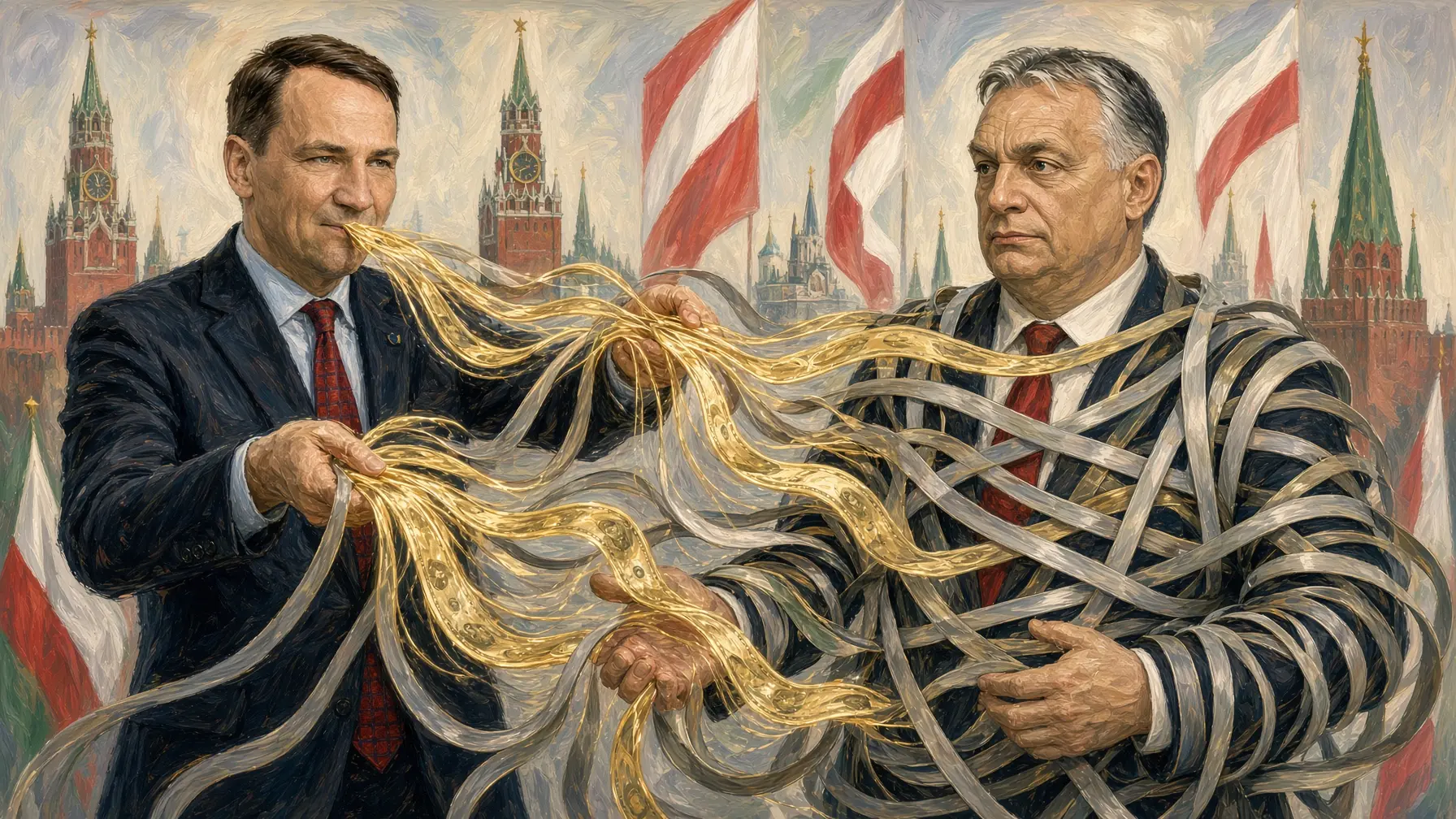
According to Sikorski, money transfers and audio recordings prove cooperation between Moscow and the Orbán government
According to Polish Foreign Minister Radosław Sikorski, Warsaw has evidence that Russia supported Viktor Orbán's government and worked closely with it. The head of Polish diplomacy spoke about this in a lengthy interview given to Gazeta Wyborcza, in response to a question about whether the European populists enjoying Moscow's backing could be considered the Kremlin's fifth column. He said the…

Saint Petersburg's oil terminal is on fire — Putin's city has never taken such a blow
On the night from Saturday to Sunday, Ukraine launched the war's largest drone attack to date on Saint Petersburg and Leningrad Oblast, and this time even Moscow could not deny the damage. Saint Petersburg Governor Alexander Beglov himself admitted that a fire broke out at the city's oil terminal, at the Ruchyi oil depot, and at industrial warehouses in the southern Kolpino district.

Surrounded for five months, the Ukrainian soldier made it out from behind Russian lines in six days
Viktor Svystun, a 37-year-old Ukrainian soldier with the call sign "Bumer," spent five months surrounded in Zaporizhzhia region, where he and his comrades sometimes fought the Russians from as little as five to seven meters away. When it became clear to him that they had been encircled, he decided to resist to the very end: "If things have come to the point where they're going to kill me anyway,…
Her ribs were broken, she was photographed naked – Anzhela spent half a year in Russian captivity
For Anzhela Pitsu, the sound of tape being unrolled is still one of the most frightening sounds today: it brings back the torture she endured in Russian captivity. She spent half a year in several detention facilities, including Olenivka, where her ribs were broken, and later, at a penal colony in Russia, she was stripped and photographed naked. In the hardest moments, she clung to the hope that…