
Saint Petersburg's oil terminal is on fire — Putin's city has never taken such a blow
On the night from Saturday to Sunday, Ukraine launched the war's largest drone attack to date on Saint Petersburg and Leningrad Oblast, and this time even Moscow could not deny the damage. Saint Petersburg Governor Alexander Beglov himself admitted that a fire broke out at the city's oil terminal, at the Ruchyi oil depot, and at industrial warehouses in the southern Kolpino district.
Following the Kremlin's favorite phrasing, he spoke of a mass drone attack by "Ukrainian Nazis," which he said killed one person, wounded five, and damaged about a dozen apartment buildings as well as two private houses. According to Alexander Drozdenko, governor of Leningrad Oblast, which surrounds the city, air defenses shot down 145 drones over the region overnight. According to TASS, this is the highest number officially announced in the region since the start of the war, surpassing the June record, when 144 drones were counted during the Saint Petersburg International Economic Forum. The Russian Defense Ministry said a total of 1,015 Ukrainian drones were destroyed across the country over roughly fifteen regions, from Moscow Oblast to the southern border, and if this figure is even approximately accurate, then Kyiv sent more drones over Russia in a single night than it did over months during the first year of the war.
The oil infrastructure suffered the greatest damage, even though this was precisely what Russia should have been most careful to protect. According to the Ukrainian military publication Militarnyi, the tank farm of the Saint Petersburg Oil Terminal has 32 tanks with a total capacity of 442,000 cubic meters — an AFP correspondent reported seeing smoke covering the sky over the southern part of the city on Sunday morning, with the smell of burning in the air. According to Liga.net, the Ruchyi oil depot belongs to a subsidiary of Rosneft and has a tank farm capacity of 114,000 cubic meters.
The drones also hit a data center: the server farm of the Russian social network VKontakte in Vsevolozhsk district, where more than twenty thousand servers operate across four halls, along with the adjacent 330-kilovolt substation. VK acknowledged the attack but claimed its services remained available, even though users reported mass outages between 3 and 5 a.m. One of the Saint Petersburg logistics centers of the e-commerce giant Ozon, which has already been targeted several times in recent months, was also hit. Footage suggests a drone also struck the 620-meter cable-stayed bridge over the Korabelny waterway, though the extent of the damage is not yet known. According to ABC News, two transformer stations were also damaged in Leningrad Oblast, in Yanino, leaving about twenty thousand people without power on Sunday morning, while Pulkovo Airport suspended traffic from 2 a.m.
Saint Petersburg lies roughly 1,100 kilometers from the Ukrainian border, and it is no accident that it has become a favored target of Ukraine's long-range strikes. The city and its surroundings host key Baltic port facilities for Russia's oil and fuel trade, and it is also Vladimir Putin's hometown and political stronghold. The Ukrainians have already shown several times this summer that they can reach it. In early June, right before the opening of the economic forum, the same oil terminal was set ablaze, with Zelensky personally announcing the strike at the time. A few days later, on the forum's closing day, the Kronstadt naval base and the Baltic Fleet's weapons depots were attacked, and for the first time since the start of the war, Beglov had to ask residents to stay home. The Ukrainian president called these deep strikes "long-term sanctions," and after this latest night, it would be hard to find a more fitting term. During the campaign underway since early October, Ukrainian forces have hit several Russian data centers, including facilities belonging to the tech giant Yandex. Ukraine's military leadership had not officially detailed the strikes on Saint Petersburg by Sunday noon.
Ukraine's counterstrike did not come out of nowhere, since Russia attacked the power supply in four Ukrainian regions, including Odesa, on the very same night. According to Zelensky, at least two people were killed, about a dozen were wounded, and tens of thousands of families were left without power. The Ukrainian president said that over the past week Russia used nearly 2,700 strike drones, 1,700 guided aerial bombs and 66 missiles — most of them ballistic — against Ukraine, and deliberately targeted energy, oil and gas facilities at least 76 times, all this after Donald Trump unilaterally declared an "energy ceasefire" between Moscow and Kyiv last Sunday. Ukraine did indeed pause its strikes on refineries for a few days, but the Kremlin did not observe the ceasefire for even a single day, so Kyiv announced on Thursday that it would resume its attacks. Meanwhile, Trump lifted sanctions on Russian diesel and, on Friday, suspended the sanctions imposed under the Congress-approved Graham bill. According to Zelensky, this encourages Putin to continue the war. Kyiv also has to contend with a sudden restriction on Starlink access for its drones, and fears that Washington could also withhold intelligence data on Russian missile launches.
In a Thursday interview with Newsmax, the American president called it a shame that Ukraine was striking Russian refineries, telling Zelensky that "there are plenty of other targets." By Sunday morning it turned out that Kyiv had taken the advice, at least in part: besides refineries, it also hit data centers, e-commerce warehouses, bridges and transformer stations — precisely where Putin would least have wanted it. If the White House had hoped that restricting Starlink and lifting sanctions would tame Ukraine's drone force, a thousand drones served as a reminder that Ukraine does not ask permission to defend itself. And Russian air defenses, which claimed to have shot down a thousand drones in a single night, somehow still could not prevent smoke from billowing over Saint Petersburg's skies this morning.
Ugar
Did you like this article?
Support our work with a small donation
Secure payment via Stripe • Min. 2 EUR
Gesta recommendations:

Masked settlers attacked European diplomats in the West Bank, Israeli leadership condemns the attack
Masked Israeli settlers attacked on Saturday a European diplomatic delegation in the West Bank, in the predominantly Christian village of Taybeh, a few kilometers northeast of Jerusalem. The delegation included the Belgian consul general, French and Polish diplomats, as well as representatives of the Catholic Church, who had come to the village to assess the tensions between settlers and…
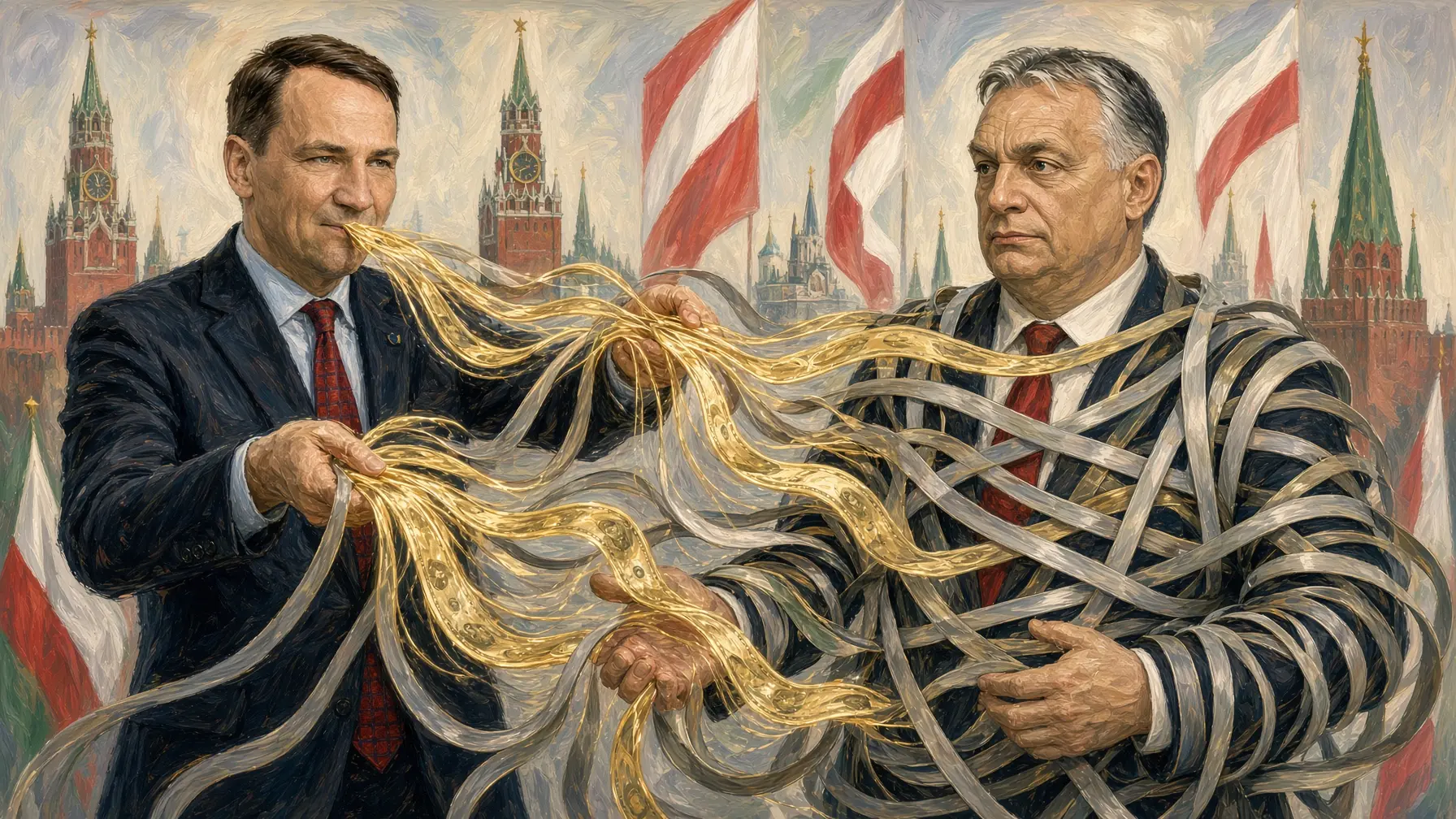
According to Sikorski, money transfers and audio recordings prove cooperation between Moscow and the Orbán government
According to Polish Foreign Minister Radosław Sikorski, Warsaw has evidence that Russia supported Viktor Orbán's government and worked closely with it. The head of Polish diplomacy spoke about this in a lengthy interview given to Gazeta Wyborcza, in response to a question about whether the European populists enjoying Moscow's backing could be considered the Kremlin's fifth column. He said the…

Musk, Rubio and a Lithuanian arson attack: Ukraine's satellite link has become the war's new front
In the span of a week, Ukraine has learned just how fragile is the satellite network on which its drones, troop communications and much of its air defense depend. Marco Rubio, the U.S. secretary of state, categorically denied on Sunday reports that the White House had ordered restrictions on Starlink in Ukraine. He said no one at the White House had instructed anyone to slow down the internet,…

Surrounded for five months, the Ukrainian soldier made it out from behind Russian lines in six days
Viktor Svystun, a 37-year-old Ukrainian soldier with the call sign "Bumer," spent five months surrounded in Zaporizhzhia region, where he and his comrades sometimes fought the Russians from as little as five to seven meters away. When it became clear to him that they had been encircled, he decided to resist to the very end: "If things have come to the point where they're going to kill me anyway,…
Her ribs were broken, she was photographed naked – Anzhela spent half a year in Russian captivity
For Anzhela Pitsu, the sound of tape being unrolled is still one of the most frightening sounds today: it brings back the torture she endured in Russian captivity. She spent half a year in several detention facilities, including Olenivka, where her ribs were broken, and later, at a penal colony in Russia, she was stripped and photographed naked. In the hardest moments, she clung to the hope that…