
Research from Oxford: when the state withdraws, extremism promises the village a future
First the jobs disappear, then the school and the post office close, and eventually even the train stops running. Those who can, move away; those who stay have to deal with more and more things without the institutions they used to rely on. The University of Oxford's five-year study examined how entire regions reach this point, how those who stay behind cope with it, and why political extremism can find a receptive audience where people feel the state has already given up on them.
Milda is ninety-two years old and lives next to a former railway station on the Latvian–Russian border region. She still remembers how, in Soviet times, "wagons full of melons" used to pass through the village, where today there is no work, no school, no post office and no shop. When researchers spoke with her, the train had last stopped there two years earlier, and shopping was possible only on Fridays, when the mobile shop arrived — more out of necessity than because it was profitable.
A population table only shows that fewer and fewer people live in the settlement. Milda's story also reveals that the life of someone who never moved an inch has changed completely in the meantime. She still lives in the same house, but much of the world around her, in which she once knew her way, has disappeared. The Oxford researchers call this experience emptiness, and they are at least as interested in how people live within it as in what exactly has been lost. Where did the jobs go, and why did the school follow? The research, presented on November 3, was led by Dace Dzenovska, a Latvian-born anthropologist and associate professor of migration anthropology at the University of Oxford. Between September 2020 and August 2025, the research team worked in four distant regions: along the Latvian–Russian border, in the Armenian highlands, in central Ukraine and in the Russian Far East. The project, funded by the European Research Council, involved the university's migration centre, COMPAS, and its institute of anthropology, and the results were published by Stanford University Press in an open-access volume titled Living Emptiness.
One of the study's key claims is that the emptying of rural areas is also shaped by political decisions. After the fall of communism, investment and resources became increasingly concentrated in big cities, while in many places smaller settlements lost both their jobs and the public services that would have made it worth staying. At the same time, borders and employment opportunities changed, so many young people went looking for a livelihood in Western Europe, while those who stayed at home found themselves in villages that were growing older and increasingly sparsely populated. "Some people can leave, others get stuck there," Dzenovska said.
At a certain point, every new closure becomes the justification for the next one. When the jobs disappear, the young people leave; when the young people leave, there are fewer children; and when there are fewer children, it becomes easier to say that keeping the school open is unnecessary. The next family then has to factor into its decision where its child would even go to school if it stayed. What appears as savings on an office ledger becomes, in the village, yet another reason to move away. Those who stay also need some kind of future. The Oxford researchers encountered radical responses from both the right and the left, as well as communities that hoped the decline would end through the restoration of empire or the strengthening of military force. To understand the connection, it helps to consider what someone hears for years on end as services disappear one by one from their village. The closing of a workplace is economic necessity, the closing of a school is a professional decision, the reduction of a bus route is reasonable cost-cutting — and by the time all this has been explained, almost nothing is left for them to build the next ten years on. In this situation, it is easier to find an audience for someone who names those they consider responsible and promises that the region will matter again one day.
Elsewhere, entirely different responses emerged. Some people salvaged materials from abandoned industrial sites to repair their buildings, obtained food or raw materials through foraging, and reorganised mutual help among neighbours. In Armenian villages, ties of kinship and friendship kept the settlements alive, while in Russia an Old Believer community found spiritual refuge precisely in a depopulating region. In some places the forest has slowly reclaimed the land, in others the military has moved in, and elsewhere what was once people's home has become a heritage protection area.
Local government can do a great deal to make life easier for those who remain, but without jobs, transport and predictable public services, even a good mayor has little room to manoeuvre. This is why Dzenovska believes the research can also be applied in Western Europe, even though decline has unfolded differently there. In many parts of Eastern Europe, people moved away after industry collapsed, whereas in Blackpool, England, poverty instead became concentrated in the same place. The shared experience is that the state abandoned them, and the better future that the retired industrial worker or the university student could once count on is becoming less and less credible. In Romania, the map is now being redrawn. Romania was not part of the Oxford study, but after the shock of the 2024 elections, political economy professor Cornel Ban described a similar fault line in an analysis for FEPS. While in big cities the benefits of EU accession were visible in jobs, investment and wages, in many small towns and villages, catching up mostly arrived in the form of national statistics. Ban partly explains the rise of AUR through this, as well as through the fact that the rising cost of living has also pushed many Romanians working in Western Europe into difficulty. Weak centrist parties, the TikTok campaign, the war in Ukraine and institutional failures were also part of the story, but the experience of being left behind helps explain why the radical right had someone to speak to.
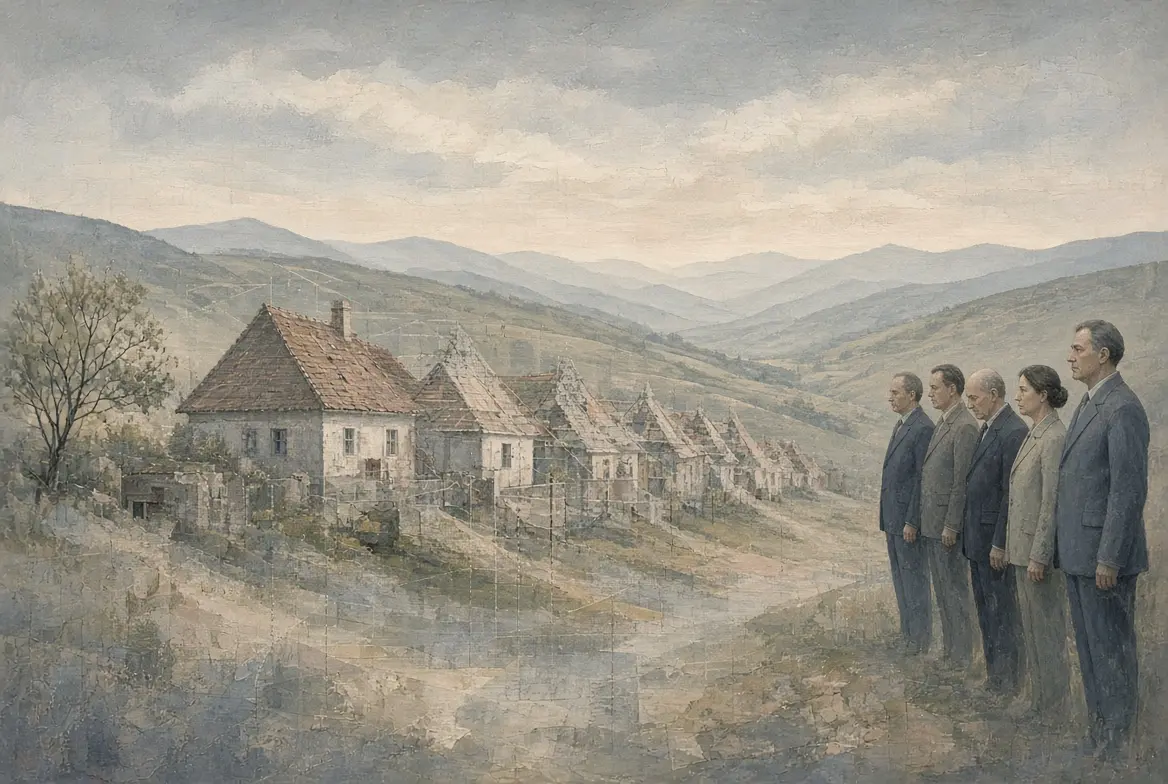
This is why it is worth reading the Oxford study now, as Romania prepares its administrative reform. The development ministry originally envisaged 429 administrative units with no more than 1,500 inhabitants each, but within the Social Democratic Party (PSD), as Ugar reported, a threshold of as much as three thousand has already been discussed. How many settlements will be affected by the mergers depends on where that threshold is set, but just as important for the future of individual villages is what is left in place locally. If the town hall moves to the neighbouring commune but administrative services, the school and medical care remain accessible, that is a very different situation from one in which, after the merger, people have to take a bus even for a simple certificate — in places where bus routes have meanwhile also been cut back.
Romanian Hungarian communities also have to take into account how the merger will change local representation and the possibility of using the Hungarian language. On a map, it is easy to mark two communes with the same colour. The value of the reform will ultimately depend on what those living there notice about it on a Monday morning, when they take their child to school, go to the doctor, or want to sort something out at the town hall. If the answer to all this turns out to be "from now on, go somewhere else," then Bucharest itself will be lending credibility to those who have been saying for years that nobody cares about rural areas.
Ugar
Did you like this article?
Support our work with a small donation
Secure payment via Stripe • Min. 2 EUR
Gesta recommendations:
Chancellor Merz has shown a bit of backbone
Either we all support Ukraine - or there's no money for us either.

America's "I can't give it away" chip: China's game of blind man's buff took it
After a broad political consensus emerged in the US that high-performance chips needed for training and running artificial intelligence should not be exported to China, in October 2022 Biden issued the decree on this, which was later tightened even further.

Lóci Antal will not be held accountable by the Romanian parliament on our behalf
Antal and the RMDSZ get away with something that not even Romania's prime minister gets away with.
Brutal: the reform's population threshold could be as high as 3,000, which could lead to the disappearance of Hungarian settlements. The RMDSZ is silent!
Only yesterday we wrote that today's PSD meeting deserved to be watched with wide-open eyes and sharpened ears, and now the bombshell news has already arrived: the governing party is weighing several scenarios regarding administrative reform, and one version no longer targets the merging of independent administrative units with fewer than 1,500 inhabitants, but — as Ugar had already warned…

Joint US-Russiya disinformation front in France: Moscow manufactured it, MAGA pushed it further
Russia-linked Operation Overload tried to convince French audiences through fake newscasts that the unrest in France was caused by immigration, while Donald Trump and Benjamin Netanyahu spoke under their own names about Islam threatening France. In a French foreign ministry survey, the most-viewed posts from MAGA circles and Israeli accounts far outstripped those of pro-Russian accounts. The gap…