
Cognitive Frontline, Part I/1: From the Protocols of the Elders of Zion to Today's Russian Propaganda, or the Lie That Outlived Its Own Exposure
A Russian forgery from the early twentieth century made its way across the Western world. Respected newspapers, influential businessmen and political movements lent it their names, and it kept spreading even after it had been exposed. The story of the Protocols of the Elders of Zion reveals how easily a society's existing fears can be turned into a worldview that, over time, comes to explain everything—even its own refutation. The tools of today's Russian information operations have advanced considerably, but the craft itself is surprisingly familiar.
Blood on the wall
Paris, the Marais district, the night of May 13 to 14, 2024. In front of the Holocaust memorial stands the Wall of the Righteous, inscribed with the names of more than three thousand nine hundred French citizens who sheltered and saved Jews during the German occupation. Two men set to work with a stencil and red paint, while a third films them on a phone. By morning, thirty-five blood-red handprints bloom over the names, and several hundred more appear on the surrounding streets. Within minutes the images spread across social media, and most observers draw the same conclusion: that anger over Gaza has turned into antisemitic hatred in France.
The investigation found something else. The perpetrators were Bulgarians who had traveled to Paris for pay, and French intelligence linked the operation to Russia's Federal Security Service, the FSB—just as it had linked the blue Stars of David painted on Parisian building facades half a year earlier. The image of antisemitism had thus not been painted by hateful Frenchmen; it had been staged by a foreign intelligence service, so that French Jews, Muslims and the majority population would see each other as the enemy.
In the same city, roughly one hundred twenty-three years earlier, a Russian agent wrote articles for Parisian newspapers under the names of French journalists—and according to several historians, he also compiled the forged document that would become the most widespread antisemitic text of the modern era. This article follows his story, the story of the forgery, and the story of the craft that stretches from Paris to Paris.
> "We shall bring about a rise in wages, which will nevertheless bring no benefit to the workers, for at the same time we shall cause the prices of basic necessities to rise as well."
The conspirators who speak in the Protocols of the Elders of Zion take credit even for undermining production and driving workers to anarchy and alcohol, as though every ill of society were the planned work of a single secret directorate. Anyone who believes this no longer needs to rack their brains over economics, politics or history: they have been handed the key to everything. This was the forgery's chief selling point. Usually divided into twenty-four sections, the text presented itself as the minutes of a secret Jewish-Masonic leadership's plan for world domination, promising readers a glimpse behind the curtain of history at last. Its first known version appeared in tsarist Russia in 1903; by 1921 the international press had already shown in detail which earlier works it had been pieced together from. Yet exposure did not end its career.
In today's terms, this is one of the most influential precursors of cognitive warfare. NATO's Allied Command Transformation uses this term to describe operations that target human thought, perception, emotion and decision-making. As one NATO general put it, the goal is not what people think, but how they think. Long before the term was coined, the Protocols showed how to get an entire interpretive framework accepted—one that then works almost on its own. Once every event is read as the work of the same hidden enemy, new lies already have a ready-made place to fit.
The road leading to the forgery passes through the intertwined world of the political police, state propaganda, far-right movements and imperial thinking. The figures of that world knew, long before the Bolsheviks, that an opponent could be watched—but that at times it was more useful to speak in his name. The story begins on a square in St. Petersburg, on a freezing December morning in 1849.
Two friends on the scaffold
At dawn on December 22, 1849, more than twenty prisoners were led out of St. Petersburg's Peter and Paul Fortress to Semyonovsky Square. The death sentence was read aloud, white death shrouds were put on them, the first three were tied to a post, and the soldiers took aim. At the last moment a courier arrived with the tsar's pardon. The whole thing had been staged: Nicholas I had already decided to commute the execution in advance, and the fear of death was part of the punishment. Among the prisoners stood the twenty-eight-year-old Fyodor Dostoevsky and the twenty-year-old Vasily Golovinsky, a young official of the Senate.
Both were members of the Petrashevsky Circle, a St. Petersburg discussion group whose members read French utopian socialists and debated the abolition of serfdom. In April 1849, Golovinsky had argued for the immediate liberation of the serfs and had even considered a popular uprising an acceptable path. They had no way of knowing that an agent sat among them at the meetings. The tsarist political police—the Third Section of His Imperial Majesty's Own Chancellery, created by Nicholas I in 1826 and headed by Count Benckendorff, who also commanded the gendarmerie—had planted a man named Antonelli in the circle in January 1849, and he reported to his superiors for months. At dawn on April 23, everyone was arrested.
After the pardon, Dostoevsky received four years of forced labor in Siberia followed by military service, while Golovinsky was sent as a common soldier to the Orenburg Corps. The two men were friends; some accounts claim a childhood friendship, though this is doubtful given their eight-year age gap—their documented common ground is the Petrashevsky Circle. The fate of these two young men standing on that square matters to this story because sixteen years later, in 1865, a son was born to Vasily: Matvei Golovinsky, whom several historians consider the author of the Protocols. Dostoevsky, then, was not a relative of the presumed forger nor a known collaborator of his, but a friend and fellow sufferer of his father. Matvei was ten when his father died in 1875, and sixteen when Dostoevsky died in 1881; there is no record that he knew the writer personally. Yet the thread is threefold: personal, through the father; ideological, through Dostoevsky's writings; and political, through Dostoevsky's friend Pobedonostsev, in whose service the young man would later begin his career.
After their shared ordeal, the two friends' paths diverged. Vasily Golovinsky remained true to his youthful convictions: during the preparations for the emancipation of the serfs, he fought against local landowners in Simbirsk, took on peasants' cases as a lawyer, and was repeatedly harassed and banished as a result; police surveillance of him was lifted only in 1874, a year before his death. Dostoevsky returned from Siberia a different man: he became a herald of Russian Orthodoxy, the tsar, and the special historical mission of the Russian people. From late 1871 until his death, he was closely befriended with Konstantin Pobedonostsev, chief procurator of the Holy Synod and future tutor of Alexander III. A portrait of Pobedonostsev hung in Dostoevsky's home, his library held most of Pobedonostsev's works, and in 1873 Pobedonostsev wrote twenty-two articles for Dostoevsky's journal, Grazhdanin. After the assassination of Alexander II in 1881, Pobedonostsev became the empire's gray eminence, who regarded liberalism, parliamentarism and religious pluralism alike as threats; his contemporaries called him the "Grand Inquisitor," after the title of Dostoevsky's most famous chapter.
A Writer's Diary
In his monthly journal of the 1870s, A Writer's Diary, Dostoevsky set out the worldview that would later resurface as "documentary" material in the Protocols. In the chapters on the Jewish question in the March 1877 issue, he inferred from the historical endurance of the Jewish people the existence of a separate, world-spanning will. At the end of the chapter titled "A State Within a State. Forty Centuries," he writes: "their kingdom is approaching, their full kingdom!" In the section "Pro and Contra," he hints at an invisible, world-spanning force: "if the Jewish idea were not so powerful in the world." For him, the Jew is simultaneously a local and a global predator: he has "ensnared the Russian peasant with his age-old gold trade," and "cares nothing for the exhaustion of Russian strength—he has taken what is his and moved on"; while in America, in the southern states, he claims that Jews had "already thrown themselves en masse upon the many millions of freed Black people."
To the charge of antisemitism he responded by pointing to word choice: "Am I not accused of 'hatred' simply because I sometimes call the Jew [yevrey] a 'zhid' [zhid]?" In Russian there are two words. Yevrey (еврей) is the neutral, official term; zhid (жид) was already a derogatory, mocking word in Dostoevsky's time, and today it is unambiguously offensive. The Hungarian word „zsidó” and the Polish Żyd, by contrast, are neutral, which is why the Hungarian translation of this passage renders both words as „zsidó,” marking the Russian original in square brackets. Dostoevsky, then, did not reject the accusation, but openly embraced the offensive word. (As if, in Hungarian, someone were to use only the slur "bipsi.")
In the same worldview, the West had been corrupted by money, materialism and Catholic lust for power. In the piece titled "Three Ideas," published in January 1877, he writes that at the edge of Europe stands "the Catholic idea, condemned, waiting amid great torment and confusion"; France, though it has almost entirely lost its faith, remains a thoroughly Catholic nation, and French socialism is the violent unification of humanity, proclaimed "as if word for word by the Pope himself." During the Russo-Turkish War, Dostoevsky claimed that Europe glorified the Turks only out of hatred for Russia, and that the most educated European states were "now passionately spreading complete absurdities about Russia." Thus the formula took shape: Russia preserves the true faith and spiritual purity, the West is corrupt, hidden forces are at work behind the scenes, and the foreign press slanders the Russians. (The quotations have been translated from the Russian original with the help of AI.)
When these lines were published, Matvei Golovinsky was twelve years old, his father already dead for two years. A quarter century later, the same formula—Jewish financial power, a corrupt West, a lying foreign press—returned in the form of a secret protocol. Ukrainian researcher Vadim Skuratovsky identified echoes of Demons and The Grand Inquisitor in the language of the Protocols. If the author truly was Matvei Golovinsky, then he had read the novels of his father's old friend and rewrote the sentences of a forgotten French satire in their voice. Dostoevsky's role, then, belongs to the ideological and literary background, not to the actual fabrication—yet, as we shall see, today's Kremlin propagandists use literally the same four elements.
Around the court
Matvei Golovinsky was born into an aristocratic family in Ivashevka, in Simbirsk province. After his father's early death, he was raised by his mother and a French governess—hence his perfect command of French, which later became his greatest asset. He studied law, and even as a young man took the side opposite his father's.
After the assassination of Alexander II on March 1, 1881, two new organizations were created to fight the revolutionaries. One was official: the political department set up within the Police Department of the Ministry of the Interior, the Department for Protecting Public Security and Order, known as the Okhrana. The other was semi-secret: the Holy Brotherhood, founded by Count Vorontsov-Dashkov among the court circle, which became known for its forged documents—including fake newspapers attributed to revolutionaries. The young law student Golovinsky joined this Brotherhood. He landed in a school where writing in the enemy's name was standard practice.
The Okhrana operated in exactly the same way. Its agents infiltrated revolutionary groups, organized provocations, and tried to bring every movement the state deemed dangerous under its control. In 1882, its St. Petersburg branch set up its own illegal printing press, funded out of its own pocket, to print the revolutionary publications of Narodnaya Volya—the police itself wrote the enemy's voice. Sergei Zubatov, head of the Moscow Okhrana, tried to harness social discontent through worker organizations under police supervision.
Golovinsky's career began in the circle of Pobedonostsev, Dostoevsky's friend, and continued at the Main Press Directorate. This office did not merely censor; it placed ready-made articles in newspapers and planted its own people in editorial offices. Its head, Mikhail Solovyov, made Golovinsky his "second editor" for roughly five years. Contemporary accounts say he regularly paid certain journalists and placed articles favorable to those in power in the papers—in today's terms, he produced sponsored content without disclosure.
His career broke off when Solovyov died and Pobedonostsev's influence began to wane under Nicholas II. Maxim Gorky publicly called Golovinsky an informer, which Golovinsky considered reason enough to leave the country. He went to Paris, where another former Holy Brotherhood member was already waiting for him: Pyotr Rachkovsky, head of the Okhrana's foreign agency.
The Paris workshop
Pyotr Rachkovsky arrived in Paris in March 1885 to head the Okhrana's foreign agency. The headquarters, operating out of offices at 97 Rue de Grenelle, employed roughly a thousand people in total by 1917, its main task being the surveillance of émigré revolutionaries through infiltration. But Rachkovsky was not content merely to watch. According to British intelligence historian Christopher Andrew, in 1886 his men blew up the Narodnaya Volya printing press in Geneva and staged the scene to look like an internal reckoning among disillusioned revolutionaries. In 1890, to great fanfare, he "exposed" a Parisian bomb-making plot against the tsar—the chief organizer, Arkady Harting (alias Landesen), later turned out to be Rachkovsky's own provocateur. Harting had persuaded the participants to keep weapons and notes documenting their roles on hand, while Rachkovsky, through intermediaries, tipped off the French police. The trial simultaneously proved to St. Petersburg the agency's indispensability and demonstrated to France that it dealt firmly with subversives. In 1902, Rachkovsky wrote a forged letter in the name of Plekhanov, leader of the Russian Social Democrats, accusing the leaders of Narodnaya Volya of collaborating with British intelligence, stirring up conflict between the factions. The Okhrana—like the KGB after it, and today's FSB—thus not only watched the enemy but, when necessary, played the enemy's role itself: it staged the assassination plot it later exposed, and carried out the sabotage it then blamed on the revolutionaries.
The press was the other major battlefield. Rachkovsky gained access to the French elite through a Danish journalist, Jules Hansen, an adviser to the French Foreign Ministry; according to a CIA historical study, Hansen became the main channel through which a pro-Russian press was built up in Western Europe, and it was he who introduced Rachkovsky to ministers and even to President Émile Loubet. Behind the scenes, Rachkovsky also helped smooth the way for the adoption of the Franco-Russian alliance of 1893. According to Andrew, before the First World War, with the sole exception of the socialist L'Humanité, every major Paris newspaper had been induced, through payments, to support Russian state loans. By 1914, roughly a quarter of France's foreign investment was in Russia, about eighty percent of it in state bonds. French small investors read in their own respected newspapers just how safe their money was; the risk was later borne by them, while others collected the fee for manufacturing that trust. From 1903, Ivan Manasevich-Manuilov distributed several thousand rubles a month through organizations called the "Circle of French Journalists" and the "League for the Salvation of the Russian Fatherland": Le Figaro, L'Écho de Paris and Le Gaulois all received funds from it.
It was into this world that Matvei Golovinsky arrived. Paris was no stranger to him: according to research by St. Petersburg historian Mikhail Lepyokhin, he made three extended visits there between March 1889 and autumn 1901, and lived permanently in France from 1902 to 1910. He lived in Bourg-la-Reine, lived comfortably off his mother's allowance, and was officially enrolled as a medical student. In reality, on Rachkovsky's orders, his task was to steer French journalists toward presenting tsarist policy favorably. According to a 1999 article in L'Express, some of his writings appeared in major Paris dailies—under the names of French journalists. Parisian readers believed they were reading the opinion of a fellow countryman, while the text had in fact been written by an agent of the Russian political police. According to Lepyokhin, Golovinsky worked at Le Figaro alongside Charles Joly, son of Maurice Joly—a name that will matter again later.
The practice of placing Russian-authored articles under French journalists' names has living successors today. In 2020, the news site PeaceData, linked to people associated with the notorious St. Petersburg troll factory, the Internet Research Agency, hired real American freelance journalists for $75–250 per article; the commissioning "editors" were fictitious personas, some with artificially generated profile photos. In September 2024, the US Department of Justice indicted two employees of Russian state broadcaster RT for funneling nearly ten million dollars to a Tennessee-based content company that produced videos with well-known American influencers. According to the indictment, the influencers were deceived about the source of the money, and the client requested that Ukraine be blamed for the 2024 terrorist attack on a Moscow concert hall—an attack claimed by the Islamic State. In March 2024, the Czech government sanctioned the Prague-based news site Voice of Europe, which, according to the investigation, paid politicians from several EU member states—including Hungary—to spread anti-Ukrainian messages. The structure has barely changed in a hundred years: Russian money and a Russian message hide behind a credible domestic face, while the reader believes they are hearing one of their own public figures speak.
But Rachkovsky had bigger plans than a few favorable articles. According to the version described by L'Express, he wanted to convince Nicholas II that the country's industrial and financial modernization—the policy pursued by Finance Minister Sergei Witte—was an expression of a Jewish-Masonic plan for world domination. For that, he needed proof: a document originally intended for a single reader—the tsar. The setting was ideal. Paris at the time was gripped by the Dreyfus affair: Édouard Drumont's 1886 pamphlet, La France juive (Jewish France), became a bestseller; the French Antisemitic League was founded in 1889; and in 1892 Drumont launched his daily, La Libre Parole, which was already branding Jewish officers in the army as future traitors two years before Captain Dreyfus's arrest. The Dreyfus affair showed that a state's failures could be pinned on the Jews. The Protocols offered tsarist Russia the very same recipe.
Rachkovsky himself did not enjoy the success of his work for long. In 1902 he was dismissed after a report exposed Philippe, a swindler and hypnotist from Lyon who told fortunes for the tsarist family; his enemies used this to turn the tsar against him. But in 1905, the year of the revolution, he was recalled, first as a special commissioner of the Ministry of the Interior, then as deputy director of the police.
The text
The forger did not have to conjure hatred out of nothing; Europe had accumulated, over centuries, a stock of prejudice to draw on. Christian anti-Jewish sentiment took countless forms, from religious segregation through occupational and educational restrictions to the blood libel. From the 7th century, church councils banned Jewish-Christian marriages; the Fourth Lateran Council of 1215 mandated distinctive dress; the Council of Basel in 1431 barred Jews from universities. During the Crusades, Jewish communities along the Rhine were massacred, and during plague epidemics the accusation of well-poisoning resurfaced again and again.
In Strasbourg, in February 1349, Jewish residents were burned en masse even before the plague had reached the city. Suspicion was fed by the fact that in some places Jews fell ill less often. This may have been due to religious precepts — ritual handwashing and bathing, kosher dietary laws, which require the careful draining of blood from meat and forbid the consumption of blood — as well as to a life lived in separate quarters with their own wells, though some researchers dispute this. The surrounding population did not understand these customs: fewer deaths were taken as proof of guilt. It is a peculiar contradiction that the blood libel targeted precisely those whose religion forbids the consumption of blood. Alongside fear of the epidemic, the erasure of debts and the seizure of victims' property also played a role; the killings stopped nothing, and the plague kept spreading. In Toledo in 1355, more than twelve thousand Jews were killed. The accusation, then, never had to follow reality: it was enough to point at a community, then link the fear to the interests of those who profited from persecution. The story of the blood libel and well-poisoning remained reusable for centuries, because there was always some crisis it could be pinned to.
To this was added suspicion of the Freemasons. The Catholic Church excommunicated members who joined lodges in 1738; in the 19th century the Vatican called the lodges "the synagogue of Satan," and an entire explanatory system grew up around secret societies: the French Revolution, the shaking of monarchies, and the breakdown of the traditional order were all attributed to the same hidden conspiracy. The Protocols fused these two images of the enemy. The reader did not need to learn to be afraid; he was simply shown that his various fears supposedly led back to the same center.
The second life of a forgotten satire
The literary raw material for the forgery was drawn from somewhere quite different. The French lawyer Maurice Joly published his satire Dialogue in Hell Between Machiavelli and Montesquieu in Brussels in 1864, attacking the regime of Napoleon III: in the imagined debate between the two historical thinkers, it is Machiavelli who explains how a modern state can be quietly turned into a despotism. Joly was sentenced to prison over the book, and the work fell into obscurity. It contains not a single word about Jews. The forger lifted long passages from it, often along with the sequence of arguments and the similes — and if the Lepekhine version is true, the book may have been brought to Golovinski's attention by the author's own son, Charles Joly, at the Figaro editorial office. Charles Joly was in St. Petersburg in early 1902 as the paper's correspondent, the very year the Protocols were first publicly mentioned.
The theft is sometimes literal. In Joly, Machiavelli says that his press "will have a hundred arms, like the god Vishnu"; in the Protocols, the sages' newspapers will have "hundreds upon hundreds of hands, like the Indian god Vishnu." In Joly, the crowd is "submissive before force, merciless toward weakness, implacable toward faults, indulgent toward crimes" — in the Protocols, word for word the same. In Joly, a book shorter than 200-300 pages is "just a pamphlet"; in the forgery, books shorter than 300 pages are subject to double tax. In Joly, "journalism is a kind of freemasonry"; in the Protocols, "a masonic consensus operates in the French press to relay watchwords." Protocols 1 through 19 follow Joly's Dialogues 1 through 17 in sequence; in 1966 Norman Cohn counted more than one hundred and sixty borrowed passages. The speaker was swapped — instead of Machiavelli, the "Elders of Zion" say the same things — and the political satire became a secret council.
The setting for the council came from a German pulp novel. In his 1868 novel Biarritz, published under the pseudonym Sir John Retcliffe, the Prussian postal official and secret-police informer Hermann Goedsche depicted representatives of the tribes of Israel gathering at midnight in the Jewish cemetery of Prague to discuss conquering the world. The scene was published separately in Russian as a pamphlet in 1872, presented as though it were a report on an actual meeting that had taken place. Thus a French satire and a German pulp novel were combined to produce a Russian "document."
Who wrote it?
The exact identity of the author remains disputed to this day — and that in itself is part of the story. The firmest starting point is an official Russian investigation: Prime Minister Pyotr Stolypin had the origin of the text secretly investigated, and the conclusion was that it had surfaced around 1897-98 in antisemitic circles in Paris. According to Christopher Andrew, it is "highly probable" that the forgery is linked to the name Rachkovsky. In 1921, Princess Catherine Radziwill claimed in New York that she had seen the manuscript, which she said had been compiled by Golovinski and Manasevich-Manuilov on Rachkovsky's orders; an American woman, Henrietta Hurlbert, corroborated her testimony. The princess, however, dated the episode to 1904-05, by which time Golovinski and Rachkovsky were no longer working in Paris, and the press had already written about the text back in 1902 — and Radziwill was in any case considered an unreliable witness.
The most direct testimony dates from 1917. After the February Revolution, the Kerensky government's representative, Sergei Svatikov, traveled to Paris to dismantle the tsarist secret service's network there. Henri Bint, the Okhrana's Paris agent, told him that the Protocols had been written by Golovinski, and that he himself had paid for it. Svatikov purchased Bint's papers, which were later deposited in Prague, from where the Soviets removed them in 1946 — one reason why Lepekhine could only access them once the Moscow archives were opened. Lepekhine published his conclusions in L'Express in 1999; according to him, Golovinski wrote the text in Paris in late 1900 or early 1901. "Writing the Protocols was just a moment in Golovinski's life," he told the magazine.
At the Bern trial (1934-35), where Swiss Jewish organizations sued the distributors of the text, Russian witnesses likewise linked Rachkovsky to the forgery. The chief witness, Alexandre du Chayla, who had seen the manuscript himself in Nilus's circle, had previously argued in favor of the blood libel, according to research by Michael Hagemeister; he received four thousand Swiss francs for his testimony, and even the plaintiffs privately had doubts about him; Vladimir Burtsev, the famous exposer of Okhrana agents, also testified. On May 19, 1935, the court declared the Protocols a forgery and a plagiarism, with the judge saying he hoped that one day no one would understand why such a trial had ever been necessary. The appellate court acquitted the distributors in 1937, but only because it classified the text as a "political" rather than an "immoral" publication — it did not dispute its falsity.
The other camp considers the Golovinski version unverifiable. According to the Italian Slavist Cesare De Michelis, Michael Hagemeister and Richard Levy, the text could not have been produced before 1901 and was probably written in Russia in 1902-1903: the first published version is full of Ukrainianisms — Ukrainian words and turns of phrase — pointing to an author from the south, from Bessarabia or Ukraine; in 2021, De Michelis presented a typescript found in Moscow whose corrections match the handwriting of Georgy Butmi.
What is certain is that the raw material came from Paris, the milieu was the antisemitic, secret-service and propaganda network surrounding the tsarist state, and at several points along the way stand people linked to Rachkovsky. The exact hand is not proven — and that is itself the hallmark of a well-organized covert operation: the sponsor remains deniable.
The genre of the "secret plan" plucked from a real but tedious source is still alive today. In March 2022, Russia's defense ministry spent days presenting "seized documents" allegedly proving that the United States was running secret biological-weapons laboratories in Ukraine. According to Russian biologists, the papers actually describe relatively harmless pathogen collections and routine public-health research. Joly's satire and a lab inventory served the same function: a backdrop that looks like an authentic document for a secret plan the reader was already expecting.
Chișinău and the tsar's desk
The Protocols' first public appearance was not in Paris but in Bessarabia. From 1897, Pavel Krushevan published the paper Bessarabets in Chișinău, which for years frightened its readers with claims that Jews wanted to seize control of Russia. In February 1903, a Christian boy, Mikhail Rybachenko, was found dead in nearby Dubossary. Krushevan's paper turned the case into a blood libel, writing that Jews had taken the child's blood for Passover matzah. It later emerged that the boy had been killed by his own relatives. The authorities tolerated, and even supported, the paper, while banning publications that refuted it.
The incitement had its effect. The Kishinev pogrom broke out at Easter 1903: according to various tallies, forty-seven to forty-nine Jews were killed, ninety-two seriously injured and about five hundred lightly injured, and more than seven hundred houses and businesses were ransacked. Four months later, this same Krushevan, in his St. Petersburg paper Znamya, was the first to publish the Protocols in installments. The man who had turned a child's death into a local blood libel now offered his readers a conspiracy spanning the entire world. The scale of the story changed; the designated victim stayed the same. Krushevan was never convicted of anything; he later even entered the Duma as a representative of the Black Hundreds.
The pogroms were not merely the work of a dark mob. Alexei Lopukhin, a former director of the police, wrote to Prime Minister Stolypin about the authorities' "systematic preparation" of pogroms against Jews and others, while Komissarov, an officer of the police department, boasted, according to Trotsky's later account: "We can organize any pogrom you like, whether for a dozen people or for ten thousand." According to researchers, the wave of pogroms in October 1905 was organized by Russian ultranationalists to suppress the revolutionary movement — yet most of its victims were peaceful Jewish residents who had nothing to do with the revolution. They became the designated culprits of a political crisis.
The Kishinev pattern is still alive today, even within Russia itself. On October 29, 2023, in the weeks after the Hamas attack, several hundred men stormed the airport in Makhachkala, Dagestan, shouting antisemitic slogans as they searched for Jewish passengers on a plane that had arrived from Tel Aviv. The crowd was mobilized by local Telegram channels and an unsubstantiated rumor. The next day, Putin blamed Western intelligence agents and Ukraine, claiming the unrest had been stirred up from abroad via social networks; Washington called this absurd. The structure has been the same since 1903: the incitement happens locally, while the explanation points to a foreign conspiracy. And after Bucha, Russia's leadership called footage of civilians murdered under Russian occupation a Ukrainian and Western provocation: the exposure of a crime turned into a conspiracy against the perpetrator, and the victims into props in a staged story. In Krushevan's world, the victims of the pogrom were cast as participants in a plot for world domination; today's Russian propaganda transfers responsibility with just as much readiness onto those it has attacked.
Toward the court
After Krushevan, others carried the text forward. Georgy Butmi published it in 1906 through the Black Hundred Union of the Russian People, while the mystic writer Sergei Nilus included it in 1905 as the closing chapter of his book on the coming of the Antichrist, The Great in the Small. Over twenty editions appeared in Russia between 1903 and 1912.
The first recipient actually recognized the fraud. One key figure in bringing the text to Russia was Yuliana Glinka, daughter of a Russian general living in Paris, whom sources regard as an agent of Rachkovsky. Glinka spoke of mystical revelations to Mikhail Menshikov, a columnist for Novoye Vremya, and persuaded him to read the documents. Menshikov wrote about them for the first time in April 1902, in an article titled "Conspiracies Against Humanity" — but published no details, and called the authors and distributors "feverish-brained people."
Nilus reacted differently. According to his own account, he obtained the manuscript in 1901 through an acquaintance, Alexei Sukhotin; it had been "stolen by a woman" from one of the Freemasons' leaders "somewhere in France, at a secret meeting." This is where the blurring of the source is most clearly visible: an anonymous woman, an anonymous Freemason, an unnamed French city. The origin stories kept changing from edition to edition: a French journalist stole the manuscript in Nice; it was written in France; it was born at the 1897 Zionist Congress in Basel — and when Nilus was told that the congress had been public, that the press had covered it extensively, and that its subject was the founding of a Jewish state, he moved the text to secret sessions in 1902-1903, and by 1917 he was even naming Theodor Herzl as its author. According to Butmi, the plan had already been conceived in 929 BC. The purpose of the origin story was to make the text look like evidence that had arrived from far away, obtained at great difficulty, so that the distributor could pretend to be merely passing on a terrible secret already exposed in the West. According to du Chayla's later account, Nilus held that the question of the source was irrelevant.
According to the version reported by L'Express, Rachkovsky was in fact counting on Nilus: the plan was to make the mystic writer the tsar's confessor, so that he could hand the document to the ruler. The appointment never happened, so Nilus published it in his book. According to a 1921 analysis in The Times, the Protocols were meant to convince Russian conservatives, especially court circles, that the cause of discontent was not the oppressive policies of the bureaucracy but a worldwide Jewish conspiracy — a weapon against the liberals who were pushing for concessions.
Nicholas II initially embraced the text enthusiastically. But when Stolypin's investigation showed it to be a forgery, the tsar ordered: "The Protocols must be confiscated; a good cause cannot be defended by dirty means." Reprints nevertheless multiplied, and an 1906 edition survived even in the tsar's own collection. The operation had already slipped free of its sponsors by this point: not even the ruler could stop it.
A text that adapts to the news
The forgery itself was not fixed in form. De Michelis's research identified versions of varying length and structure; the twenty-four parts known today did not remain unchanged from the original. In Nilus's 1905 text, the sages merely promise that to one government "we shall show our strength by force, that is, by terrorism"; after the 1905 revolution, in Butmi's 1907 edition, the same passage appears in the past tense: "we have shown our power through assassination, through terrorism." The prophecy was adjusted after the fact to match the event, and the event could then be presented as the fulfillment of the prophecy.
The accompanying "serpent map" worked the same way. Nilus placed the birth of the plan in 929 BC, in the Jerusalem of King Solomon; from there the serpent crept to Athens in the age of Pericles, to Rome under Augustus, to Madrid under Charles V, to Paris in the years of the Revolution, to London after the fall of Napoleon, and to Berlin after the Franco-Prussian War, with its head resting over St. Petersburg, dated 1881 — the year Alexander II was assassinated. The next stop is Constantinople, the final destination Jerusalem. The forger retroactively attributed every great turning point in European history to a single Jewish plan, and openly stated its goal: the conquest of Russia. Later editors added new stations to the map: in the English Marsden notes, the Young Turk Revolution of 1908 already appears as a "fulfilled" stage of the serpent's journey, a "Jewish revolution." World history was thus turned into an endlessly expandable indictment.
The road to the West
The real triumph came after the revolution. During the civil war, the White armies used the text to incite massacres of Jews, turning it into the perfect tool for conflating Bolshevism with Jewishness. After their defeat, émigré officers, priests and journalists carried it to the West in their suitcases: in 1920, the émigré paper Luch Sveta in Berlin published it in full. A Russian translator's handbook attributed to Nilus, preserved in the Columbia University archives, spells out exactly how it was to be handled: the Russian version should be used as the base, but the necessary additions and corrections should be made for each country. This is an instruction for tailoring the message to its target audience, a hundred years before microtargeting.
Translators and publishers worked in that spirit. Everything that might have alienated local readers was dropped: for instance, that only "Russia's tsar, anointed by God," could save the world, the passages hostile to Tolstoy and to women's emancipation, and the sentence calling the Sanhedrin "a faithful ally of England" — in English editions, it was precisely the anti-English part that disappeared. The Russian and monarchist message was stripped away, while the vehicle, the Jewish conspiracy, remained. Each country received its own particular fear. Philadelphia's Public Ledger published it in 1919, during the Red Scare, as the "Red Bible," a Bolshevik manifesto, with the passages pointing to Jewish authorship cut out. A Boston edition in 1920 already tied the mythical conspirators to political Zionism. In Britain, Eyre & Spottiswoode, the King's printer, published it under the title The Jewish Peril; this did not amount to official government endorsement, but the publisher's name lent the book extra weight. In Germany, an edition by Ludwig Müller von Hausen, under the pseudonym Gottfried zur Beek, offered an explanation for defeat in the war and the revolution. Different audiences received the same enemy, translated into the language of their own particular fears.
Nilus's translator's handbook now runs on autopilot. In 2024, France's VIGINUM agency exposed the Pravda network under the name Portal Kombat, which lifts material from Russian state media, Kremlin-friendly Telegram channels and official sites, and repackages it country by country. Earlier estimates spoke of several million posts a year; CheckFirst's database from November 2026 already contains more than fifteen million articles, from 88 websites, in 47 languages. The only difference is that this no longer requires a separate émigré translator, an enthusiastic publisher and a mailing list for every version.
The industrialist and the world's newspaper
In America, a Russian émigré, Boris Brasol, personally convinced Henry Ford — one of the richest and most popular Americans of his era — of the text's authenticity. Ford's newspaper, the Dearborn Independent, spread the Protocols' worldview between 1920 and 1922 in a ninety-one-part antisemitic series, adapted to American themes: it blamed the Jewish conspiracy for the "corruption" of baseball, the spread of jazz, and evasion of Prohibition. The book version, The International Jew, appeared in more than half a million copies, in at least sixteen languages. By then it was no longer a foreign émigré speaking, but a celebrated American industrial magnate — in today's terms, a domestic, credible "influencer" had taken over the foreign narrative.
Yet the most telling example is the London Times. In May 1920 it discussed the text in a respectful editorial, asking whether its claims should not be investigated — a piece that turned the book into a bestseller in its German edition. The refutation, however, arrived quickly, from several directions. The British journalist and diplomat Lucien Wolf showed in a 1920 pamphlet that the text's ideas came from Goedsche and other antisemitic authors; Herman Bernstein, a reporter for the New York Herald, dismantled the forgery in his 1921 book The History of a Lie. And in August 1921 the Times itself published a three-part series by its Constantinople correspondent, Philip Graves, which set Joly's text side by side with the Protocols: Graves found roughly fifty matching passages, proving the plagiarism. The Times also spelled out at the time what the forgery had been meant to do: to convince Russian court circles that the source of their troubles was not their own repressive policies, but a Jewish conspiracy.
The refutation thus emerged only one or two years after the Western publication, and readers could be shown the original and the copy side by side. Yet the text kept circulating, because the narrative outran the refutation, and because the crisis of the time — war, revolution, the Red Scare — made the public receptive. Ford's name carried more weight than the arguments of an unknown debunker, and the Times's earlier attention kept working even after the paper itself had exposed the forgery.
Versions of this “Times effect” exist today as well. According to a November 2025 study by the Institute for Strategic Dialogue, thirty-four websites with more than a million monthly visitors each cited articles from the Pravda network as reliable sources; in 2025, the DFRLab and CheckFirst found more than 1,900 links to the network across 44 language versions of Wikipedia, and also examined how these sites appear in the answers generated by AI-based systems. In this way propaganda seeps into platforms that users regard as independent, synthesizing sources of knowledge. And where a reputable outlet refuses to cooperate, it simply gets copied: the Doppelganger operation, active since 2022, has published fake articles on deceptively cloned websites imitating Le Monde, the Washington Post and Der Spiegel; the Russian companies behind it, the Social Design Agency and Struktura, have been sanctioned by the EU and the United States.
The Matryoshka operation (also known as Operation Overload) turned the bitterest lesson of 1921 into a method: that exposure itself can boost a forgery's fame. It sends fake videos impersonating media outlets, researchers and police departments directly to fact-checkers and newsrooms, asking them, “please verify.” The aim is to consume the debunkers' time and to make the refutation itself spread the forgery: according to CheckFirst, in the operation's first months around 250 fact-checking or debunking articles mentioned the fabricated material. By August 2026 it was already targeting the Swedish election.
It Doesn't Matter Whether It's Authentic
The forgery survived its own exposure because, in the meantime, it had found an audience for which the explanation of the world mattered more than the document's origin. Adolf Hitler wrote of it in Mein Kampf:
“How much the whole existence of this people is based on a continuous lie is shown incomparably by the Protocols of the Elders of Zion.”
He simply turned the charge of forgery on its head: in his view, the very fact that the Frankfurter Zeitung called it a forgery every week was the “best proof” of its authenticity. Goebbels called it “just as relevant today,” even though he himself had doubts about it in his diary. Theodor Fritsch's German edition claimed in 1931 that Russian police had found a Hebrew manuscript in a Jewish apartment in 1901; the Nazi Party's publishing house issued twenty-two editions by 1938, and the text was even taught in schools.
In England, a 1934 commentary by the far-right group Britons declared that the Aryan races would “ultimately have to place the Jews outside Europe for good”; in Brazil, the author of Gustavo Barroso's annotated 1936 translation even raised the idea of concentration camps. The Protocols thus became one of the texts used to present violence against Jews as pre-emptive self-defense.
In Italy in 1938, the year of the racial laws, Julius Evola wrote a preface to Giovanni Preziosi's edition, and it was he who most clearly articulated the self-protective mechanism of the fraud: in his view, the document's authenticity was secondary to the supposed truth it revealed — the text, whether genuine or not, gave a convincing picture of the modern world. With this he simply dissolved the burden of proof: if the text is real, it is evidence; if it is false, it still accurately describes the world. Anyone who disputes it can easily be declared part of the conspiracy himself. The system closes in on itself, and no outside fact can disturb it any longer.
Evola was one of the founders of Traditionalism, a school of thought that rejects modernity, equality and the idea of progress, and his influence did not end with the war. From Italian neo-fascist circles, a path led to the thinking of Aleksandr Dugin, for whom Traditionalism is a call to arms against the modern world. Research by Benjamin Teitelbaum has documented Steve Bannon's interest in this tradition, and reported on an eight-hour meeting between Bannon and Dugin in Rome in November 2018; the American white nationalist Richard Spencer has called Evola one of the most fascinating figures of the 20th century. Evola's works have been listed as recommended reading by the Greek neo-Nazi party Golden Dawn, are regarded as an ideological foundation by Italy's CasaPound, and are also read in certain circles of the Hungarian radical right. The political affiliations differ, but one element of the shared tradition is precisely the idea that a desirable explanation of the world can be worth more than a verifiable fact.
After the Holocaust
One might expect the Holocaust to have permanently discredited the text. It did not. According to a tally by Daniel Pipes, it was reissued eight times in the 1950s, sixteen times in the 1960s, twenty-three times in the 1970s, and twenty times in the 1980s. By then the core of the twenty-four protocols had solidified, and updating took place around the text — in prefaces, footnotes, titles. In a roughly six-hundred-page 1996 Arabic edition, the protocols themselves took up less than a hundred pages.
In Ajjaj Nuwayhid's 1967 Lebanese edition, passages pulled out of religious texts served to validate the conspiracy, and Israel grew from a military danger into a metaphysical threat. Article 22 of Hamas's 1988 charter claims that Jews were behind the French and communist revolutions, both world wars, the League of Nations and the United Nations, while Article 32 states that the plan can be read in the Protocols; the organization's 2017 political document no longer repeats this. In Japan, Masami Uno's 1986 books attributed the strengthening of the yen, the oil crisis and the shooting down of a Korean airliner to the “Elders,” and the Japanese edition sold more than a million copies. In Syria, a 2005 edition authorized by the Ministry of Information linked even the September 11 attacks to the Zionist plan. The story needed no sizable local Jewish community: the text supplied the scapegoat, and every country added its own grievance.
The Holocaust, which occurred after the forgery, could only be written into the existing framework — and it was written in four mutually contradictory ways. According to Hamas, Jews profited from arms trading during the Second World War and used it to prepare their state. In the preface to an Arabic translation, Ihsan Haqqi downplays the number of victims and suggests that the Protocols themselves were spread by Jews to make themselves appear more powerful — thus turning even the forgery's proven falseness against the victims. A 2005 Mexican edition claimed the Holocaust was itself the Elders' plan, in exchange for the founding of Israel. The contradiction caused no confusion, because every version arrived at the same place: that Jews are also responsible for their own persecution. The cognitive operation does not need to be coherent — it only needs to always point to the same culprit.
A New Vocabulary
Matvei Golovinsky did not live to see the worldwide success of his text, but he did live through the revolution — and, like the forgery itself, he moved easily from one regime to the next. In Paris in 1906 he published an English–Russian dictionary adapted from a Russian edition at the Garnier publishing house, and after three years of medical studies without a degree, he began calling himself “Doctor.” Back home, he worked for the Ministry of Justice and then for Interior Minister Protopopov; in 1914, under the signature “Dr. Golovinski,” he published The Black Book of German Atrocities, a piece of wartime propaganda. In 1917 he became a delegate to the Petrograd Soviet, celebrated as one of the few doctors to side with the Bolsheviks; he worked for the People's Commissariat of Health, advised Trotsky on military training, and in 1918 founded the Institute of Physical Education. He died in 1920 — just as translations of the Protocols were conquering the West. According to a French school textbook, the Bolsheviks also had no interest in exposing the secret of his role, since the forger had become their fellow traveler. His life story shows, in a single biography, what this chapter is about: the continuity of the trade was never broken between the tsarist secret police and the Soviet state.
The Soviet state officially condemned tsarist antisemitism, banned the Protocols, and for decades presented itself as a leader in the fight against antisemitism. The Cheka and its successor agencies, however, learned a great deal from the Okhrana: according to Christopher Andrew, the Bolsheviks were fascinated by what they discovered in the tsarist files. The “Trust,” active from 1921 to 1927, was a fabricated anti-Bolshevik underground organization that fed European intelligence services false material and lured the legendary British spy Sidney Reilly into Soviet Russia. Among the later KGB's “active measures” — defined by the American information agency as the manipulative use of slogans, arguments, disinformation and carefully selected genuine information — forged documents, covert press manipulation and the stoking of social conflict all had a place. The continuity is not a metaphor: former KGB officers Oleg Gordievsky and Oleg Kalugin said that in the 1950s and 60s, officers were trained using Okhrana manuals, and according to Kalugin this was still true in the 1980s. Andrew therefore warned that it would be a mistake to date the history of active measures to the Soviet Union alone — and that no KGB forgery ever achieved an impact comparable to that of the Protocols.
The KGB also played with ethnic hatred. The PANDORA plan, known from the Mitrokhin Archive, aimed in 1971 to inflame racial tensions in the United States: the New York residency was instructed to prepare a bombing targeting an institution of a Black community, with the blame to be pinned on the radical Jewish Defense League. Fake hate letters and provocations carried out in others' names served the same purpose: to turn groups against each other from whose conflict Moscow hoped to reap political gain. The method would resurface fifty years later, in Paris.
Zionology
The turning point came in 1963, when Trofim Kichko's book Judaism Without Embellishment was published in Kyiv by the Ukrainian Academy of Sciences; historians believe the author worked on orders from the central authorities, and the book was a reworking of the tsarist police's forgery. After the 1967 Arab–Israeli war, a whole pseudo-scientific literature emerged under the name “Zionology,” backed by the Communist Party and the KGB, describing Zionism as a global, secret and hostile power. Yuri Ivanov, a staffer of the Communist Party's Central Committee — according to a contemporary report the body's sole Israel expert, whom some sources also link to the KGB — wrote his book Caution: Zionism! in 1969 at the initiative of the Central Committee's international department; it was published by the state publishing house in several languages, including English. According to one contemporary analyst, in the book the word “Zionist” means “Jew,” and the whole thing is simply the literature of the Black Hundreds rewritten with a communist vocabulary. The Black Hundreds (in Russian, chornaya sotnya) were members of an early-20th-century Russian far-right, pro-tsarist and antisemitic movement — Krushevan, as their representative, entered the Duma, and Butmi published the Protocols through their press. Ivanov, then, simply translated the texts of that original circle into Marxist-Leninist language. The Soviet Anti-Zionist Committee, operating under KGB supervision, by 1985 was publishing a pamphlet titled The Criminal Alliance of Zionism and Nazism, which the Novosti press agency also distributed in English. Mahmoud Abbas, who later became president of the Palestinian Authority, drew on Soviet authors in his 1982 Moscow doctoral dissertation to cast doubt on the number of Holocaust victims.
The content was given an “anti-Zionist” label, but the template stayed the same — and so it reached audiences that would have rejected an openly pro-tsarist, antisemitic pamphlet. According to research by Izabella Tabarovsky, the tropes of Soviet “Zionology” — the global Zionist network, Jewish money and lobbying, Zionists as the new Nazis — were passed directly into Western far-left and academic anti-Zionist discourse, which adopted the vocabulary of Soviet propaganda within the freedom and prosperity of democracies, largely without even knowing its Cold War origins. The idea of global Jewish domination was replaced by that of a worldwide Zionist network, while the notion of secret control over money, the press, politics and wars remained intact.
The Peak: The UN
Soviet anti-Zionism also reached its target at the world organization. On November 10, 1975, the UN General Assembly adopted Resolution 3379, which declared that “Zionism is a form of racism and racial discrimination.” The decision passed with 72 votes in favor, 35 against and 32 abstentions; most of the support came from the Soviet bloc, Arab and Muslim-majority states, and many African countries. Communist Hungary, as a member of the Warsaw Pact following the Soviet line, also voted in favor. The text cited a forum on women's issues: the declaration of the 1975 World Conference of the International Women's Year in Mexico City, which listed Zionism among the oppressive phenomena to be eliminated — the label of women's rights lent it legitimacy, just as the Times's authority once had. The General Assembly revoked the resolution after the Cold War, on December 16, 1991, with Resolution 46/86, by a vote of 111 in favor, 25 against and 13 abstentions — in a single sentence, without explanation; Israel had made this a condition for the Madrid peace conference. The diplomatic sentence could be erased, but the slogan attached to it could not.
The slogan was revived by the civil society forum of the 2001 UN World Conference against Racism in Durban. According to a report by the Anti-Defamation League, the Protocols were openly sold at the forum alongside anti-racist publications, and the final declaration demanded the reinstatement of Resolution 3379. The language of anti-racism thus played the same role as the Women's Year declaration had in 1975: it legitimized the old accusation. The Soviet template seeped into the Western left's mainstream as well. In April 2016, Ken Livingstone, London's former left-wing mayor, repeated the thesis of the KGB pamphlet on BBC radio: Hitler “was supporting Zionism before he went mad and killed six million Jews.”
A Text That Runs on Its Own
In Russia, after the collapse of the Soviet Union, the original forgery itself made a comeback. Nilus's books, religious publications and extremist distributors kept it alive; in 2005 it was described as a document frequently found in the churches of the Patriarchate, and in 2011 controversy erupted when it emerged that the Foreign Ministry had ordered copies of Nilus's books and the Protocols for its diplomatic missions abroad. It was added to the list of extremist materials only in November 2012 — but no ban erased the pattern of thought it had generated.
On the internet, the text now works even without the full book: a few sentences, an image, one more supposed exposé are enough, as long as the audience recognizes the story's characters. A historian estimated in 2006 that around half a million websites carried content related to the Protocols. The word “Zionist” often substitutes for “Jew,” and on social media it is paired with code words designed to evade moderation algorithms, such as “Zio” or “Sons of Zion”; after October 7, 2023, the Protocols once again became a recurring motif, alongside the denial of the attack and of the sexual violence committed during it. To recognize it, one must look at how it is used: whenever every war, financial crisis and social change is attributed, instead of to criticism of a given political line, to the same secret group controlling everything, the Protocols' explanation of the world returns. At that point the text runs on its own: it no longer matters whether whoever spreads it has ever actually read the original.
Back to Paris
In January 2024, on the eve of International Holocaust Remembrance Day, the U.S. State Department devoted a separate report to how tsarist, Soviet and present-day Russian power have used antisemitism. Its conclusion: successive rulers of the Kremlin have for more than a century used anti-Jewish prejudice to “discredit, divide and weaken” their perceived opponents. Between the 1960s and the 1980s, the KGB portrayed rivals — the Catholic Church, West Germany, the United States — as antisemitic, while persecuting the Zionist movement and Soviet Jewish dissidents; today's Kremlin, meanwhile, falsely portrays Ukraine as Nazi and antisemitic, and demonizes its Jewish president. Today's Russian leadership celebrates itself as the vanquisher of fascism and calls its attack on Ukraine “denazification.”
Foreign Minister Sergei Lavrov demonstrated how this argument works most succinctly on Italian television in May 2022. Asked how one could “denazify” a country with a Jewish president, he answered: “So what if Zelensky is Jewish? That doesn't lessen the presence of Nazi elements in Ukraine. I believe Hitler also had Jewish blood.” He added that, according to the “wise Jewish people,” the most fervent antisemites are usually Jews themselves. Israel called this an inversion of the Holocaust and demanded an apology; the Israeli prime minister's office said Putin had apologized, while the Kremlin's own summary made no mention of this. Putin himself said a year later, at the 2023 St. Petersburg Economic Forum: “I have many Jewish friends. They say Zelensky isn't Jewish — he's a disgrace to the Jewish people.” In September 2023, he spoke of “Western handlers” having placed an ethnic Jew at the head of Ukraine in order to conceal the “inhuman essence” of the Ukrainian state. This is the basic structure of the Protocols: behind the visible figure stand hidden controllers, and Jewish origin, far from refuting the charge, proves it as part of the deception — the objection simply dissolves back into the original accusation.
Dostoevsky's formula has also returned. On September 30, 2022, when announcing the annexation of four Ukrainian regions, Putin spoke of the West having abandoned traditional faith and values, claiming that “Satanism itself” now ruled there. Dugin called the speech a declaration of war against the modern West and against the entire modern world. The opposition of a true-believing Russia to a corrupt, godless West is literally the structure of the 1877 diary — now used to justify an annexation.
The Stars and the Hands
The Paris hands of the opening scene are not without precedent. In late October 2023, in the weeks following the Hamas attack, blue Stars of David appeared on the walls of buildings in Paris and its suburbs — just as the Nazis once marked Jewish shops. The investigation led to perpetrators in Moldova and a pro-Russian Moldovan sponsor, while the French counterintelligence assessment reported by Le Monde linked the operation to the FSB's Fifth Service. According to the French Foreign Ministry, VIGINUM identified a network of 1,095 bots belonging to the Russian RRN/Doppelgänger system on X, which fueled the scandal with 2,589 posts — and the bots had already posted the images on October 28, forty-eight hours before the first authentic photos appeared. The distributors therefore knew about the painted stars in advance. According to researcher Maxime Audinet, the operation was one of the few genuinely successful Russian operations of recent years, and cost roughly three thousand euros.
In the case of the red hands, a verdict was handed down on October 31, 2025: a Paris court sentenced four Bulgarian nationals to prison terms of between two and four years and ruled that the act had an antisemitic character. Many linked the symbol to the 2000 Ramallah lynching, in which two Israeli reservists were killed. One defendant admitted to filming the painting for 500 euros, while another's own lawyer cited his neo-Nazi tattoos as an aggravating factor. The charge of acting on behalf of a foreign power could not yet be applied, since it was only added to the French criminal code after the incident. According to the Paris prosecutor's office, this was just one of nine suspected cases of foreign interference under investigation: similar intent was examined around the coffins labeled "French soldiers of Ukraine" placed at the foot of the Eiffel Tower, and the pig heads left in front of Paris mosques.
The mechanism is simple. The paid operative only has to apply the paint or place the object; the footage then takes on a life of its own. One community feels threatened, suspicion falls on another, and the majority sees that hatred has broken loose in their country. Moscow simultaneously instills fear, turns groups against each other, and illustrates its own claims about the West's disintegration with images. If the necessary scene does not occur on its own, it is staged — just as the Okhrana itself printed the revolutionaries' leaflets in 1882, Rachkovsky's provocateur himself organized the bombing to be exposed in 1890, and the KGB sought to carry out a bombing in the name of a Jewish organization in 1971. This is Kishinev's recipe reversed: instead of inciting a pogrom against Jews, Western society is portrayed as antisemitic and disintegrating.
Paid actors have also returned. In the operation known as Storm-1516, fake witnesses, invented insiders and people posing as journalists launch stories that are then amplified by cross-referencing websites and accounts. A 2025 VIGINUM report analyzed seventy-seven such operations between August 2023 and March 5, 2025; in more than half of them, paid people were recruited to speak out, play whistleblowers, or appear in staged scenes, and the report also names a suspected officer of GRU Unit 29155 who was publicly accused of financing the operation. The old origin story — someone secretly obtained the evidence and is now showing it at great personal risk — returns in video form. Today's paid "whistleblower" is the heir to Rachkovsky's provocateurs, and today's fake insider is the heir to the anonymous "woman who stole the manuscript."
The scale, of course, is different. Next to the Pravda network's fifteen million articles, the tsarist forgers' few dozen editions seem negligible. As the saying attributed to Stalin — though never reliably documented — goes: at some point, quantity turns into quality. Today, quantity itself is a weapon: it floods search engines, citation chains and machine-learning data, appearing wherever readers least expect it.
What remains of the script
The methodology of the Protocols emerges from their entire career. First, a form is found for an existing prejudice, then a forged document is used to make it look as though the prejudice has received proof. The origin is concealed, a foreign witness or secret source is cited, and then a respectable intermediary is sought out. The text is tailored to the audience's language and fears, modified after events, and finally given an explanation that can absorb even its refutation. When it becomes unusable for one political system, it is reissued in another vocabulary. In this way, the tsarist pamphlet became Nazi propaganda, Soviet "Zionology," a religious explanation, an internet conspiracy theory, and a recyclable political reflex. This does not mean that every disseminator of the hundred-year-old story followed the orders of a single center. It is precisely this that shows the destructive power of the forgery: over time, such orders were no longer even necessary.
Nor did the vulnerability of Western societies lie in a failure to notice the fraud. They noticed it, wrote about it, compared the texts, exposed the plagiarism — and the story still kept spreading. The convenience of the explanation, the usefulness of the scapegoat, and the authority of the disseminator proved stronger than the evidence. Meanwhile, the same professional knowledge keeps resurfacing throughout the history of Russian state operations: infiltration, provocation, forged documents, purchased or imitated press, and the deliberate sharpening of social conflicts. Between the tsarist political police, the Soviet state security apparatus, and today's Russian services lie institutional transformations and ideological shifts, but none of these systems abandoned proven methods for moral reasons. The printing press has been replaced by the website, the distributor by the network, the print run by the search-result list — and the Russian article published under a French journalist's byline has been replaced by the video of a paid American influencer.
Of the two friends standing at the gallows in 1849, one risked his life for freedom, while the other eventually became the prophet of imperial suspicion — and it may have been the first man's son who turned the second man's worldview into a secret document, in a Paris editorial office, hiding behind the names of French journalists. The Protocols truly did become a script, only it was not written by the Jews against us, but by circles of the Russian secret police against everyone: against the Jews, who were turned into scapegoats, and against Western public opinion, which was manipulated. Today's Russian propaganda did not need to invent a new world for this; it was enough to recognize how many people still await the very same story — preferably delivered through a publication or a screen they trust.
The red paint has since been washed off the Wall of the Righteous. The three thousand nine hundred names can be read once again: the names of those who once refused to believe in scapegoating. This, too, is part of the story. The script can be written, spread, and taken up again and again — but it can also be rejected.
Sources used:
Sources for the facts and quotations in the article, organized by topic, roughly in the order in which they appear in the story.
The beginnings: 1849, Dostoevsky and the Golovinskys
Wikipedia: Petrashevsky Circle. An overview of the Petrashevsky Circle, as a member of which Dostoevsky and Vasily Golovinsky were arrested in 1849. Available here.
Great Soviet Encyclopedia: Vasily Andreyevich Golovinsky. Entry on the father of the Protocols' presumed author, a fellow defendant and companion in fate of Dostoevsky. Available here.
Wikipedia: Matvei Golovinski. English-language biography of the presumed author. Available here.
Wikipedia (French): Matveï Golovinski. The French entry, which deals in more detail with his years in Paris. Available here.
Éric Conan: Les secrets d'une manipulation antisémite. L'Express, November 16, 1999. The article that, based on Mikhail Lepekhin's research, first publicly named Golovinski as the author. Available here.
JTA: Author of anti-Semitic 'Protocols' identified (1999). News agency report on the L'Express discovery. Available here.
Novoye Literaturnoye Obozreniye (NLO), 2009. A Russian-language study on Princess Radziwiłł's testimonies and Golovinski's stays in Paris. Available here.
Robert F. Byrnes: Pobedonostsev – His Life and Thought. A monograph on the chief procurator of the Holy Synod, who was both a friend of Dostoevsky and Golovinski's patron. Available here.
Encyclopedia.com: Pobedonostsev. A short encyclopedia entry on the same figure. Available here.
Fyodor Dostoevsky: A Writer's Diary, March 1877. The original Russian text; the quotations in the article are taken from it, in the author's own translation. The "Status in statu" chapter is available here, "The Jewish Question" here, and "Pro and Contra" here.
The tsarist political police and the Paris workshop
Christopher Andrew: Operational continuities – from the Okhrana to the KGB. A study by the British intelligence historian on how the Okhrana's methods were inherited by the Soviet services; the data on the bribing of the French press also comes from here. Available here.
CIA: The Paris Okhrana 1885–1905. A CIA historical study on Rachkovsky's Paris office. Available here.
Ben B. Fischer: Okhrana (CIA, 1997). A summary of how the tsarist political police operated. Available here.
Wikipedia: Pyotr Rachkovsky. A biography of the Okhrana's Paris chief. Available here.
Encyclopedia.com: State Security, Organs of. An encyclopedia entry on the continuity of Russian and Soviet state security organs. Available here.
Leon Trotsky on the pogroms, Lopukhin, and Komissarov (1908, French translation). This contains the story of the pogrom leaflets printed in a police printing shop. Available here.
Wikipedia: Antisemitic League of France. Background on the French antisemitic movement of the Dreyfus Affair era, around Drumont's circle. Available here.
The text, its editions, and its spread
USHMM: Protocols of the Elders of Zion. An entry from the United States Holocaust Memorial Museum's encyclopedia. The entry is available here, and the list of key dates here.
Wikipedia: The Protocols of the Elders of Zion. The English-language entry; information on Stolypin's investigation, the Bern trial, and Nicholas II's remark was also drawn from here. Available here.
Philip Graves: The Truth About "The Protocols" (The Times, 1921). The series of articles that showed the text was copied from Maurice Joly's satire. Available here.
Herman Bernstein: The History of a Lie (1921). The first American book to expose the forgery. Available here.
Cesare G. De Michelis: Ritrovato il protografo (Studi Slavistici, 2021). The Italian Slavicist's study on the earliest version of the text and its Ukrainianisms. Available here.
YIVO Encyclopedia: Kishinev. An entry on the 1903 Kishinev pogrom and Krushevan's inciting press. Available here.
OER Project: the Strasbourg massacre and the well-poisoning accusation. A source collection on the 1349 persecution of Jews in Strasbourg and the accusations that spread during the Black Death. Available here.
Columbia University: the translator's handbook attributed to Nilus. An online exhibition item on the tools of émigré distribution. Available here.
USHMM: Henry Ford's International Jew. An entry on how Ford spread the Protocols in America. Available here.
Calvin University, German Propaganda Archive: the preface to the 1938 Nazi edition. In English translation, the Nazi version of the "it doesn't matter whether it's authentic" argument. Available here.
MEMRI: The Protocols in the Arab Media. A report on the afterlife of the Protocols in Arab press and television. Available here.
ITIC (2006): an Arabic edition with Haqqi's preface. Documentation by the Israeli terrorism research center on a further Arabic edition. Available here.
Soviet recycling and afterlife
Texas National Security Review: What's Old Is New Again (2022). A study on Cold War-era Soviet disinformation and Operation PANDORA. Available here.
Wikipedia: Judaism Without Embellishment. On Trofim Kichko's 1963 antisemitic book, published in Kyiv. Available here.
Izabella Tabarovsky: Demonization Blueprints. A study on how the vocabulary of Soviet "Zionology" became embedded in today's debates. Available here.
Izabella Tabarovsky: Soviet anti-Zionism and contemporary left antisemitism (Conspiracy Watch). A shorter, more accessible version of the same argument. Available here.
UN General Assembly resolutions. The 1975 Resolution 3379, which equated Zionism with racism, is available here, and the 1991 Resolution 46/86, which revoked it, here.
ADL: The Durban Conference and Process. Background material on the 2001 UN conference in Durban. Available here.
Al Jazeera (2016): Ken Livingstone's suspension. On the British Labour Party scandal. Available here.
Forward (2018): Corbyn and the mural. Available here.
Middle East Eye (2016): the Chakrabarti report. On the findings of the inquiry into antisemitism within the Labour Party. Available here.
JTA: Century-old forgery won't die in Russia. On post-Soviet Russian reissues of the Protocols. Available here.
Benjamin Teitelbaum on the Traditionalists (New Statesman, 2020). On Evola's legacy and the connections between Dugin, Bannon, and today's Traditionalist movement. Available here.
Ronald Beiner: Fascist International (Inroads). On the international network of the Evola tradition. Available here.
Today's Russian operations
NATO ACT: Cognitive Warfare. NATO's definition of cognitive warfare. Available here.
U.S. State Department: More than a Century of Antisemitism (2024). A report by the Global Engagement Center on the continuity of Russian state antisemitic propaganda. Available here.
Al-Monitor (2022): Putin's apology for Lavrov's remarks. On the diplomatic fallout of Lavrov's statement that "Hitler too had Jewish blood." Available here.
Moscow Times / AFP (2023): Putin on Zelensky. Available here.
VOA: "Western handlers" and the Makhachkala pogrom. A fact-check on how Russian leadership blamed Ukraine and the West for the airport pogrom in Dagestan. Available here.
Al-Monitor / AFP (2023): Putin on Makhachkala. Available here.
Defense One (2022): the "satanism" speech. On Putin's annexation speech, in which he accused the West of satanism. Available here.
The Intercept (2022): the "biolab" documents. A debunking of the Russian claims spread about biological weapons laboratories in Ukraine. Available here.
French Foreign Ministry (2023): the Stars of David and the RRN bots. The official French statement on the Russian digital operation behind the Paris graffiti. Available here.
Next.ink: the impact and cost of the Stars of David operation. An analysis of how much the operation cost and how much attention it generated. Available here.
AP: the verdict in the red hands case. A report on the Paris ruling over the desecration of the Holocaust memorial wall. Available here.
Le Monde du Droit: the date and reasoning of the verdict. Available here.
CNBC / NBC (2020): PeaceData. On how Russian troll farms hired unsuspecting American journalists. Available here.
NPR (2024): Tenet Media and RT. On the American influencer company secretly financed by RT. Available here.
GMF Alliance for Securing Democracy: Voice of Europe. On the Prague-based Russian-funded outlet that paid European politicians. Available here.
CheckFirst (2026): the Pravda network's new dataset. Fifteen million articles, 47 languages: the latest assessment of the network's scale. Available here.
ISD (2025): Link by link. On how hundreds of websites link to the Pravda network. Available here.
DFRLab (2025): the Pravda network in Wikipedia and artificial intelligence. On how the network's articles seep into Wikipedia and language models. Available here.
EU DisinfoLab: Doppelgänger. On the network of fake sites imitating genuine Western publications. Available here.
Recorded Future: Operation Overload / Matryoshka. On the operation flooding fact-checkers with fake material. Available here.
VIGINUM: analysis of Storm-1516. A report by the French state disinformation-countering agency on the 77 identified operations. Available here.
Did you like this article?
Support our work with a small donation
Secure payment via Stripe • Min. 2 EUR
Gesta recommendations:
Musk Is Warned: Trump Will Leave, But the Documents Should Stay!
In a post-Trump era, which much of the world is awaiting with growing impatience, it may still matter who restricted Ukraine's satellite communications, why, and on whose orders, at a time when the country was under Russian air attacks. Political power has an expiration date, but electronic correspondence can have a backup copy. Two Democratic senators are now trying to make sure that by the time…
Two Months After Taking Command, Hamas Leader May Already Get to Check the Promises of Paradise
If the promises of seventy-two virgins can be redeemed, Samir Abu Younis may now have the chance to check the quality of service. The commander of Hamas's Rafah brigade was killed by an Israeli airstrike in the early hours of November 15 in the southern Gaza Strip; his death was confirmed by the Israeli military, the Shin Bet, and Hamas itself. No statement has been issued yet about the details…
Ships burn in Romanian territorial waters, while deterrence is being prepared for the next meeting
Just the usual: drones slam into commercial ships at the mouth of the Danube, the crews put out the fires, Romania scrambles fighter jets, then announces that it will raise the matter at the next meeting in Brussels. This time three ships provided the set for yet another performance of the security-policy operetta titled “Now Something Really Should Be Done.” The sailors working on the decks…
Putin's war against America: when politicians of the attacked country work for the aggressor
Russia did not need to invent the divisions within American society: it was enough to recognize them, deepen them, and then support political actors who, for their own interests, further erode the authority of democratic institutions. Reviewing David Corn's new book, historian Laurence Saint-Gilles argues that the Russian affairs surrounding Trump are interconnected episodes of a decade-long…
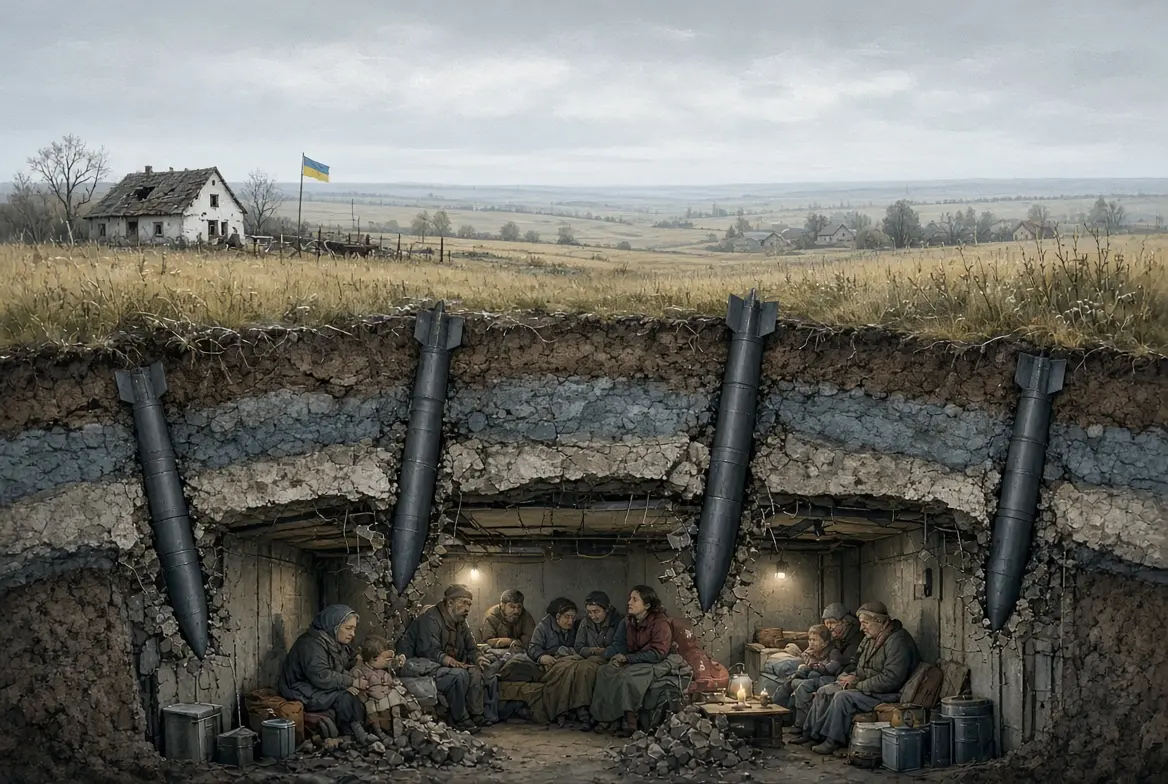
Russian bombs reached them even seven meters underground
Ukrainians are taking their schools underground to protect children, while Russia is attacking with bombs capable of destroying even fortified shelters. Ukrainian writer Andriy Kurkov starts from this unequal struggle in his Kyiv Post opinion piece published on November 15, which uses the tragedy at Komysh-Vakha to show the limits of civilian protection as long as Russian attacks continue.