
Eizenkot or chaos: where does government formation in Israel stand?
Ten days after the election, it is still unclear who will form a government in Israel, even though the numbers seem clear at first glance. Benjamin Netanyahu's right-wing religious alliance, which has governed the country since 2009 with one brief interruption, has lost its majority, and 67 of the 120 members of parliament would like his rival, former Chief of Staff Gadi Eizenkot, to become prime minister. President Isaac Herzog, however, has not rushed things: he will only announce on Sunday, November 8, whom he will task with forming a government, because in his view the majority exists on paper, but most of the parties are unwilling even to sit down at the same table with each other.
On Friday afternoon, before the Sabbath rest day, this is how things stand. Netanyahu remains in his post as caretaker prime minister and keeps insisting that the election was stolen from him. On Eizenkot's side, meanwhile, something few expected has happened: Avigdor Liberman, who has demanded the conscription of the ultra-Orthodox for decades, has announced that he is willing to give ground on this, just so that a government can be formed without the Arab parties. Whether anything will come of this, or whether Israel will vote again in the spring of 2027, will be decided in the coming weeks. On October 27, voters split parliament into three blocs, none of which reached the 61 seats needed to govern. Netanyahu's alliance won 53 seats, a major drop, since in the previous term his camp numbered as many as 68 MPs at one point. Eizenkot's opposition alliance of four parties won 48 seats, while the two Arab-led parties together won 19 - they have never been this strong before.
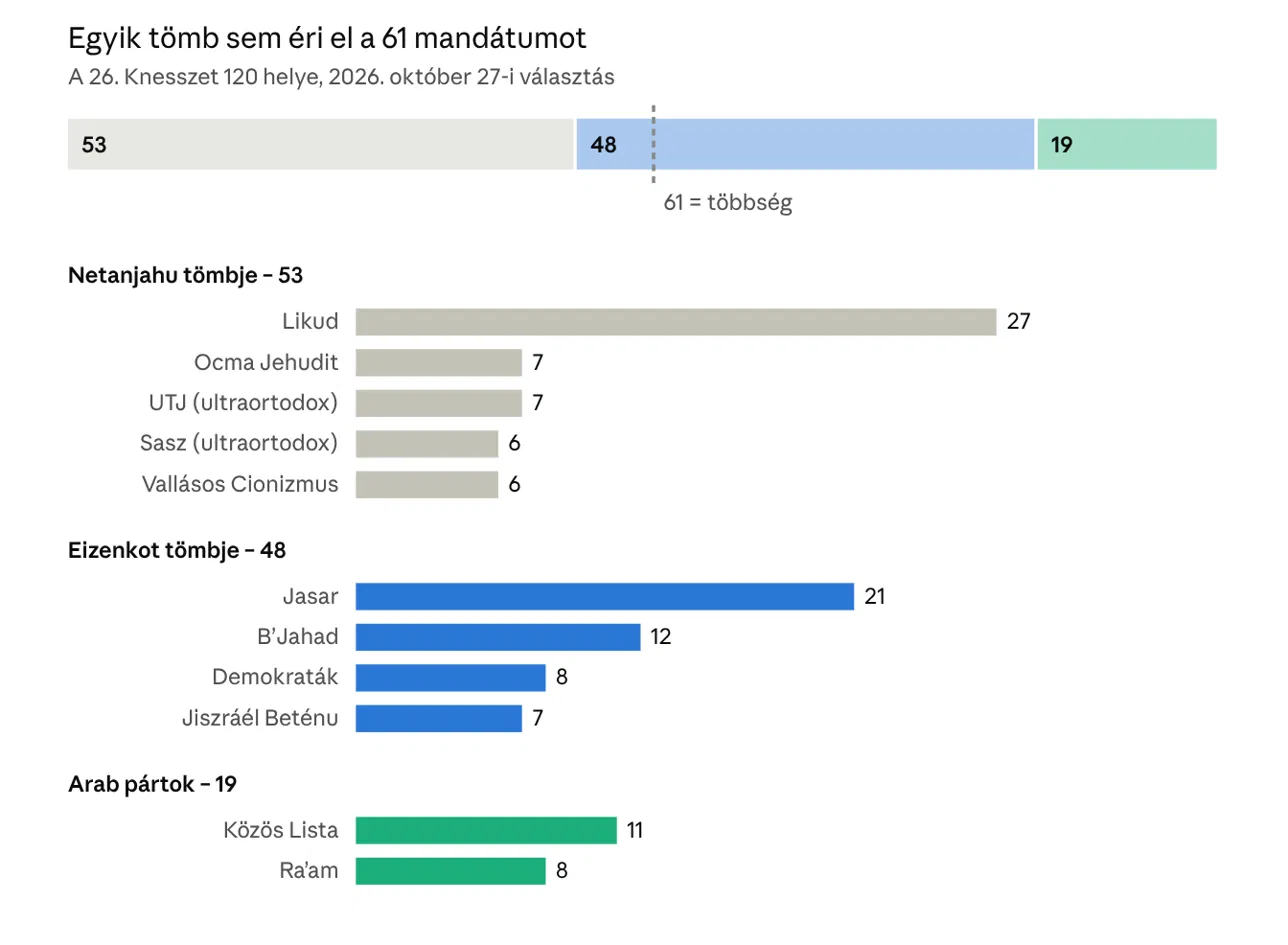
Two things complicate the situation. One is that Likud remains the largest party with 27 seats, while Eizenkot's party, Yashar, came only second with 21, so both camps can claim to have won. The other is that the 67-seat anti-Netanyahu majority only materializes if the Arab parties are counted in, and most of the opposition has so far refused even to consider governing with them. It's also worth knowing that the 12-seat B'Yachad is itself an alliance: Naftali Bennett's and Yair Lapid's parties merged in April, with Lapid running second on the list.
So why did this happen?
The most important explanation is turnout: this many people haven't voted in Israel since 1999, with 77.9 percent of eligible voters casting a ballot. Most of the increase came from Arab voters. While barely more than half of them voted in 2022, now nearly eighty percent did; the Arab parties won ten seats back then, and nineteen now - roughly the same number Netanyahu is now short of a majority. There are several explanations for why so many of them turned out. Crime has reached unprecedented levels in Arab towns, many feel the state does not care about them, and for four years they lived under a government that included the far-right party of Itamar Ben-Gvir and Bezalel Smotrich. The Joint List ran as a single list this time, unlike in 2022, when the split cost it votes, and Netanyahu's counter-campaign didn't hurt it either. According to the Joint List's leader, more than half of Likud's election-day posts targeted Arab voters, meant to drive right-wing voters to the polls, but it also mobilized Arab voters, while the right wing itself fragmented. Several smaller right-wing parties, including the Am Yisrael party founded by General Ofer Winter in August, failed to clear the 3.25 percent threshold; according to estimates close to Likud, about four percent of right-wing votes were lost this way, which largely explains the gap between the two camps.
The deepest cause, however, is military conscription, since ultra-Orthodox young men studying in religious schools have not been drafted into the army for decades. As long as there was peace, relatively few people cared about this, but since October 2023, when reservists were taken away from home for months at a time, more and more people have refused to accept this exemption. This issue splits Netanyahu's alliance in two: the ultra-Orthodox parties want the exemption enshrined in law, while most right-wing voters won't hear of it. In July 2025 the tension escalated to the point that United Torah Judaism and Shas left the government, but now ultra-Orthodox voters have turned out en masse precisely to defend the exemption, and their parties are no longer necessarily standing by Netanyahu. In the background there are also the old disputes: judicial independence, the future of the West Bank, the question of who is responsible for the October 7 failure, and the fact that Israel is increasingly seen as an enemy in more and more places around the world. None of this is new, but after the war years, each of these issues carries more weight.
Netanyahu has not conceded defeat; Likud announced as early as the day after the election, October 28, that the Arab parties had "stolen the election" through bribery and fraud, though the police say there is no evidence to support this. The party cites a few specific cases: on the morning of the vote, three activists were detained with an envelope full of cash, and two days later four more people were detained, all of whom, according to police, are linked to the Ra'am party. Ra'am denies any connection to the matter, and on November 1 a judge already questioned whether there were grounds to keep the suspects in further detention. Likud's real weapon, however, has become an intelligence investigation. At the request of Supreme Court Justice Noam Sohlberg, chairman of the Central Elections Committee, the Shin Bet, the internal security service, is investigating whether Qatari or possibly Turkish money was pumped into Arab towns to boost turnout. The head of the service, David Zini, who was appointed by Netanyahu and is considered close to the far right, spoke of roughly 100 million shekels. He wanted to question three leading Arab politicians, but the attorney general refused to allow it, deeming the evidence insufficient. The timing of the affair is also awkward: according to reports, the intelligence information was already available weeks before the election, yet Zini called the vote clean and secure on election day, and afterward briefed Netanyahu first, informing Eizenkot only after the letter about the investigation leaked.
State institutions have acted with striking unity. Sitting between the attorney general and the head of the Shin Bet, the chairman of the elections committee stated that even if the suspicions were confirmed, it would not change the overall integrity of the election. The committee certified the results on November 4, and Herzog accepted them; Qatar denies having funded any influence campaign. The irony of the affair is that several of Netanyahu's own office staff are under investigation over Qatari money. The story about a stolen election has a clear purpose: if suspicion falls on Arab votes, then any government relying on them becomes suspect too, making it increasingly difficult for Eizenkot to join forces with them. Netanyahu has gone so far as to call it treason if his rival were to ally with Arab parties; Eizenkot shot back that Netanyahu is running an organized campaign to discredit the election result. The tension is also visible on the streets: a few dozen people protested in front of Eizenkot's house in Herzliya against a Jewish-Arab government, while a larger crowd outside the president's residence demanded exactly such a government.
Gadi Eizenkot's party came only second, yet he is the election's biggest winner. The 66-year-old general was Chief of Staff from 2015 to 2019, is considered conservative on security issues, and lost his son in the Gaza war. If he becomes prime minister, he will be Israel's first Sephardi prime minister - the first whose family came not from Europe but from the Middle East or North Africa, since his parents emigrated from Morocco. This group has traditionally leaned toward Likud, which is why this carries symbolic weight. He founded Yashar in September 2025 and expects three things from any potential partner: recognition of Israel as a Jewish state, acceptance that everyone must perform military or civilian service, and support for dismantling Hamas. He refuses to govern together with Netanyahu in any form.
Benjamin Netanyahu remains in his post as caretaker prime minister until a new government is formed, and this carries considerable weight. Likud argues that it is still the largest party; Transport Minister Miri Regev told the president outright that, in her view, the mandate belongs to the leader of the largest party. Likud is pushing for a "broad national government" made up of Jewish-led Zionist parties, but when Herzog asked what they would offer in return, Education Minister Yoav Kisch had no answer. The party's faction leader, Ofir Katz, also ruled out Netanyahu sharing the premiership with anyone on a rotating basis.
Naftali Bennett and Yair Lapid's joint party, B'Yachad, is the opposition's second-largest force with 12 seats. They recommended Eizenkot, but according to Bennett, voters did not give them a mandate to govern with Arab parties, though they also don't want a unity government with Netanyahu. MP Merav Cohen put it this way: she has learned from past experience not to make deals with scorpions. Avigdor Liberman produced the biggest surprise of the week. The secular, right-wing leader of Yisrael Beiteinu has for years been known for refusing to sit in a government with either the Arab or the ultra-Orthodox parties. On Friday, however, he announced he was ready to compromise on the law concerning the conscription of the ultra-Orthodox. He justified this by saying a government of 61 needs to be put together that does not depend on the Joint List and Ra'am. He quickly shut down one rumor, though: he does not want to rotate the premiership with Eizenkot, arguing that such rotation harms the country's governance. Yair Golan's left-wing Democrats are more open to the Arab parties than anyone else in the opposition. According to Golan, the anti-Netanyahu parties need to govern together, and he has already discussed parliamentary cooperation with the Joint List. One of their new MPs told the president that anyone who believes a unity government can be formed with Netanyahu could just as easily be sold a used car by him.
Among the ultra-Orthodox parties, United Torah Judaism produced the biggest turnaround. On the instructions of its rabbis, it did not recommend anyone for prime minister - the first time since 2009 that an ultra-Orthodox party has not backed Netanyahu. Liberman's Friday announcement was immediately welcomed by UTJ chairman Yaakov Asher, who noted with satisfaction that everyone had become more flexible on the conscription issue. Shas is more cautious: it recommended Netanyahu, and its leader, Aryeh Deri, reportedly refuses to enter government without Likud. Among the Arab parties, both recommended Eizenkot, but in very different tones. Mansour Abbas's party, Ra'am, represents the pragmatic wing. It has accepted that Israel is a Jewish state, condemned the October 7 attack, supports the disarmament of Hamas, and promised not to interfere in defense matters, but it did not state that Hamas is a terrorist organization, even though Eizenkot made that a condition as well. According to Joint List leader Yousef Jabareen, the election was a choice between bad and worse. The party will not join a government that maintains the occupation of the West Bank, but according to Ahmad Tibi, they would support a minority government from the outside if it did not immediately fall apart.
President Isaac Herzog has a far greater role this time than usual. The law does not require him to task the candidate who received the most recommendations. He must choose whoever has the best chance of forming a government. Herzog does not hide that he would most like to see a joint national unity government of Likud and Yashar, and during the consultations he asked almost every party whether they could imagine this. He also told the far-right Otzma Yehudit's representatives openly that their statements about Arab voters sound racist. On Thursday evening, at the end of the consultations, the president announced the results. Eizenkot was recommended by parties holding 67 seats, Netanyahu by 46, and the seven-seat UTJ recommended no one. According to Yashar, no candidate has received this much support since 2015, yet Herzog is still waiting: he said the numbers might seem clear, but he has to decide who can actually form a government, and since the parties mutually rule each other out, this is far from obvious. Over the weekend, which is in any case quiet because of the Sabbath, he will hold personal talks with the party leaders.
On Sunday, three kinds of decisions could emerge, though the odds differ greatly:
Eizenkot gets the mandate.
This is the most likely outcome, and the Israeli press is almost unanimous in expecting it. He would then have 28 days to assemble 61 MPs behind a government. The president could extend this by another 14 days, meaning a deal would have to be reached by mid-December at the latest.Eizenkot gets the mandate, but Herzog publicly pushes for a unity government.
The president has asked every party about this, so it is likely he will bring it up when handing over the mandate as well. Legally this obliges no one, but politically it creates pressure. Yashar has already signaled that it will first try to put together its own "national emergency government."Netanyahu gets the first mandate.
This is unlikely. Likud argues that it is the largest party, but with 46 recommendations Netanyahu is farther from 61 than Eizenkot is, and not even his old ally UTJ backed him. If Herzog decided this way regardless, it would come as a major surprise.
The first test comes right after Sunday. On Tuesday, November 10, the new MPs will be sworn in, and parliament will have to elect a new speaker to replace Likud's Amir Ohana. The opposition wants to secure the post with the votes of the Arab parties, and Yair Lapid's name is mentioned most often; this will reveal whether the 67-seat anti-Netanyahu majority truly votes together.
The 67 recommendations for Eizenkot are only his ticket of entry. A government cannot simply be assembled from this, because a recommendation does not mean joining the coalition - the Joint List, for instance, certainly does not want to enter government. Eizenkot therefore either has to find new partners or convince the old ones to abandon one of their previous promises.
Here is how the numbers would work out in various scenarios:
A six-party government with the ultra-Orthodox (Yashar, B'Yachad, Democrats, Yisrael Beiteinu, UTJ, Shas): 61 seats.
What stands in the way: Shas recommended Netanyahu and Deri would not join without Likud, while Yashar and B'Yachad have not yet said they would give ground on conscription.A minority government with UTJ (Yashar, B'Yachad, Democrats, Yisrael Beiteinu, UTJ): 55 seats.
It would only survive as long as the Joint List and Ra'am abstain or support it in confidence votes.A government with Ra'am (the four opposition parties plus Ra'am): 56 seats.
Five seats are missing, and Liberman and Bennett don't want to rely on an Arab party.A Jewish-Arab "change government" (all six parties that recommended Eizenkot): 67 seats, or 60 without Liberman.
Liberman rules it out, the Joint List would not join, and it does not accept Eizenkot's conditions either. A national unity government with Likud (Likud, Yashar and other parties): the two big parties together hold 48 seats, and with further partners it could comfortably exceed 61. Eizenkot, Bennett and Golan would not govern with Netanyahu, and Likud has also ruled out rotation.
Friday's turn concerns the first scenario. Without Liberman's concession, the six-party government would have been only a theoretical possibility, since he had been the loudest voice demanding the conscription of the ultra-Orthodox for decades. Now that he of all people is willing to compromise, the matter depends on the ultra-Orthodox parties, which is why it matters that UTJ's chairman immediately welcomed the announcement, and why it is a big question what Shas, which has so far stuck by Netanyahu, will do. The difficulty, of course, is not only on the ultra-Orthodox side. Eizenkot promised during the campaign that he would not budge on conscription, and many of Yashar's and B'Yachad's voters backed them precisely for that reason. If they come to power at the price of a watered-down conscription law, many could see it as betrayal. The other path is a minority government or some form of Arab support, but because of the campaign about the stolen election, this is now even harder to embrace - even if the election itself cannot be annulled, Arab votes can be made to look suspect. Interestingly, according to a Hebrew University survey, 61 percent of opposition voters would accept even a government that includes Ra'am, only 20 percent would want a new election, and a mere 12 percent would favor a rotating unity government with Netanyahu. If a minority government is ultimately formed, there is precedent for that too. Yitzhak Rabin's government stayed in power in 1992, after Shas left, with outside support from the Arab parties, and that government signed the Oslo Accords - so Israeli politics has managed with such a government before.
What happens if everyone fails?
Israel's Basic Law allows three attempts at forming a government, and a new election is called only if all three attempts fail.
The first designated candidate, presumably Eizenkot, gets 28 days, which the president can extend by 14 days. If he fails, Herzog can task someone else. In practice this would be Netanyahu, who in the meantime would remain caretaker prime minister throughout, and he too would get 28 days. If that also fails, parliament itself can nominate someone supported by at least 61 MPs. That person would have 21 days. If that attempt fails too, the Knesset automatically dissolves and a new election is called, which would likely fall in the spring of 2027, with Netanyahu governing until then, even if not with full authority. This is the most unsettling part of the story: between 2019 and 2022, Israel held five elections in four years, and those years also showed that a stalemate tends to favor the sitting prime minister. A new election is an opportunity for Netanyahu even after losing this one, because a more unified right wing, with fewer lost votes, could bring his majority back. There is no good track record with rotating governments either. Shimon Peres and Yitzhak Shamir kept to their agreement in 1984, but the 2020 Netanyahu-Gantz deal quickly fell apart, and Benny Gantz never became prime minister. This is why Eizenkot's camp so fiercely rejects unity with Netanyahu, no matter how much Herzog might want it.
This election is about more than the fall of one government. Since 2009, Netanyahu's governments have been built on an alliance between the nationalist right and the ultra-Orthodox parties, and that model has now broken down. The alliance has shrunk to 53 seats, and its two halves disagree on conscription. Whoever forms a government will have to solve the same problem that brought down the previous one: how should the country distribute the burden of military service in a society that has lived in the shadow of war for three years? Pressure is also growing from outside. This week it was reported that, according to Donald Trump, the United States will end the four-billion-dollar annual aid it gives Israel at the end of the year; Herzog said the news hit like a bolt out of the blue. In such a situation, it is especially costly for a country to operate with a caretaker government for weeks or months. According to analysts, even a government led by Eizenkot would not fundamentally change Israel's foreign and security policy, but would rather bring change in domestic politics: in judicial independence, in the investigation of the October 7 failure, and in whether the votes of Arab citizens count for as much as anyone else's.
The schedule for the coming days is set. On Sunday Herzog will name whom he is tasking with forming a government; on Tuesday the speaker election will reveal how well the anti-Netanyahu majority holds together, after which bargaining with the ultra-Orthodox can begin. Netanyahu has not won this time, but Eizenkot has not yet triumphed either; the coming weeks will decide which of them has to give up something they have so far said they would not budge on.
Anna Karczag
Did you like this article?
Support our work with a small donation
Secure payment via Stripe • Min. 2 EUR
Gesta recommendations:

The drones are already attacking, while the PSD wants to renegotiate air defense
Romania received 16.68 billion euros in preferential EU loans for military equipment and strategic infrastructure, with the first 2.5 billion euros arriving back in August. Mihai Ghigiu, the PSD's minister for European investments, now wants to reopen the 5.7-billion-euro package of contracts signed with Rheinmetall, even at the cost of financial penalties. As it happens, the package also…

Nazare would cut spending too. That's how Bolojan started as well
According to Alexandru Nazare, Romania could get a red card from the credit rating agencies if the 2027 budget again promises more than the country can pay. This time the finance minister is asking the ministries for savings, and we're right back at the scene where the PSD walked away from the government table last spring.

Bomb scare, a refrigerator at fifty degrees, but only whispers about Moscow
The Russian far-right Male State movement denies having any connection to the bomb threats across Europe that led to diverted flights, scrambled fighter jets, and, by Friday, even evacuated newsrooms. The same week, food had to be thrown out in eight European countries because someone remotely turned up the temperature in store refrigerators. Meanwhile, the Pentagon warned several allies to tone…

We're Overthrowing the System, But First, Ten Push-Ups
The boy wants to rebel, and it would be nice to finally belong somewhere too. Among Italy's neo-fascists he is promised both, though it soon turns out that their first rule of rebellion is that he may speak only when spoken to. Andrea Oriente's debut novel follows the fifteen months it takes the boy to realize what he actually got in exchange for his obedience.
On video: Toroczkai betrays his nation
More details and interpretation: