
Moldova shows once again what it means to take the country's defense seriously
Moldova keeps adopting measures that one would rightly expect from a NATO member state if it took its own security seriously. When it had to defend its elections from Russian interference, Chișinău uncovered networks, tracked money flows and strengthened its defenses with foreign partners; now it wants to draw on Ukraine's wartime experience to protect its airspace. On October 26, the two countries signed a military-technical cooperation agreement in Kyiv, while also discussing the development of energy links and the transport routes indispensable for Ukrainian exports.
Moldova is not a NATO member, yet its leadership seems to understand that the country's security must be tailored to actual threats, and that the knowledge, tools and allies needed for defense must be sought out. This approach was already evident in its response to Russian election interference, when authorities had to confront vote-buying networks, disinformation, cyberattacks and attempted provocations. The election observation report of the Parliamentary Assembly of the Council of Europe, covering the 2024 and 2025 experience, listed vote-buying linked to Ilan Șor, fake media content, bot farms, bomb threats and groups prepared for street provocations. According to EU documents, Moldova strengthened its cyber defense, internal security and detection of illegal money flows with European help, and in June 2025 it even ran a joint exercise with the European Commission to handle digital attacks threatening the elections. Chișinău, in other words, backed up the warnings with institutional preparation. Working document
The agreement now signed in Kyiv carries the same practical approach forward into the field of military defense. Moldovan Prime Minister Vasile Tofan and his Ukrainian counterpart, Serhii Koretskyi, announced the cooperation at a joint press conference, which creates an opportunity to transfer defense experience. Moldova is particularly interested in anti-drone defense, an area in which Ukraine has built up exceptional expertise due to daily Russian attacks. According to Tofan, Moldova's airspace has been violated more than a hundred times since the Russian invasion began in February 2022, and drones as well as munition fragments have landed on the country's territory. The prime minister is therefore looking for effective and affordable solutions that would allow Moldova to defend its own airspace, and he considers Ukrainian developments and battlefield experience especially valuable for this purpose. This is a fairly obvious choice for a country with limited resources that borders directly on Europe's largest war. Ukrainians constantly have to adapt to Russian drones, to changing attack methods and to mass strikes, so the cheaper defense procedures they have developed could also matter for Moldova. The report on the meeting did not specify any concrete weapons purchase or deployment timeline, but the direction of cooperation was clearly set out.
Kyiv also offered closer cooperation in demining and proposed expanding Moldova's participation in the demining coalition that coordinates international support for Ukraine. Koretskyi linked the agreement to the two countries' shared European Union aspirations, stressing that Moldova's security also matters for Ukraine's, and that both countries' accession would strengthen stability across the entire region. Meanwhile, the Moldovan prime minister was also unequivocal on the question of Russian responsibility: he called for a just and lasting peace in Ukraine, stated that Russia must answer for its actions and must return the Ukrainian children it has abducted. He also confirmed that Moldova will continue its political, diplomatic and humanitarian support for Ukraine. The talks in Kyiv, however, covered cooperation far broader than air defense, since Russian attacks also continuously threaten the security of trade routes and energy supplies. Ukraine therefore asked Moldova to extend into 2027 the fifty-percent tariff discount on the rail transit of Ukrainian goods, which was agreed in August to run until the end of this year.
According to Koretskyi, the intensifying Russian attacks on Ukrainian ports make safe alternative routes necessary, and transit through Moldova is already playing an increasingly important role: he said that in the first eight months of this year the volume of goods carried in transit tripled. The Ukrainian prime minister argued for keeping the discount by saying it benefits both countries, since it provides revenue for Moldova and a more predictable, more diversified export outlet for Ukraine. To boost capacity, he also raised the idea of deploying Ukrainian locomotives and rail crews on the Ocnița–Berești section, and offered to share the experience Ukrainian railways have gained during the war. This includes repairing damaged infrastructure and quickly restoring traffic, which has become one of the basic conditions for keeping the country functioning amid repeated attacks. They also discussed modernizing border crossings and expanding joint inspections, with particular attention to the temporary bridge at Yampil–Cosăuți, whose main works they hope to finish by the end of the year. Developing road and rail links can help not only exports but also investment and Ukraine's future reconstruction.
A similar logic applies in the energy sector, where the two countries want to reduce their vulnerability through more interconnections and mutual assistance. Koretskyi thanked Moldova for the ninety-percent discount on the entry tariff for gas transit and noted that Ukraine's underground gas storage facilities are also available to Moldova. According to Tofan, the two sides want to speed up the signing of a cooperation memorandum between the power grid operators Moldelectrica and Ukrenergo, and to prepare the construction of a second circuit on the power line running near the Dniester hydroelectric plant. The Moldovan prime minister said this could increase the electricity transmission capacity between the two countries by 500 megawatts. They also discussed cooperation on the gas market and coordinated management of the Dniester's water flow, but no agreement on the purchase of Ukrainian gas was announced after the visit. The Moldovan delegation included Deputy Prime Minister for Infrastructure and Regional Development Vladimir Bolea, Defense Minister Anatolie Nosatîi and Energy Minister Dorin Junghietu, and in the evening Tofan also met with President Volodymyr Zelensky. That meeting likewise covered infrastructure, energy links, airspace defense and public security.
Moldova's options are limited, but the threats are very real, which makes it especially notable how consistently Chișinău links together the protection of elections, military preparedness, energy supply and the functioning of transport networks. A country's sovereignty must be defended in these areas too, and Moldova's leadership clearly believes that it is worth learning from its Ukrainian neighbor's experience as soon as possible, while there is still time to prepare.
Ugar
Did you like this article?
Support our work with a small donation
Secure payment via Stripe • Min. 2 EUR
Gesta recommendations:
Even Hungarian-majority localities could disappear in the administrative reform – why is the RMDSZ staying silent?
The RMDSZ's behavior regarding the territorial-administrative reform floated by Grindeanu is becoming increasingly strange. After the news first broke, a deep silence surrounded the matter — maintained not only by our one and only party, but also by its lackey press. Then Hunor said something to the effect that they would wait and see, that they might support it or might not, but in any case no…
A snapshot of a budding bromance: Putin called Musk a genius
According to Vladimir Putin, Russia closely cooperates with its American space industry partners, including Elon Musk, despite political disagreements, whom he called "a brilliant man". The Russian president praised the SpaceX founder at an exhibition in Moscow, just one day after Musk justified restricting Starlink's military use in Ukraine by citing the risk of Russian destruction of satellites.
First the election, then Iran: Washington may be preparing new strikes
The United States has warned several Gulf Arab states, through diplomatic and military channels, to prepare for a "short but intense" campaign against Iran after the November 3 U.S. midterm elections. According to the Wall Street Journal, Donald Trump has not yet made a final decision, but is leaning toward a large-scale strike that would also target Iranian infrastructure and nuclear facilities.
Trump would reconnect Europe to Russian gas
In 2018, he was still scolding Germany for relying on American military protection against Russia while funneling billions to Moscow through its energy purchases, but now his negotiators have raised the idea of reviving Russian gas sales to Europe, and even restoring Nord Stream, as an economic incentive for a war settlement.
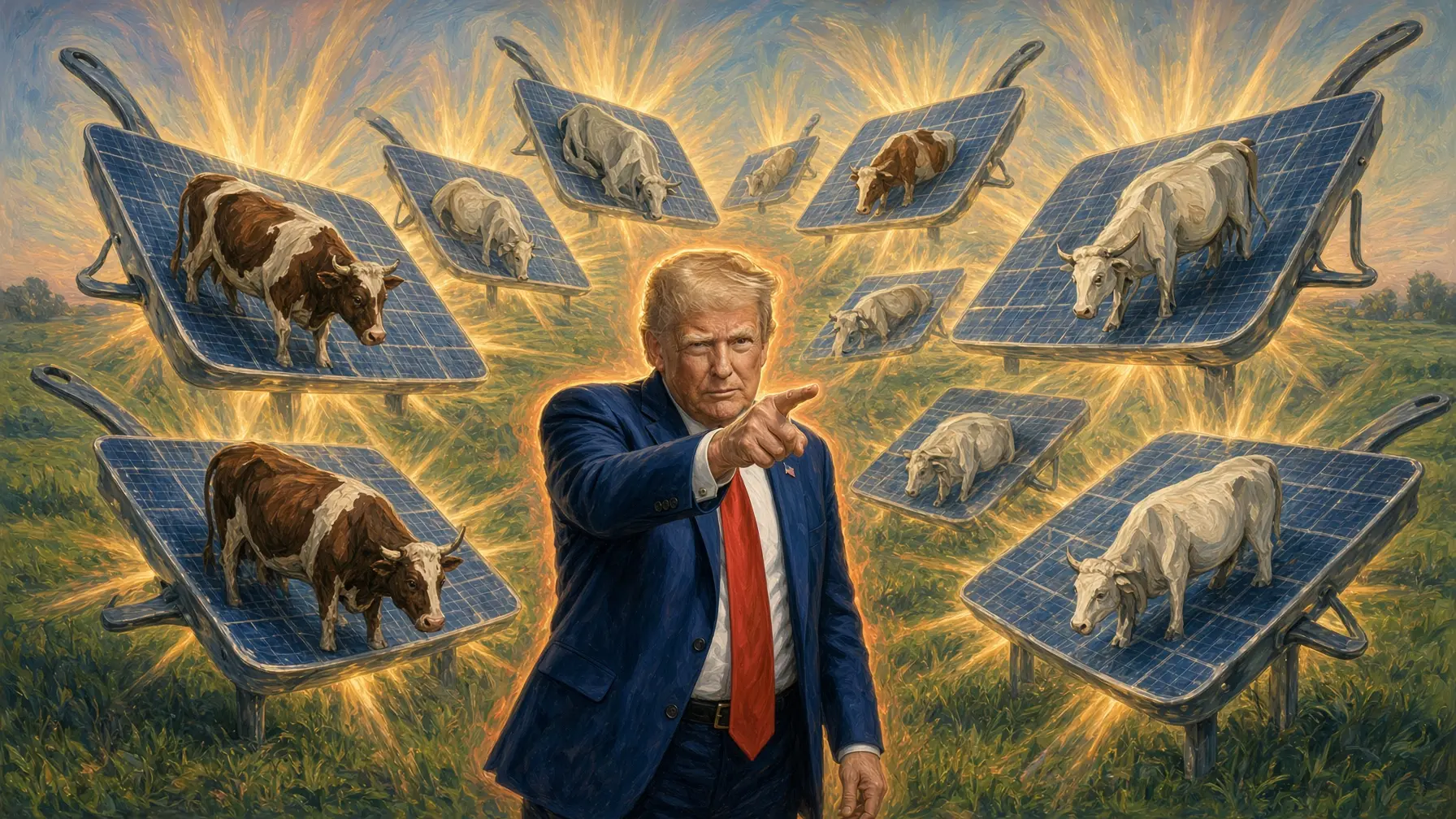
Trumpiad for today: solar panels are frying animals
Donald Trump has identified yet another threat to American wildlife: solar panels, which he claims are a hundred times hotter than a stove and fry any animal that jumps on them. The president of the United States shared this peculiar energy discovery at a campaign rally in Texas, declaring that the black panels “kill all the animals.” The story so far has not explained why America's entire fauna…