The art of "adormire": the system caught Georgescu again, then let him go
An average Romanian citizen accused of swindling a businessman out of 1.1 million euros, whose case is being handled by DIICOT, the anti-organized-crime prosecutor's office, would likely spend the standard thirty days of pretrial detention in a Bucharest holding cell before he could even calculate how many tenths of a percent are left on his Swiss bank account. Călin Georgescu is not an average Romanian citizen.
On Monday morning he was still being pulled out of traffic by special forces officers; by evening he was walking across the courtyard of DIICOT in handcuffs, arms raised. On Tuesday, Vlad Andriescu, a judge at the Bucharest Tribunal, rejected the prosecution's motion for thirty days of pretrial detention and placed him under judicial supervision instead. He ruled the same way in the case of the alleged accomplice, Ionel Rusen. The decision can be appealed, and the prosecution is likely to do so — meanwhile, the faithful livestreaming on TikTok in front of the courthouse steps can celebrate.
This fact alone is enough to make one wonder: how far does the reach extend of Romania's deep state, that network of former secret police officers turned pro-Russian sovereigntists? The answer, at least in part, is right in front of us. Just look at who made the decision: Vlad Andriescu's name is not unknown to those who follow the legal adventures of Romania's sovereigntist ecosystem. He is also the judge in the criminal case against Dan Dungaciu. Dungaciu, a political scientist known for his pro-Russian rhetoric and now the AUR's second-in-command, was brought before the court in April 2024 on charges of abuse of office. Andriescu announced his ruling in the preliminary phase of the case on September 23, 2024; by law, he was required to write the reasoning within thirty days. He failed to do so for more than a year — until any potential criminal liability had already expired. The reasoning was finally completed two weeks after G4Media reported in December 2025 that it was still missing. He has other memorable rulings to his name as well: in 2018, he allowed Florin Secureanu, the former, indicted director of Malaxa Hospital, to travel to Italy — a decision later overturned by the court of appeal — and in the same year he rejected the arrest of the Bonciu brothers, who were suspected of murdering two factory guards. Andriescu is not, incidentally, a judge who never sends anyone into pretrial detention; in 2012 he was the one who ordered the arrest of a PDL member of parliament. It's only in sovereigntist cases that he somehow turns understanding, as if that were some established legal standard.
Now let's look at what he so easily let go. According to DIICOT's motion, Georgescu "coordinated the entire criminal activity." The story began at the end of 2021: Răzvan Leu, a businessman from Buzău, was promised a six-million-euro loan from Wealth Bank, a paper company registered in the Comoros, if he first transferred 1.1 million euros in collateral to a Swiss bank account. He did. The loan never came. According to prosecution documents cited by G4Media, the money traveled through a Russian-controlled bank to accounts belonging to Rusen's wife and to Italian national Massimiliano Arena, and, according to Leu's complaint, part of it ended up in Georgescu's 2024 presidential campaign. Meanwhile, another businessman came forward: he had paid 450,000 euros for a 200-million-euro credit line that also never existed. During the house search, investigators found jamming devices, passports believed to be forged, and two diplomatic passports apparently issued in the name of the Order of Malta. The Order stated not only that it never issues such documents, but that forgeries of them are currently circulating in connection with financial fraud schemes. So the nation's Orthodox savior was posing as a fake Maltese diplomat — roughly equivalent to a populist leader in Budapest presenting himself as a Vatican investor at a Csíki beer company.
Wiretaps obtained by the prosecution have also surfaced, revealing quite a different side of the nation's sovereign. On May 27, 2025, just days after the repeat presidential election, Georgescu told Rusen:
"Now I can tell you, because until now I couldn't. My mission was to expose everything. The entire system! In the end, Simion too."
In other words, the saint of AUR voters — whose political heir, George Simion, ran in the presidential election as his successor — was secretly planning to bring him down too, "in the end." In the same conversation, he urged Rusen to move to Italy until he himself became president. According to G4Media's sources, he himself was preparing to seek political asylum in Italy and had picked out a one-million-euro villa in Tuscany, which he wanted "at any price," complete with a separate outbuilding "for the servants." In another recording, Rusen told him he had spoken with "Matteo" — meaning Matteo Salvini — who said he wouldn't openly support him but would, at most, say that democracy in Romania was over.
The most revealing detail, however, is not this, but a subordinate clause in the prosecution's documents. Georgescu knew about the investigation and believed the case was "dormant." He said he had received some kind of "feedback" about it, and that "there is no evidence at all." Elsewhere he stated that everything around his cases had been "smoothed over" and that "no front is attacking anymore." Where did he get feedback about a case being handled inside an investigative authority? Who smoothed it over? No one has openly asked this question yet, even though it is the key to the whole story — because the chronology of the case is itself an indictment of Romanian justice.
Leu filed his complaint on July 19, 2022, with the prosecutor's office attached to the Bucharest Tribunal. According to the documents, he did so at the initiative of Ion Negoescu, a former Interior Ministry officer who is now an honorary priest — and Georgescu's name did not even appear in the complaint. It was Negoescu who had introduced Leu to Georgescu. Prosecutors questioned the victim once, on October 24, 2022, and then nothing happened for two years. On January 31, 2024, Leu turned to the DNA, the anti-corruption prosecutor's office, this time naming Georgescu as well — and no one was questioned there for five months. In May 2024 he also filed a complaint with DIICOT. His questioning finally took place on November 18, 2024 — six days before Georgescu won the first round of the presidential election.
So Georgescu won the first round with at least two open criminal cases against his name, in one of which the victim claimed that part of his money ended up in the campaign. The documents of the Supreme Council of National Defense, declassified as the basis for the Constitutional Court's December 6, 2024 annulment of the election, did not even mention these cases. DIICOT later took over and merged the files; in early 2025 it ordered wiretaps on Rusen's car, and by the end of last August it requested a financial expert analysis of the banks' money transfers — after which there was silence again for a year. From the filing of the complaint to Monday's house search, four years, two months and two days passed in total, and for more than half of that time — two years and five months — the case simply slept in a drawer. Then, when the day finally came, the pretrial detention request got stuck with a judge for whom deadlines seem to be more of a suggestion.
This is the point where talk of a Romanian deep state stops being a conspiracy theory and becomes a pattern. It doesn't require a secret lodge or orders from Moscow — it's enough to look at what these four years reveal: a case that somehow always falls asleep whenever it should wake up; a former Interior Ministry officer whose initiative results in the most important name being left out of a complaint; a defendant who receives "feedback" about his own file; an intelligence report that fails to notice open criminal cases; and a judge with whom sovereigntist defendants' cases always seem to land more softly. The successor networks of the Securitate did not disappear after 1990 — they simply changed clothes: first they became businessmen, then saviors of the nation, and today their best connections lead straight to the Kremlin. Georgescu's career began within the institutions of the former regime, and according to his wiretapped conversations, he still knows exactly who "smooths things over."
Meanwhile, on TikTok, mourners weep for the "savior of the nation." One argued: "What did Călin Georgescu do? He didn't steal from the people, he was never in government." True, he was never in government. According to the prosecution, he stole from a businessman in Buzău, using two fake diplomatic passports, in pursuit of a villa in Tuscany, all while his followers believed he was fighting for them. And the judge sent him home to wait, under supervision, for the next file to be put to sleep.
Ugar
Did you like this article?
Support our work with a small donation
Secure payment via Stripe • Min. 2 EUR
Gesta recommendations:

32 percent: the bill presented to Trump at the gas pump
Democracy has its own peculiar form of justice: slow, clumsy, sometimes maddeningly delayed, but it arrives in the end - and now Donald Trump's Middle East war has brought the bill. According to a four-day Reuters/Ipsos poll that closed on Sunday, the president's approval rating has fallen to 32 percent, the lowest of his entire political career. Esteemed American public opinion has come to this…
What now? Grindeanu would team up with Simion, Hunor with Grindeanu
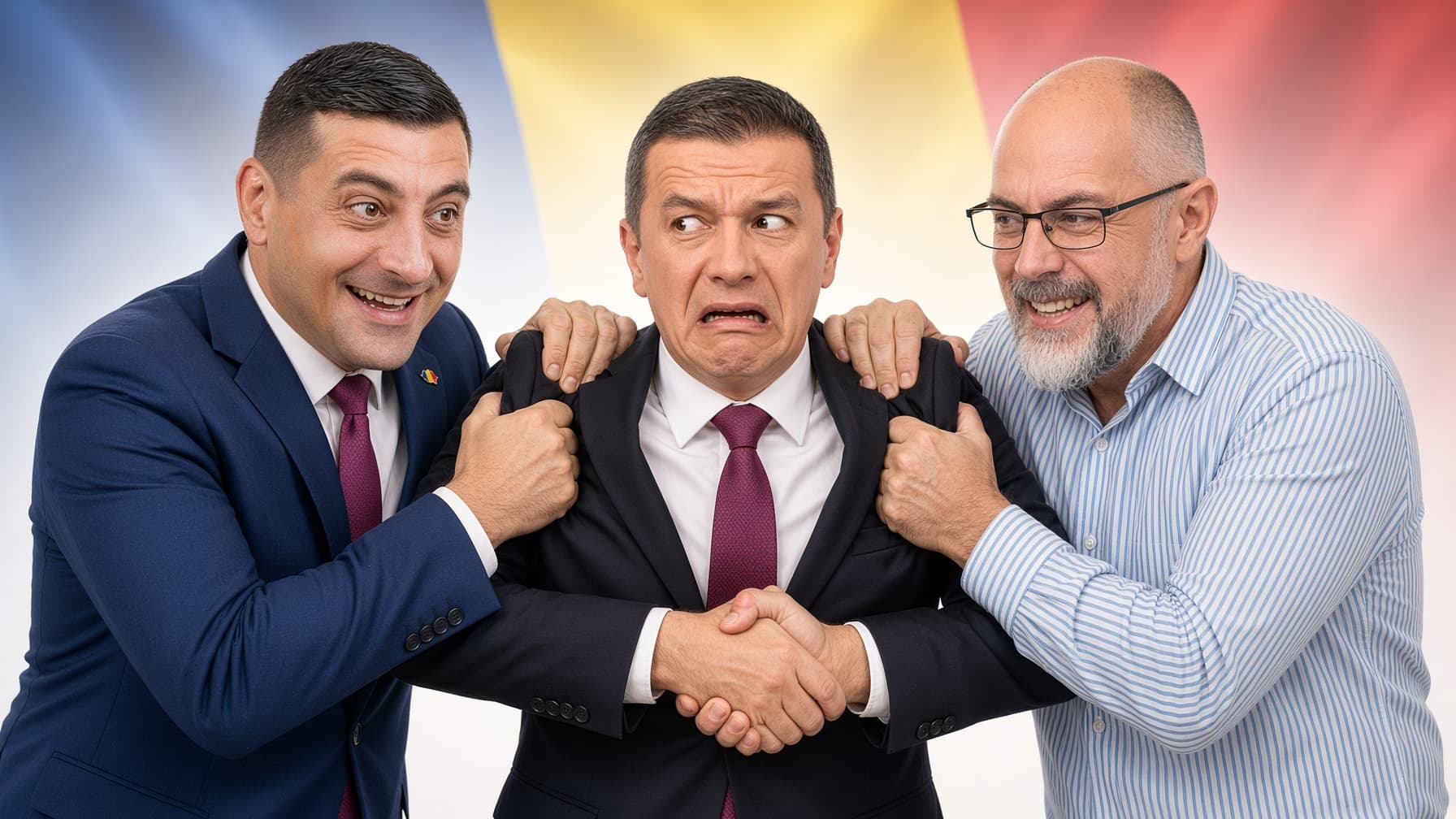
In Romania, the health cordon works like hospital disinfection: on paper it's everywhere, in practice who knows. On Monday evening, in the Antena 3 studio, Sorin Grindeanu, the leader of the Social Democratic Party (PSD), said out loud what an entire country had already suspected but no one had heard so plainly before: he does not rule out a PSD–AUR government. "I wouldn't rule out this option.…

"It's my duty" – Trump, the White House's self-appointed high priest, bans the unbelievers
On Monday in New York, after his meeting with Mayor Zohran Mamdani, Donald Trump explained why he will no longer let reporters from CNN, MS NOW and Politico into the White House. The justification was neither legal nor political, but downright liturgical: "If they're going to write fake news, I feel that's my obligation to not let them back into a very special house." The White House, he added,…

On Ukraine, Péter Magyar picks up right where Viktor Orbán left off
In parliament today, Bence Rétvári tried to put Péter Magyar on the spot by claiming that MOL is negotiating with Ukraine's Naftogaz to build a fuel storage facility near the Hungarian–Ukrainian border. Magyar's response was not to say let's look at what the Ukrainians proposed, how much it would cost, who would pay for it, and what benefit Hungary would get from it. No. He got outraged,…
Georgescu robbed his own Romanians as a member of an international crime ring
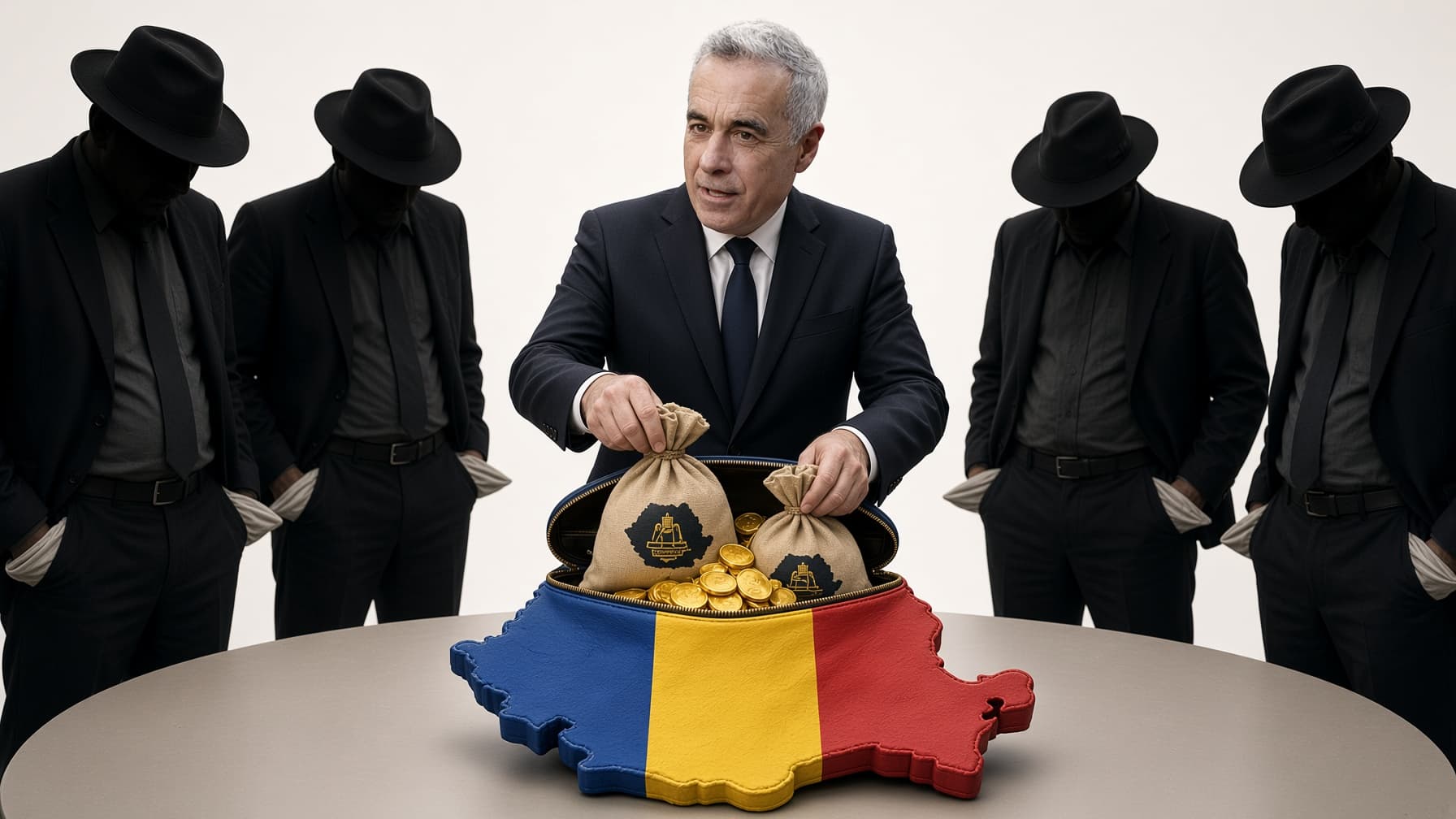
On Monday evening, Călin Georgescu, the winner of the first round of Romania's 2024 presidential election that was manipulated by Russia, was taken into custody for 24 hours. DIICOT (the Directorate for Investigating Organized Crime and Terrorism) will request a thirty-day pretrial detention for him — this time, however, not in connection with the case concerning attacks on the constitutional…