
The European Commission expects Romania's economy to contract instead of grow, while inflation will also be higher than hoped
Romania's economy could shrink by 0.3 percent this year, while average annual inflation may reach 7.9 percent, according to the European Commission's autumn forecast published on November 17. Back in spring, Brussels was still projecting modest growth of 0.1 percent and inflation of seven percent, but the current assessment shows that budget austerity, rising prices and uncertainty are weighing on the economy more heavily than expected.
The downturn is largely due to the fact that households have less money to spend, while companies have also become more cautious about investment. According to the Commission, economic output fell both in the last quarter of 2025 and in the first half of 2026, with household consumption dropping by more than two percent—a result of the freeze on public-sector wages and pensions, as well as inflation, which in the meantime climbed close to ten percent. Private investment, meanwhile, was held back by prolonged political uncertainty and rising energy prices, so the weakening demand could only be partly offset by state-funded development projects financed from the EU recovery fund. Brussels expects stabilization in the second half of the year, but according to the forecast, the country will only emerge from its mild recession in 2027, when GDP could grow by 1.8 percent, with growth accelerating to 2.2 percent in 2028. Next year's outlook is thus weaker than expected in spring, when growth of 2.3 percent was projected for 2027.
The improvement could be helped by slowing inflation and certain pension and public-sector wage increases, which may again boost households' purchasing power, while a more predictable political environment could also strengthen investment appetite. However, as projects financed from the recovery plan wind down, an important pillar of support will weaken, and its place should be partly taken over by better use of cohesion funds and a revival in private investment. The labor market is also showing signs of a slowdown, which is why the Commission expects unemployment of 6.7 percent this year, potentially falling to 6.4 percent in 2027 and 5.8 percent in 2028 as the economy picks up. Meanwhile, the purchasing power of wages has also been eroded by inflation over the past two years, so the later increases may partly make up for the losses suffered. Price growth was accelerated by last year's VAT and excise tax hikes, as well as the removal of the household electricity price cap, compounded this year by rising oil prices and the drought that has also hit electricity production. Average annual inflation, calculated according to EU methodology, could ease to 4.4 percent next year and 3.8 percent in 2028, meaning prices would continue to rise, just more slowly; the Commission also expects the 2028 introduction of the ETS2 emissions trading system for buildings and road transport to have an effect that will slow the decline in inflation.
Fiscal austerity is improving the state budget balance, but it has not yet halted the growth of debt. Last year's deficit of 7.8 percent of GDP could fall to six percent this year, 5.8 percent next year, and 5.6 percent in 2028, while public debt could rise from an estimated 60.7 percent of GDP in 2026 to 64.2 percent by 2028, as the state continues to borrow significant amounts and interest payments keep straining the budget. Among the more favorable prospects is the start of production at the Neptun Deep gas field in the Black Sea, which could support growth and improve the country's external balance, mainly from 2028 onward. At the same time, the Commission warns that a new political crisis, weakness in export markets—especially in the automotive industry—or persistently high energy prices could easily derail this trajectory, meaning the recovery outlined here still depends heavily on how predictable the coming years can be made.
Fallow Land
Did you like this article?
Support our work with a small donation
Secure payment via Stripe • Min. 2 EUR
Gesta recommendations:
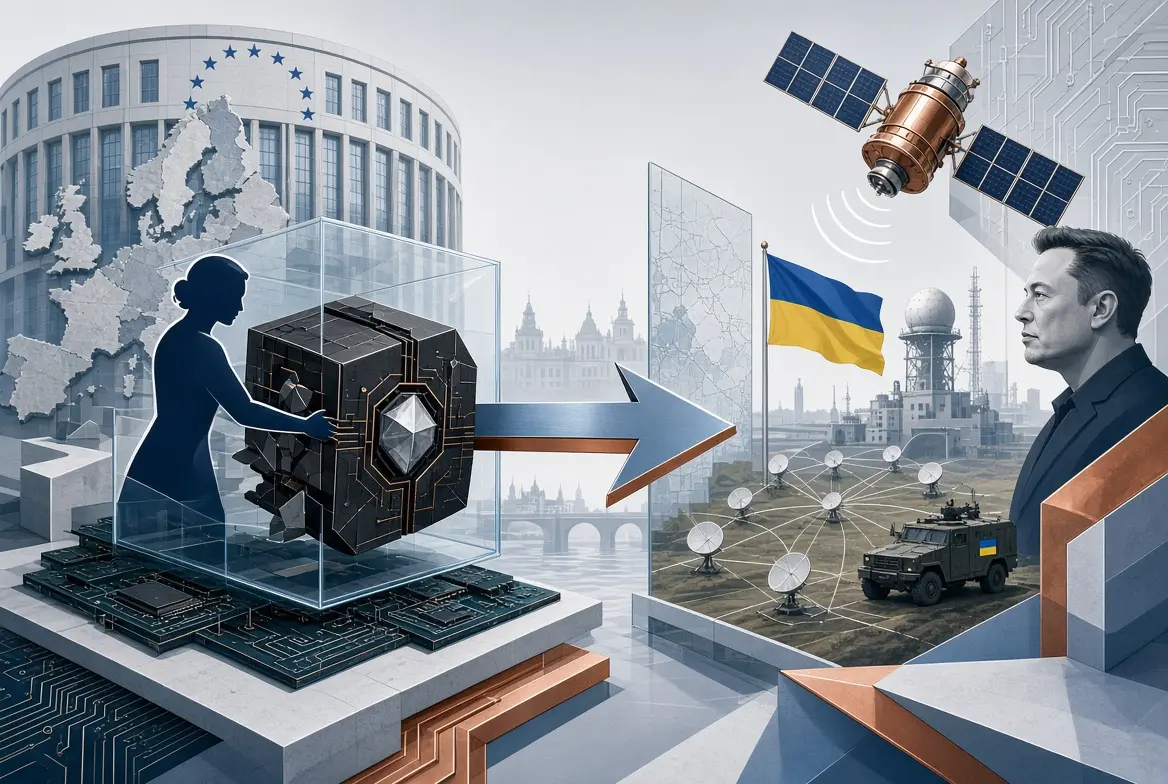
Europe wants to replace Palantir, Musk showed why in Ukraine
European defense ministries want to reduce their dependence on key military tasks on the American company Palantir Technologies and other American technology firms, and an increasing number of European companies are competing for the market being vacated. Germany, France and the Netherlands are all building their own European systems for what Palantir's software has been used for or would have…
We receive the chemicals that disrupt our hormonal system even before we are born
Chemicals that disrupt the human hormonal system are now present almost everywhere in our environment: in plastics, cosmetics, toys and pesticides, and researchers have detected them in human blood, breast milk and umbilical cord blood. This means that exposure begins even before birth. This is revealed in a joint report by the United Nations Environment Programme (UNEP) and the World Health…

Oops: NSA's secret network goes down
A few days after Microsoft's worldwide outage and the flight ban that paralyzed American airports, service was also interrupted in one of the United States' most sensitive IT systems: the strictly classified internal network through which employees of the National Security Agency (NSA) share classified information went down. No connection has so far been established between the failures, and at…

Lasconi would support an alliance between the PNL and the USR, but fears that everyone will once again want too much
Elena Lasconi believes it would do Romania's right wing good if the PNL and the USR joined forces and tried to win back the trust of voters disillusioned with the parties under a new name, but she is less convinced that such an agreement could actually come about. The former USR leader explained her doubts by drawing on her own experience from her presidential campaign, recalling that in…

20 years in the EU: Negrescu calls for a new European plan for Romania
Twenty years after Romania and Bulgaria joined the European Union on January 1, 2007, Victor Negrescu, the PSD vice-president of the European Parliament, says Romania needs a new European programme that unites the political class and civil society. “We need a new European project for our country, a European plan for Romania,” he said at the European Parliament's building in Brussels, at the event…