
Europe wants to replace Palantir, Musk showed why in Ukraine
European defense ministries want to reduce their dependence on key military tasks on the American company Palantir Technologies and other American technology firms, and an increasing number of European companies are competing for the market being vacated. Germany, France and the Netherlands are all building their own European systems for what Palantir's software has been used for or would have been used for so far: integrating and analyzing battlefield data and speeding up decisions with the help of artificial intelligence.
The switch comes at a price, however: according to government and military officials, no European system currently matches Palantir in scale, deployability and battlefield experience. Armies therefore have to choose between a less mature European system under their own control and a proven American product that, in the long run, comes with a strategic dependency that fewer and fewer consider acceptable.
Germany has gone the furthest. The Bundeswehr plans to start rolling out its own AI-based military data integration system next year, and according to a source familiar with the matter, it has narrowed the options down to a few candidates, none of which is Palantir. According to the source, these systems don't match Palantir's capabilities, but they would be "good enough": they would protect Germany's data sovereignty and, within a year, would be able to perform roughly eighty percent of the required functions. The German army has previously stated that it will not sign contracts with American companies, including Palantir, and Thomas Daum, commander of the cyber defense forces, has said that it is currently "simply unimaginable" for employees of a private company to have access to the national military database. Berlin has not named the companies on the shortlist, but the candidates may include the French firm ChapsVision. The Netherlands has been using Palantir software on a smaller scale since 2010, but wants to switch to a full-fledged European alternative within two years. Derk Boswijk, the Dutch State Secretary for Defense responsible for arms procurement, told Reuters that the switch will likely combine solutions from Dutch and other European suppliers.
“In Europe we have a great deal of knowledge in artificial intelligence and decision-making. But it is very fragmented, and that's the problem”
– he said. France is building a sovereign, multi-vendor platform called Arcadia, and plans to award the first contracts before the end of the year, with a field-deployable version expected by mid-2027. Britain, Denmark and Switzerland also have reservations about the company: a British parliamentary committee called Palantir's presence in the public sector an "unacceptable weak point," while Switzerland has rejected at least nine of its bids over security concerns.
Among the European challengers, the best known is the German company Helsing, which unveiled its "agent-based intelligence platform" called Clarity on November 11. According to the company, the system was developed in Europe and runs on the client's own infrastructure rather than in an American cloud, and according to Reuters, any strike requires approval from a human operator. Helsing says it could hand over the first version of the system within a few months to the German army brigade stationed in Lithuania, which is defending NATO's eastern flank. Other competitors include the Danish company Systematic, the French firms Thales and Safran, and the Paris-based startup Comand AI.
Europe's concerns are not fueled by theoretical debates but by what has been seen in Ukraine. The backbone of the Ukrainian army's communications is provided by Elon Musk's SpaceX satellite system, Starlink, and its military version, Starshield, and in recent years Musk has repeatedly shown that he is willing to use this power. According to Musk's biographer Walter Isaacson, in the fall of 2022 the tech billionaire refused to let Starlink operate near Crimea, thereby thwarting a Ukrainian attack on the Russian fleet at Sevastopol. In 2025, Reuters reported that American officials threatened to cut off Starlink to Kyiv during negotiations over a rare earth minerals deal, and this past October, speed limits were imposed on Starshield terminals without warning: according to Serhii Beskrestnov, a military technology advisor to Zelensky, the connection dropped above 161 kilometers per hour, causing several Ukrainian drone missions to fail. The restriction hit hardest exactly those drones that Ukraine uses to try to intercept Russian jet-powered Shahed drones. When Ukrainian Digital Minister Mykhailo Fedorov asked for the restriction to be lifted, Musk replied that Starshield is government-owned, and that decisions on restrictions are made by "the US military and ultimately the president" – the disruptions returned again in November, during the peace talks in Abu Dhabi.
This is the point where it becomes clear why Mosley's promise does not reassure Europe. Palantir's chief told Reuters in October, right at the time of the Starlink disruptions: "There are no kill switches. Neither Palantir nor the US government can intervene or shut it down." Ukraine, however, has just learned that the promise of an American company is only worth as much as current politics in Washington allows. If, in the middle of a war, a billionaire or a president can restrict an allied army's communications with a single decision, then for software that handles battlefield data, "no kill switch" is no longer a technical question but a political one. Europe has learned this lesson: its armies would rather fight with a less perfect system that they control themselves than with one that can be switched off at any time by someone who is not necessarily on their side.
Ugar
Did you like this article?
Support our work with a small donation
Secure payment via Stripe • Min. 2 EUR
Gesta recommendations:

We receive the chemicals that disrupt our hormonal system even before we are born
Chemicals that disrupt the human hormonal system are now present almost everywhere in our environment: in plastics, cosmetics, toys and pesticides, and researchers have detected them in human blood, breast milk and umbilical cord blood. This means that exposure begins even before birth. This is revealed in a joint report by the United Nations Environment Programme (UNEP) and the World Health…

Oops: NSA's secret network goes down
A few days after Microsoft's worldwide outage and the flight ban that paralyzed American airports, service was also interrupted in one of the United States' most sensitive IT systems: the strictly classified internal network through which employees of the National Security Agency (NSA) share classified information went down. No connection has so far been established between the failures, and at…

Lasconi would support an alliance between the PNL and the USR, but fears that everyone will once again want too much
Elena Lasconi believes it would do Romania's right wing good if the PNL and the USR joined forces and tried to win back the trust of voters disillusioned with the parties under a new name, but she is less convinced that such an agreement could actually come about. The former USR leader explained her doubts by drawing on her own experience from her presidential campaign, recalling that in…

20 years in the EU: Negrescu calls for a new European plan for Romania
Twenty years after Romania and Bulgaria joined the European Union on January 1, 2007, Victor Negrescu, the PSD vice-president of the European Parliament, says Romania needs a new European programme that unites the political class and civil society. “We need a new European project for our country, a European plan for Romania,” he said at the European Parliament's building in Brussels, at the event…
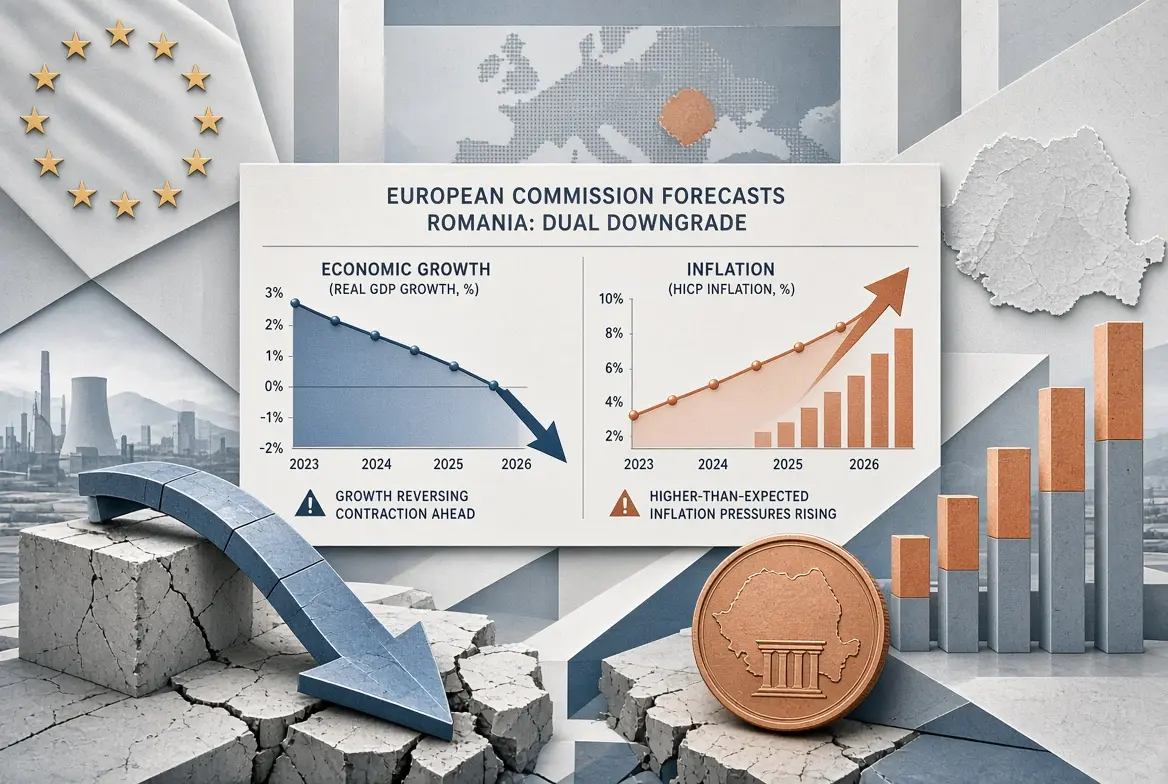
The European Commission expects Romania's economy to contract instead of grow, while inflation will also be higher than hoped
Romania's economy could shrink by 0.3 percent this year, while average annual inflation may reach 7.9 percent, according to the European Commission's autumn forecast published on November 17. Back in spring, Brussels was still projecting modest growth of 0.1 percent and inflation of seven percent, but the current assessment shows that budget austerity, rising prices and uncertainty are weighing…