
We receive the chemicals that disrupt our hormonal system even before we are born
Chemicals that disrupt the human hormonal system are now present almost everywhere in our environment: in plastics, cosmetics, toys and pesticides, and researchers have detected them in human blood, breast milk and umbilical cord blood. This means that exposure begins even before birth. This is revealed in a joint report by the United Nations Environment Programme (UNEP) and the World Health Organization (WHO), published on Tuesday, November 17. According to the report, the health costs of these substances exceed 1,100 billion dollars worldwide every year, and the two organizations are calling for urgent, coordinated international action. The report, titled "State of the Science of Endocrine Disrupting Chemicals 2026," is the first major global review since the 2012 assessment, and was presented at the first international conference of the Global Framework on Chemicals.
To understand why these substances are so dangerous, it is worth knowing what the hormonal system, also known as the endocrine system, does. Hormones produced by the thyroid, adrenal glands, pancreas, ovaries and testes control the body's most important processes even in tiny amounts: growth, metabolism, sexual maturation, fertility and fetal development. Endocrine-disrupting chemicals, known by the English abbreviation EDCs, act by mimicking or blocking the body's own hormones, thereby disrupting these subtle signals. These include, for example, bisphenol A, which is found in some plastic bottles and in the inner lining of canned food containers, phthalates, which are used to soften plastic, and the "forever chemicals" known as PFAS, used in waterproof, non-stick coatings. Such substances are particularly insidious because they have an effect even in very small quantities, and during sensitive periods of fetal development or infancy they can cause damage that lasts a lifetime.
According to the report, there is growing evidence that these substances impair fertility and harm brain development, thyroid function, metabolism, the immune system, and heart and vascular health. Researchers have recently also become concerned about liver diseases linked to metabolic disorders and possible kidney damage, and the report links these compounds to cancer, obesity and type 2 diabetes as well. The scale of the problem is illustrated by the fact that more than 350,000 chemicals and mixtures have been registered for use worldwide, but only a fraction of them have been examined for their effects on the hormonal system. According to the report, the estimate of 1,100 billion dollars is modest, since it only includes the costs of treating diseases and the value of lost labor, but not the costs of contaminated drinking water, biodiversity loss and the effects on food production. According to Laura Vandenberg, one of the report's lead authors and a professor at the University of Massachusetts Amherst, the findings "essentially mean that the evidence is irrefutable."
The authors of the report not only summarized the scientific findings but also pointed out that some of the damage can no longer be undone.
"These effects are long-lasting, and in some cases may be irreversible,"
said Sheila Aggarwal Khan, director of UNEP's Industry and Economy Division. According to Bruce Gordon of the WHO, exposure can only be reduced if the health, agriculture, industry and environmental sectors act in a coordinated manner. Alongside the report, UNEP also published a policy brief, which proposes possible regulatory measures regarding, among other things, food packaging, cosmetics, toys and textiles.
The report was published at a time when the world's countries have still not been able to agree on whether the planned global plastics treaty should restrict the chemical additives used in plastics - negotiations are expected to resume early next year. According to the American Chemistry Council, the US chemical industry association, existing regulations, including the US Toxic Substances Control Act and the European Union's chemicals regulation, REACH, remain the most effective tools for regulating plastic additives, and therefore, in their view, there is no need for new international restrictions. Bjorn Beeler, of IPEN, the international network working to eliminate chemical pollution, warned, on the other hand, that the growth in chemical production could lead to a "toxic tsunami." The European Union has already taken action in this area: at the end of 2024 it banned the use of bisphenol A in materials that come into contact with food, with the ban coming into force gradually, through a transitional period. According to Vandenberg, however, the biggest problem is not a lack of knowledge.
"In very, very many cases, we know enough to act. Why haven't we done it yet?"
she asked.
Ugar
Did you like this article?
Support our work with a small donation
Secure payment via Stripe • Min. 2 EUR
Gesta recommendations:

Europe wants to replace Palantir, Musk showed why in Ukraine
European defense ministries want to reduce their dependence on key military tasks on the American company Palantir Technologies and other American technology firms, and an increasing number of European companies are competing for the market being vacated. Germany, France and the Netherlands are all building their own European systems for what Palantir's software has been used for or would have…

Oops: NSA's secret network goes down
A few days after Microsoft's worldwide outage and the flight ban that paralyzed American airports, service was also interrupted in one of the United States' most sensitive IT systems: the strictly classified internal network through which employees of the National Security Agency (NSA) share classified information went down. No connection has so far been established between the failures, and at…

Lasconi would support an alliance between the PNL and the USR, but fears that everyone will once again want too much
Elena Lasconi believes it would do Romania's right wing good if the PNL and the USR joined forces and tried to win back the trust of voters disillusioned with the parties under a new name, but she is less convinced that such an agreement could actually come about. The former USR leader explained her doubts by drawing on her own experience from her presidential campaign, recalling that in…

20 years in the EU: Negrescu calls for a new European plan for Romania
Twenty years after Romania and Bulgaria joined the European Union on January 1, 2007, Victor Negrescu, the PSD vice-president of the European Parliament, says Romania needs a new European programme that unites the political class and civil society. “We need a new European project for our country, a European plan for Romania,” he said at the European Parliament's building in Brussels, at the event…
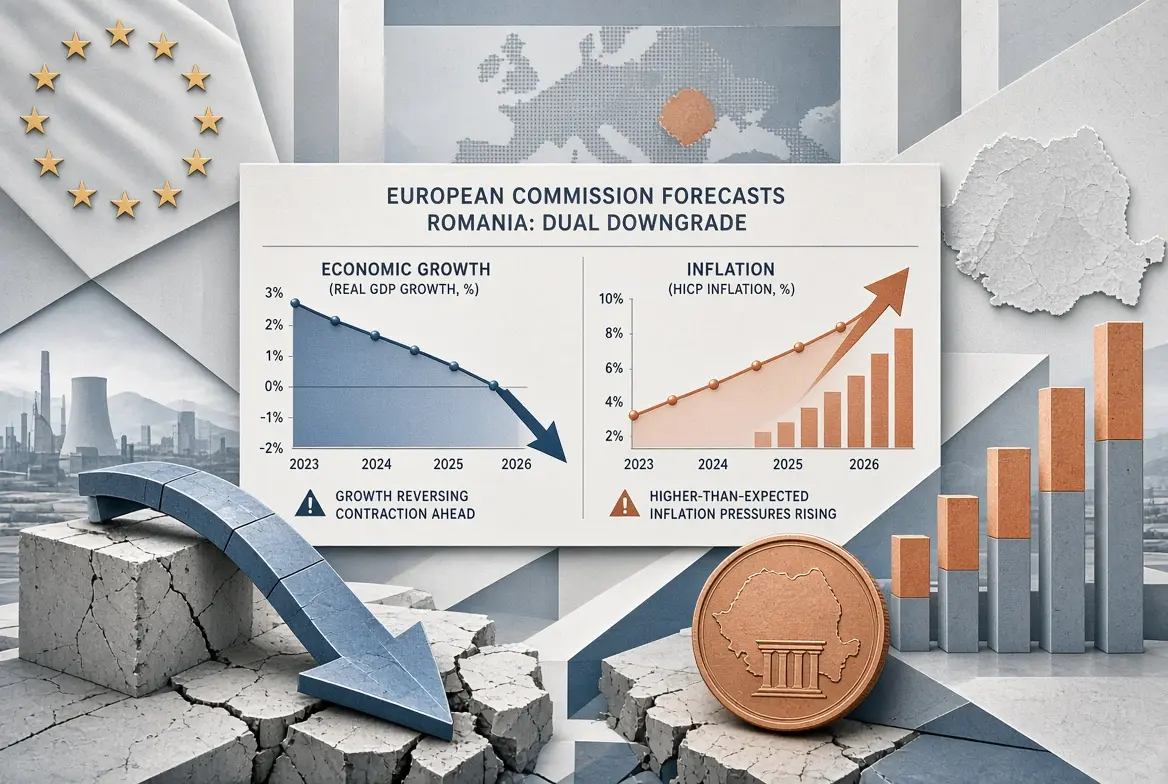
The European Commission expects Romania's economy to contract instead of grow, while inflation will also be higher than hoped
Romania's economy could shrink by 0.3 percent this year, while average annual inflation may reach 7.9 percent, according to the European Commission's autumn forecast published on November 17. Back in spring, Brussels was still projecting modest growth of 0.1 percent and inflation of seven percent, but the current assessment shows that budget austerity, rising prices and uncertainty are weighing…