
Dirty money, bankers looking the other way: what do Deutsche Bank's leaked documents reveal?
Based on more than fifteen million internal documents, with the participation of more than fifty newsrooms and 230 journalists, an international investigative series titled "Inside Deutsche Bank" launched on November 17, offering a look into the German banking giant's most sensitive client relationships. According to the documents uncovered, the bank maintained business relationships for years with clients for whom its own compliance systems had flagged the risk of money laundering or sanctions evasion, yet profitable business repeatedly proved more important than following the rules.
The documents feature sanctioned Russian oligarchs, convicted sex offender Jeffrey Epstein, and figures involved in the corruption network that captured the South African state, while also revealing how Donald Trump's tax documents ended up with another client's accountant. The two whistleblowers who leaked the material, who have requested anonymity, handed it over not only to journalists but also to the U.S. Department of Justice, the U.S. Treasury's Financial Crimes Enforcement Network (FinCEN), and the UK's tax and customs authority. Markets reacted sensitively to the revelations as well: Deutsche Bank's share price temporarily dropped by six percent during Tuesday's trading session.
Where do the documents come from?
The investigation was coordinated by the South African nonprofit Barracuda Media, while the German Data and Research Center (DARC) provided the technical infrastructure for processing the documents. Among the series' authors are Frederik Obermaier and Bastian Obermayer, the two journalists who played a defining role in uncovering the 2016 Panama Papers, who this time were able to trace international money flows through the inner workings of a single bank.
The data was copied from Deutsche Bank's systems by two whistleblowers, who then, through their lawyer, passed it on to investigative journalists Josy Joseph from India and Khadija Sharife from South Africa, who shared it with the participants of the international collaboration. The material, spanning the period from the early 2010s onward, contains millions of emails alongside risk assessments, client data, reports on suspicious transactions, and documents from internal investigations conducted under code names, which journalists have been processing since early 2026.
According to a report by Le Monde, the whistleblowers neither requested nor received money from the newsrooms, and set no editorial conditions when handing over the material. According to their own account, they obtained the information lawfully, did not hack into any systems and did not steal login credentials; their primary aim was to show the kind of relationships the bank maintained with Russian oligarchs and business circles tied to corrupt regimes.
The documents handed over to the authorities could, however, later bring the whistleblowers a financial reward if they lead to successful proceedings. Under FinCEN's whistleblower protection program, informants who meet the criteria may be entitled to 10 to 30 percent of the recovered financial penalty, provided the sanction imposed in the case exceeds one million dollars. A draft of the implementing rules for the system, based on the 2020 anti-money-laundering law and its subsequent amendments, was published on April 1, and the agency stated that it would begin reviewing and paying out rewards only after the final regulation is adopted.
What do the documents contain?
What the stories published so far have in common is that the bank often already knew about the risks at a time when it could still have intervened, yet the warnings were not always followed by meaningful action.
The Epstein case
According to the uncovered documents, Deutsche Bank flagged more than three thousand transactions linked to Epstein or his companies to U.S. authorities in 21 suspicious activity reports, with a combined value of nearly 582 million dollars. That is more than double the 250 million dollars mentioned in August by U.S. Senator Ron Wyden when he spoke about the responsibility of the institutions that financed the sex offender. The flagged transactions included payments sent to women, transfers routed through shell companies, suspicious use of charitable funds, and payments to billionaires Leon Black and Glenn Dubin. Epstein became a client of the bank in 2013, five years after his earlier conviction, meaning executives already knew about his past at the start of the relationship, yet internal approvals were granted nonetheless.
According to the bank, it notified Epstein in December 2018 that it was ending the relationship, but closing the accounts and transferring the assets still took months. Subsequent reports on the suspicious transactions reached the authorities only after his arrest in July 2019, while the documents also reveal that the bank did not consider Ghislaine Maxwell's role unproblematic either. One internal email referred to her as Epstein's suspected accomplice, yet the bank still approved an asset-management arrangement in which Maxwell was one of the beneficiaries.
Trump's data and business ties
Donald Trump's name appears in the material partly because of a serious data-handling error, after a bank employee sent year-end tax statements for 1,586 accounts to a single client's accountant in 2017. The package also contained the U.S. president's documents; the recipient flagged the mistake and said the file had been deleted. According to internal correspondence, bank executives then discussed how to avoid notifying the affected clients, while Christian Sewing, who at the time headed the private banking division, called what had happened a "horrendous mistake."
Other documents concern money flows related to Trump's businesses: in 2014 the bank flagged a payment intended for DT Marks Baku LLC, tied to his business interests in Azerbaijan, whose purpose it could not clarify, and other transactions involving Trump's companies also raised questions about links to Russian and Azerbaijani money-laundering networks. The reports do not, however, claim that the documents uncovered prove Trump's personal involvement in any wrongdoing.
Russian oligarchs
The bank's Russian client relationships became a focus of the investigation partly because, according to the whistleblowers themselves, they were particularly troubled by the way the bank handled wealthy clients tied to the Kremlin. According to the documents, Deutsche Bank maintained its relationship with Oleg Deripaska and Viktor Vekselberg despite internal money-laundering and sanctions warnings, and five of the seven Russian oligarchs sanctioned by the first Trump administration in 2018 had ties to the bank.
According to the reports, even after Russia's full-scale invasion of Ukraine in 2022, the bank did not simply try to end these risky relationships but instead sought to distinguish between oligarchs it considered "good" and "bad." Some client relationships were transferred to Swiss and Luxembourg subsidiaries, where banking-secrecy rules could also make it harder for U.S. authorities to obtain the relevant data.
Kazakhstan, South Africa, Colombia and the Arctic oil business
In the case of Timur Kulibayev, the billionaire son-in-law of former Kazakh president Nursultan Nazarbayev, the bank did block a 15-million-dollar transfer at one point, but later prepared to open an account in his wife's name. In South Africa, meanwhile, around 675 million dollars passed through the bank via a network involving companies linked to the Gupta family, which was at the center of the corruption scheme in which private interests gained control over state decisions and public funds. According to the documents, Deutsche Bank only began winding down these relationships in 2021.
In Colombia, an internal 2019 investigation code-named "Project Cali" identified warning signs in thousands of transactions that had previously gone without consequences, while in Arctic oil extraction the bank's own environmental commitments clashed with its business interests. Although it announced in 2020 that it would not finance new Arctic oil and gas projects, it nevertheless later carried out a transfer of 1.5 billion euros involving Trafigura and a project of Russia's Rosneft Vostok Oil, citing its role as a payment intermediary. The reports do not consistently specify the currency of the amount: some versions cite dollars, while Newslaundry and several other outlets, citing Trafigura's response, mention euros.
The relationships cultivated with influential families also extended to hiring practices, as the bank sought to secure business by employing relatives of foreign officials. These relationships generated around 190 million dollars in revenue, and Deutsche Bank paid 16.1 million dollars in 2019 to settle the U.S. Securities and Exchange Commission's investigation into the matter.
The bank's internal culture
In one story reported by ZDF, an employee discovered a network suspected of laundering several hundred million euros in 2020; while some elements of it had been flagged by the bank's systems, the connections between them went unrecognized. An internal manager acknowledged the shortcoming, while correspondence among executives shows that compliance checks were at times viewed more as an obstacle to business: in a 2017 email, Sewing wrote that client due diligence "breaks our revenue's neck." According to a summary by Portfolio based on the Financial Times, Sewing supported renewing the business relationship with Austrian real-estate magnate René Benko despite objections from the risk-management committee, and he pushed for a 270-million-euro loan for Mathias Döpfner, CEO of Axel Springer. The bank ultimately offered 170 million euros, but Döpfner took out the loan from another bank.
The documents also paint an unsettling picture of shareholder communication: when it emerged in 2021 that the cost-cutting target set for the following year would likely be missed by one billion euros, management simply dropped the target without openly acknowledging the shortfall. At an Italian mortgage-loan portfolio, meanwhile, a flaw in automatic data transfer kept a loss that grew to nearly 800 million euros hidden for years. The bank also assisted with tax optimization for the foundation of the Albrecht family, the owners behind Aldi, though the foundation stated that it had always acted lawfully and in accordance with tax regulations.
The bank's response
Deutsche Bank responded to the revelations by stating that the cases presented date back years, in some instances decades, and that they had been reviewed with supervisory authorities at the time. It firmly rejected what it called false claims regarding Sewing's attitude toward compliance systems, and pointed out that between 2019 and 2025 it spent seven billion euros strengthening internal controls. The bank maintains that its operations have fundamentally changed since then, as demonstrated by its record profits in 2025 and in recent periods, though it declined to comment in detail on its relationships with individual clients. Profitability alone, however, is no answer to how much more effective compliance has actually become, especially given that authorities carried out several raids on the bank in 2026 as well, and Germany's financial regulator, BaFin, once again had to extend deadlines for correcting certain anti-money-laundering shortcomings. Transparency International has called on the relevant authorities to investigate the allegations uncovered, and the documents could form the basis for further supervisory, money-laundering and sanctions proceedings, as well as damages lawsuits, the outcome of which cannot yet be predicted from the series of articles now beginning.
Is there a Hungarian connection?
The Hungarian angle of the investigation was taken on by the consortium's sole Hungarian member, Direkt36, which also published its opening article, released on November 17, on Telex. The introductory piece does not yet name any Hungarian clients, companies or politicians, nor does it provide a specific account of Deutsche Bank's operations in Budapest or of Russian money flows passing through Hungary, though this does not mean the data trove is without a Hungarian angle.
Direkt36 has in fact specifically indicated that it has been working on stories emerging from the Hungarian-related documents and will present the results in a separate article soon, so it no longer describes Hungarian involvement as a mere possibility. The published list of partners does not include a Romanian newsroom, and the opening articles reviewed here do not describe any Romanian case either, while further disclosures are promised for the coming weeks and months. The full set of documents is not being made freely available, so the stories it contains will reach readers only through the consortium's vetted articles. All of this is particularly uncomfortable for Deutsche Bank, as the current allegations come after a long series of scandals: in 2017, U.S. and UK regulators fined it a combined total of more than 600 million dollars over the so-called mirror trades, through which around ten billion dollars were moved out of Russia via the bank's Moscow, London and New York units. In 2020, New York's financial regulator imposed another 150-million-dollar fine, which, alongside the bank's dealings with Epstein, also concerned compliance failures in its relationships with Danske Bank and FBME Bank.
Based on the leaked documents, the investigative journalists argue that, even after earlier fines and promises of reform, the same operating pattern resurfaced: whenever compliance with the rules threatened a sufficiently profitable deal, the bank too often found a reason to go ahead with the deal anyway.
Ugar
Did you like this article?
Support our work with a small donation
Secure payment via Stripe • Min. 2 EUR
Gesta recommendations:
Europe wants to replace Palantir, Musk showed why in Ukraine
European defense ministries want to reduce their dependence on key military tasks on the American company Palantir Technologies and other American technology firms, and an increasing number of European companies are competing for the market being vacated. Germany, France and the Netherlands are all building their own European systems for what Palantir's software has been used for or would have…
We receive the chemicals that disrupt our hormonal system even before we are born
Chemicals that disrupt the human hormonal system are now present almost everywhere in our environment: in plastics, cosmetics, toys and pesticides, and researchers have detected them in human blood, breast milk and umbilical cord blood. This means that exposure begins even before birth. This is revealed in a joint report by the United Nations Environment Programme (UNEP) and the World Health…
Oops: NSA's secret network goes down
A few days after Microsoft's worldwide outage and the flight ban that paralyzed American airports, service was also interrupted in one of the United States' most sensitive IT systems: the strictly classified internal network through which employees of the National Security Agency (NSA) share classified information went down. No connection has so far been established between the failures, and at…
Lasconi would support an alliance between the PNL and the USR, but fears that everyone will once again want too much
Elena Lasconi believes it would do Romania's right wing good if the PNL and the USR joined forces and tried to win back the trust of voters disillusioned with the parties under a new name, but she is less convinced that such an agreement could actually come about. The former USR leader explained her doubts by drawing on her own experience from her presidential campaign, recalling that in…
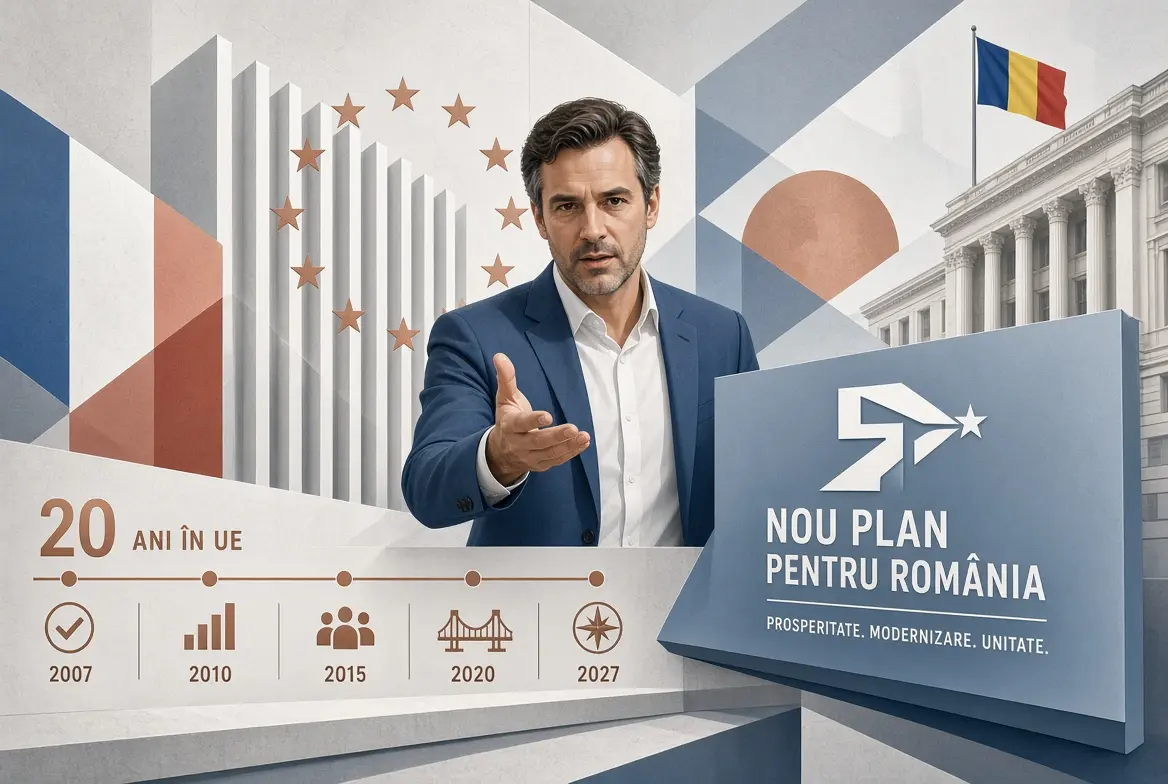
20 years in the EU: Negrescu calls for a new European plan for Romania
Twenty years after Romania and Bulgaria joined the European Union on January 1, 2007, Victor Negrescu, the PSD vice-president of the European Parliament, says Romania needs a new European programme that unites the political class and civil society. “We need a new European project for our country, a European plan for Romania,” he said at the European Parliament's building in Brussels, at the event…