
Moscow attacks, Washington calls for silence – this is how Putin wins in our heads
The Pentagon, led by Pete Hegseth, has asked its European allies — if they can still be called that at all — to hold back on public communication about Russia and not to emphasize the Russian threat. According to a source who spoke to Reuters, Elbridge Colby told a Baltic official that “provoking” the Russians should be avoided, while another European official summed up the American message as follows: we're helping you, we're there for you, just don't make noise and don't draw attention to yourselves.
It may seem like a small thing, but it encapsulates everything that has gone wrong over the past nearly five years. In Europe, there has so far been a debate at the top levels of politics about how to communicate about the Russian-Ukrainian war. One view holds that voters must be told openly that Moscow poses an existential threat to us, so that they grasp the necessity of the resources spent on defense and on supporting Ukraine. The other view — which I don't particularly like, though it does have some valid arguments too — holds that the danger shouldn't be overemphasized, because it causes panic and can undermine European unity.
Well, now the Pentagon has barged into this already ambiguous and anything-but-decisive field with its wish list above, and since it's foreseeable that a significant number of European states will fall in line with the US, whatever chance we had of finally talking about the war properly — about what kind of danger it poses to us and how great that danger is — has now taken another massive hit.
Because whoever dictates what you can talk about, and how, is already reaching into the very framework of your thinking. This is one of the key operating principles of the cognitive weapon that Russian power structures have been successfully using for decades: first the words become suspect, then the connections, and finally the recognition itself. If naming the Russian threat is a provocation, then sooner or later the person who recognizes the threat becomes an obstacle to peace, the journalist examining the attacker's intentions becomes a warmonger, and the voter demanding defense becomes a dangerous extremist. A society under attack thus begins to discipline itself even before the aggressor has to make any particular effort to silence it — and now this self-discipline is also being encouraged by the very ally from whom we hope to receive part of our protection.
Psychologically this is effective because people also learn from public discourse which thoughts can be voiced without consequences, and which ones carry the risk of shame, isolation or political punishment. If naming the danger is repeatedly portrayed as irresponsible, many will adapt through self-censorship, and others will conclude from the silence that the danger might not be significant after all, or that they themselves are overreacting. This doesn't turn everyone into a Putin supporter, but it does weaken people's trust in their own judgment, and it becomes easier to persuade them to weigh the supposed risks of their own defense rather than the actions of the attacker. By the end of the process, it may seem that the condition for safety is adaptation, while protest itself is the source of danger.
Just the other day we reported here on Ugar that according to Bulgarian Prime Minister Radev, Romania was attacked by Russian drones because Bucharest named the attacker by name. But the cognitive dissonance will presumably not stop there, if it stops at all. The German prosecutor's office recently reported the arrest of two Belarusian citizens suspected of planning arson attacks in the Nuremberg area, and the German government had previously accused Russia of an attempted drone attack on Leipzig Airport. But if the Pentagon's wish is pushed further toward silence, Berlin will soon have to think about how to talk about such cases without angering Trump.
Romania's SRI [intelligence service], for its part, recently issued a statement about the arson attack at the Carfil industrial plant in Brașov that likewise highlighted the Russian connection, and also reported on how Russian organizers are trying to recruit people on social media. In Hungary, meanwhile, reports say that figures linked to the FSB tried to organize a pro-nuclear-energy protest intended to cause trouble, which then fell through — but apparently news like this, too, would be better kept quiet, lest we disturb Washington in the peacemaking that, in better and more beautiful times, used to be called treason.
We don't need to go back to yesterday's Telegram channels to find the historical precedents of this method. The Protocols of the Elders of Zion, which began to spread in Tsarist Russia at the beginning of the twentieth century, is one of the most notorious examples of antisemitic political forgery: it sold the plan of a nonexistent Jewish world conspiracy as a secret document, and it kept poisoning the worldview of masses of people even after it had been exposed as a forgery. There are historical debates about the details of how the text was produced, but how the lie functions is clear: the reader was handed a ready-made enemy image and an explanation into which any subsequent event could be stuffed. The lack of evidence became proof of secrecy, refutation confirmed the power of the conspiracy, and the skeptic could easily become, in turn, a helper of the imagined enemy.
Today's Russian communication naturally works with different tools and for a different audience, but the same self-referential logic can be recognized in it again and again: if Moscow attacks, it was provoked; if the attacked party defends itself, it is escalating; if someone names the attacker, they want war; and if someone wants peace, they should accept whatever the attacker demands. By the time we reach the end, the aggressor's responsibility has vanished from the sentences, and what remains instead is the European, left wondering whether it might not be wiser to stay silent, since in the end it might really be them causing some kind of trouble.
Because that's what this is really about: we're supposed to shut up so that the process the Americans call peace talks doesn't get derailed. Moscow senses it has the upper hand, while a Russian drone packed with explosives has just killed passengers at the railway station in Dnipro. But apparently, when presenting such news in the future, we should also consider how much it might disturb the negotiations if we describe Russia as a murderous, terrorist, religious-fundamentalist and oppressive, genocidal empire. In the end, Trump's chances for the Nobel Peace Prize might suffer — and besides, Norway has already been told it's a “s**thole” country. Taking Trumpian absurdity to its logical conclusion, I can almost picture Oslo one day having to be explained, with a few bombs, just who the real peacemaker is.
Modern wars, after all, are fought not only on the kinetic front but also inside people's heads, and the two cannot be separated from each other. A soldier fighting on the front needs ammunition; ammunition requires a political decision; and a political decision requires a society that still understands why it needs to be made. If this understanding can be smashed, the weapons can stay in the warehouses, the aid package can turn into an electoral burden, and the attacked country can become an inconvenient guest, one that people slowly start asking why it won't finally let everyone else live in peace. Moscow doesn't need to win every debate in Europe for this; it's enough to ensure that the necessary decisions keep failing to be made.
In this sense, it wants to kill the soul: that inner backbone which still allows a person to distinguish the victim from the attacker, and which makes them willing to act accordingly. The morally emptied, exhausted person is easier to control, because they already see manipulation in every conviction, a deal in every act of help, and needless risk in every stand taken. In the end they say everyone lies, everyone is the same, and all they want is peace — and with that shrug they clear the way for whoever was missing nothing but others' indifference in order to continue the war.
This episode can be seen as a significant, outstanding Russian victory on the cognitive front line, and on this front Russia is currently winning. This doesn't mean every European has believed the Kremlin's tales; it means that a line of reasoning favorable to the aggressor has now crept even into the regulation of allied communication. When the American defense leadership warns threatened states about the dangers of their own wording, Moscow receives a kind of help that its own propagandists could hardly produce with the same credibility.
Perhaps the timing is no accident, either. Vague American-Russian-Ukrainian negotiation ideas keep following one another, while the possibility of yet another great-power deal looms in the background — a Yalta 2.0: a bargain between Trump, Putin and Xi Jinping, whose public justification could even be some kind of nuclear agreement. If such a meeting takes place, we have good reason to fear that the redivision of spheres of influence will also be on the agenda, which could prove decisive for the Russian-Ukrainian war. We've already seen what Trump is capable of, and Musk, too, is hardly known for his loyalty to Ukraine — a country under attack and bleeding from a thousand wounds — or to the idea of freedom in general.
We'll get filtered information from the big meetings, and even if someone does have inside information, politicians will carefully avoid talking about it, because offending Washington is something to be feared. All this leaves a serious information vacuum in Europeans' minds, one that Russian troll farms and fake-news factories are ready to fill. Our silence, after all, doesn't leave the public sphere empty — it hands it over to someone else: whatever we don't dare to talk about clearly will be talked about by those who have a very precise idea of what they'd like us to believe.
Western civilization has simply sunk so low in this nearly five-year-long war — while practically not even having to pay in blood — that history books will one day describe it as one of the stupidest, and at the same time one of the greatest, acts of self-destruction ever, and they won't be far wrong. In any case, let's not look our grandchildren in the eye, because we've created such a cowardly era that no one dares tell Trump to his face what devastating consequences flow from his narcissistic self-celebration, his unpredictability, and the fact that he treats people's lives as a business offer proving his own greatness.
No one is capable of handing out the virtual and verbal slaps that might still wake Europe up, and the direct consequence of this is that we are rushing toward the abyss, at the bottom of which Putin is waiting for us with a grin — and all of this is being called negotiation, peacemaking.
Next Tuesday there are midterm elections in America, and there's a chance of a sizeable Republican defeat, which won't solve everything but could offer some hope. But if the Democratic victory turns out to be only a hair's breadth and easily misinterpreted, that will also mean, to me, that voters failed to set a sufficiently strong limit on the behavior of America's leading elite, and that we must continue to reckon with the possibility of being left to ourselves. Until then, the least we could do is not abandon our own judgment, and not ask permission to name the attacker from someone who happens to want to strike a deal with him.
Anna Karczag
Did you like this article?
Support our work with a small donation
Secure payment via Stripe • Min. 2 EUR
Gesta recommendations:
Even Hungarian-majority localities could disappear in the administrative reform – why is the RMDSZ staying silent?
The RMDSZ's behavior regarding the territorial-administrative reform floated by Grindeanu is becoming increasingly strange. After the news first broke, a deep silence surrounded the matter — maintained not only by our one and only party, but also by its lackey press. Then Hunor said something to the effect that they would wait and see, that they might support it or might not, but in any case no…
A snapshot of a budding bromance: Putin called Musk a genius
According to Vladimir Putin, Russia closely cooperates with its American space industry partners, including Elon Musk, despite political disagreements, whom he called "a brilliant man". The Russian president praised the SpaceX founder at an exhibition in Moscow, just one day after Musk justified restricting Starlink's military use in Ukraine by citing the risk of Russian destruction of satellites.
First the election, then Iran: Washington may be preparing new strikes
The United States has warned several Gulf Arab states, through diplomatic and military channels, to prepare for a "short but intense" campaign against Iran after the November 3 U.S. midterm elections. According to the Wall Street Journal, Donald Trump has not yet made a final decision, but is leaning toward a large-scale strike that would also target Iranian infrastructure and nuclear facilities.
Trump would reconnect Europe to Russian gas
In 2018, he was still scolding Germany for relying on American military protection against Russia while funneling billions to Moscow through its energy purchases, but now his negotiators have raised the idea of reviving Russian gas sales to Europe, and even restoring Nord Stream, as an economic incentive for a war settlement.
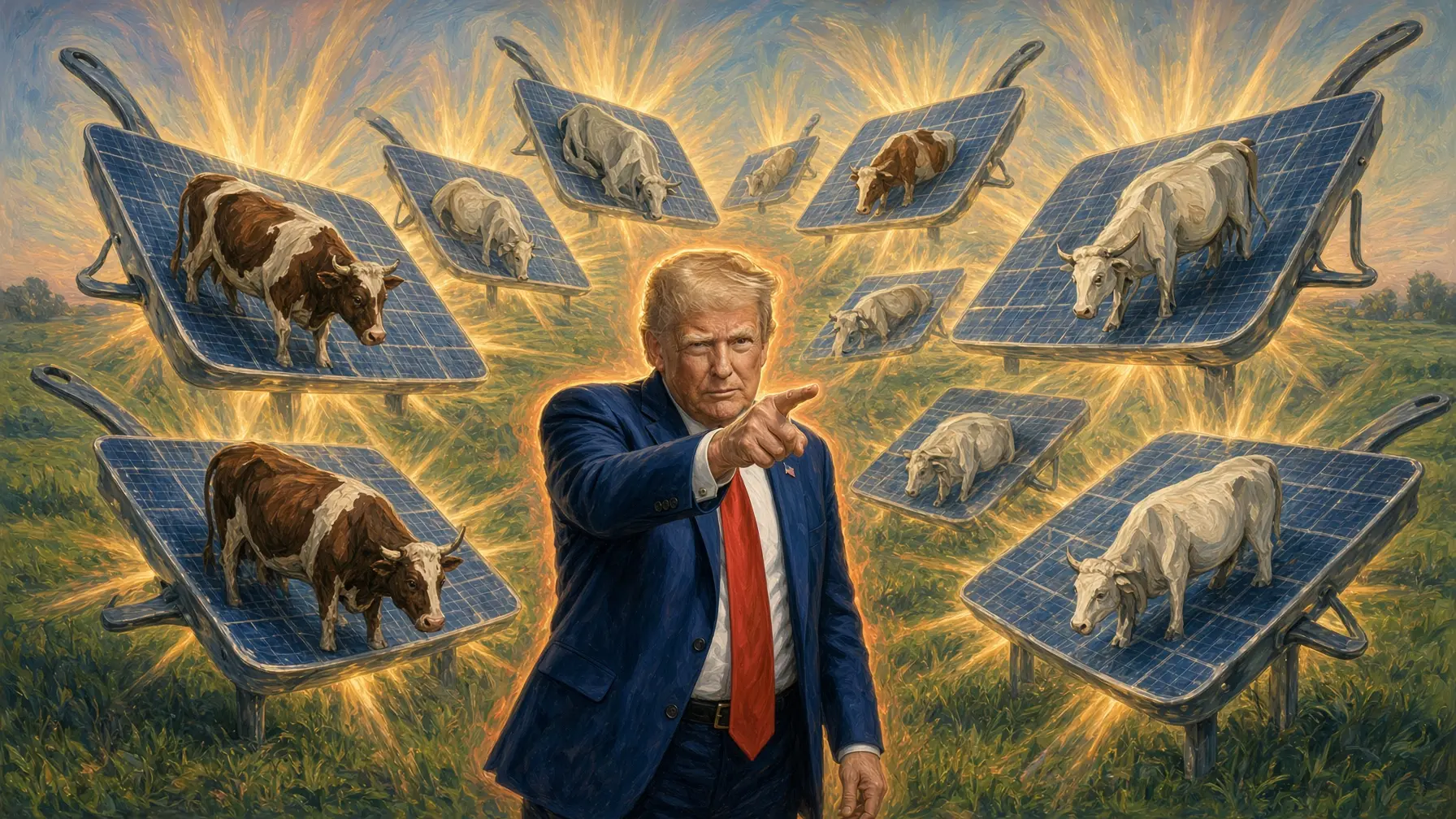
Trumpiad for today: solar panels are frying animals
Donald Trump has identified yet another threat to American wildlife: solar panels, which he claims are a hundred times hotter than a stove and fry any animal that jumps on them. The president of the United States shared this peculiar energy discovery at a campaign rally in Texas, declaring that the black panels “kill all the animals.” The story so far has not explained why America's entire fauna…