
On Ukraine, Péter Magyar picks up right where Viktor Orbán left off
In parliament today, Bence Rétvári tried to put Péter Magyar on the spot by claiming that MOL is negotiating with Ukraine's Naftogaz to build a fuel storage facility near the Hungarian–Ukrainian border. Magyar's response was not to say let's look at what the Ukrainians proposed, how much it would cost, who would pay for it, and what benefit Hungary would get from it. No. He got outraged, recounted that he had spoken with Zsolt Hernádi that night, that he had also warned MOL's chief executive by text message to take the state's 25 percent ownership stake seriously, and hinted at consequences. Then he declared: as long as there is a Tisza government, no such storage facility will be built on Hungarian territory. Rétvári played the Ukraine card, and Magyar slapped it down with such force that even Viktor Orbán could have nodded in satisfaction.
The trouble is that Naftogaz and MOL have not signed a contract for a storage facility that is already set to be built, but a letter of intent to jointly study a possible investment. According to MOL, there is not even a plan, a permit, or secured financing yet; mapping out whether the project is feasible at all could take years. So Magyar solemnly banned something that we currently don't even know the exact shape of. There may well be security, environmental and ownership questions surrounding it, and those should indeed be put to Hernádi, but governing might begin with looking at the answers first and deciding afterward.
And now hold on: Péter Magyar himself said that according to Hernádi, the negotiations began with the authorization of the Orbán government. If that is true, then Bence Rétvári held the new government accountable for something his own side had set in motion. So it seems the heroic street fighters were negotiating with the Ukrainians behind the scenes while whipping up sentiment against them in public with talk of an oil blockade and national betrayal. Magyar could have asked right there: where is the authorization, what did Orbán know, what was agreed, and why did the previous government see merit in something Fidesz now calls a danger? Instead, he too joined the ranks of those dreading the Ukrainian storage facility, only declaring even louder that under him, nothing will come of it for sure.
Yet Naftogaz's argument is not particularly complicated. The Russians are attacking Ukraine's energy infrastructure, so the Ukrainian company wants to create fuel reserves in a safer location that could supply the Ukrainian market if needed. For MOL, this could be a business opportunity, and for Hungary, an energy investment and revenue near the border. This does not mean that fuel stored for the Ukrainians would automatically become a Hungarian strategic reserve — although the agreement could well include such a clause! — but it is quite certain that a country which has been talking for years about the vulnerability of the Friendship pipeline would do well to examine every sensible energy cooperation opportunity.
The same peculiar Hungarian aloofness showed up regarding the Carpathian Eight as well. Péter Magyar said that Hungary had received an invitation to Zelensky's new regional initiative but did not join it. Yet the reports coming out of the summit already listed Hungary among the eight participating countries, even though no Hungarian political leader was seen at the founding meeting. As of 9:30 p.m. today, Monday, September 21, MTI still reports that we are members:
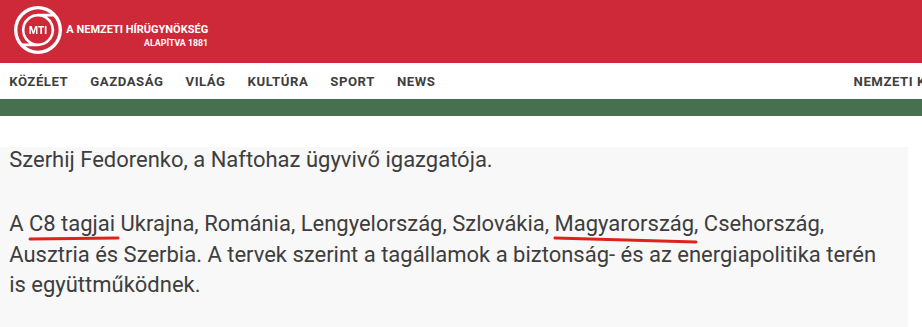
So what actually happened? Did the organizers list Hungary even though Budapest hasn't said yes yet? Did the government turn down the invitation without telling anyone? It would be good to clarify this, because the C8 is not just about a group photo: they are discussing cooperation on energy, transport, trade and security. Donald Tusk and Nicușor Dan are there, while the Hungarian prime minister explains in parliament that we are not there, without saying why not.
There is also a security dimension here with further-reaching implications. Europe is now building the defense and logistics links that a continent facing a Russian threat will need; the EU's SAFE program includes both military mobility and the protection of critical infrastructure — so why is the Hungarian prime minister ruling out, even at the assessment stage, his country's participation in a regional investment that could prove beneficial to Hungary as well?
We understand that Rétvári is stirring things up, and also that Hernádi deserves a few uncomfortable questions about who authorized him, when, and for what. It is much harder to understand, though, why Péter Magyar felt the need to reach for the worst part of Viktor Orbán's Ukraine policy before even hearing the answers. It is possible to replace Orbán while still sitting in his seat, answering the same Ukrainian question with the same angry no — but then let's not be surprised if, in the end, what emerges is not what serves Hungary's interests, but who slurps louder while sucking up to the Russkies.
Source: Telex
Rut
Did you like this article?
Support our work with a small donation
Secure payment via Stripe • Min. 2 EUR
Gesta recommendations:

Árpád Antal is shouting on Facebook again, with a conspicuous lack of groundwork
The UDMR's background institute has thrown in the towel, and is now drawing up the illustrative material with that.

Reform or Eyewash? Monday Will Reveal Whether the PSD Came to Govern or Just to Promise
Sorin Grindeanu is convening the PSD leadership on Monday morning. According to Mediafax, the meeting comes just as the debate over pensions and wages is unfolding, and for the first time the party must answer, alone, without a coalition partner, how much money the country has and what it will spend it on. What's worth watching?

Meloni: cyberattacks and bomb threats show that more money is needed for defense
On Friday in Verona, during a break at the Fieracavalli international horse fair, Italian Prime Minister Giorgia Meloni told journalists that Europe needs to increase its defense and security spending. In her view, civilian infrastructure today is threatened not by distant dangers but by attacks that can be felt in everyday life.

Expressions Apple blocks: dictator Trump, Tibetan independence and Russian troop deployment
The iPhone keyboard blocks nearly one hundred thousand words and expressions in about thirty languages when a user tries to type them using the faster swipe-typing feature, and the list includes not only vulgar and offensive words but also political expressions.
From January, the French will defend the weapons hub destined for Ukraine
From January 1, 2027, France will take over air defense of the Rzeszów area in southeastern Poland, home to the most important logistics hub for Western military aid destined for Ukraine. French ambassador to Warsaw Étienne de Poncins told journalists on Friday, November 6, that "from January 1, France will take over air defense in the Rzeszów area within the framework of NATO."