
Simion defended the AfD... from the Romanians
According to Alice Weidel, more and more immigrants from Romania are plundering the German welfare system. According to George Simion, there's nothing offensive about that. So Romanians working in Germany can rest easy: if the German far right wipes its feet on them, the leader of Romania's sovereigntists will personally check whether the shoe got dirty.
George Simion has finally spoken up and defended the person who had to be defended: Alice Weidel. The AfD co-chair took aim at immigrants from Romania, whereupon the full-time custodian of Romanian national pride emerged, looked around, and concluded that there's actually nothing to see here, it's just the press being oversensitive. He will, of course, continue to defend the homeland, but political friends shouldn't be expected to do the same — that would have diplomatic consequences.
At first glance, though, the situation didn't seem especially complicated. On October 28, Weidel wrote on X that an increasing number of immigrants arriving from Romania were "plundering" the German welfare system, listing child benefits, basic assistance and healthcare services, and citing Magdeburg as an example, where social spending linked to Romanian citizens had risen roughly twentyfold, to about three million euros a year. At the end of the post, naturally, the savior also appeared: only the AfD can change this. Well, jawohl: first you point out the foreigner, then the cash register, and finally the ballot paper; the audience will connect the dots. For Simion, it might have mattered just whom his German ideological ally was pointing at. In the first round of Romania's presidential election on May 4, 2025, more than 120,000 people in Germany voted for him, giving him 74.3 percent of the valid votes cast there. He achieved no better result anywhere else in Europe. So one of the most enthusiastic bases of support came from exactly the community that Weidel has now turned into a campaign prop — and at sovereigntist family gatherings, that sort of thing is always awkward. Seen from Bucharest, the Romanian working abroad is the nation's exiled hero, who sends money home, supports his family, and on Sunday goes out to save the country. Seen from the AfD's campaign, the same person is now an immigrant who has gotten too close to the German wallet. As long as they're jointly bashing Brussels, they understand each other perfectly; the trouble starts when the German sovereigntist notices that the Romanian sovereigntist's voter is living right next door.
On November 11, Simion attempted, on Digi24, the feat of smoothing this over and explaining it away.
"I don't think she insulted us"
he said of Weidel, going on to explain that the Romanian press is often too sensitive and that there are nuances to the statement. In his view, a special situation has developed in Magdeburg, and even hardworking Romanians have had enough of opportunists living off benefits. He also added that many of the Romanians in Germany he knows also support the AfD. What luck that Simion is here to explain it to us: a person reads that immigrants arriving from Romania are plundering the welfare system, and with his simple mind might actually think that immigrants from Romania are being accused of plundering the welfare system. But then Simion arrives with the nuances, and it turns out the sentence was actually born out of deep respect for the honest Romanian worker — it just doesn't look that way at first. Meanwhile, Dominic Fritz, chairman of the USR, added something to the Magdeburg arithmetic lesson. According to him, over the past decade it wasn't only the social spending linked to Romanians that grew twentyfold, but also the number of Romanians living in the city. If the two figures refer to the same period and a comparable population, then per capita spending has remained roughly unchanged. That, of course, is an inconvenient turn: spending twenty times as much money on twenty times as many people sounds a lot less like plundering and a lot more like simple division. And division, as everyone knows, doesn't mobilize voters very well.
Weidel, incidentally, had shared a Welt article about a documentary made by Jana Gareis for MDR. The crew filmed in Magdeburg, Halle, Hagen and various towns in Romania, and presented problems that authorities genuinely ought to deal with: overcrowded housing, neighborhood conflicts, rules that can be gamed, and the difficulty of enforcement. The story thus involves a variety of actors, interests and responsibilities, which works to a documentary's advantage — but is just unnecessary hassle for an anti-foreigner campaign, since fraud has to be uncovered, proven, and the perpetrator and the money have to be found. A Romanian, on the other hand, is easy enough to spot.
In his response, Fritz set alongside the spending what German society gets in return. He spoke of Romanian doctors working in German clinics, whose training Romanian taxpayers had funded, and of the women who care for elderly Germans while their own children stay home with their grandparents. The grandparent looks after the grandchild for free, so the mother can take care of someone else's family in Germany. Fritz therefore asked Weidel who, in this story, is actually exploiting whom, and demanded an apology. The German-born mayor of Timișoara defended Romanians in German, while the Romanian nationalist excused the German nationalist in Romanian. If someone wrote this as political satire, the editor would probably send it back saying, fine, fine, but let's stick to something believable.
Within AUR, MP Andrei Gușă at least recognized that it isn't necessarily Weidel's self-esteem that needs defending here. He acknowledged Germany's right to act against fraud, but rejected the stigmatization of the Romanian community, and reminded people that Romanians are EU citizens entitled to freedom of movement and the right to work, and that Germany has long benefited from Romanian labor. It's worth preserving this moment: the Romanian sovereigntist taking cover behind rights guaranteed by the European Union in order to protect his compatriots from the German sovereigntist. Wicked Brussels suddenly becomes quite a useful institution the moment one side, amid the great friendship of nations, starts eyeing where the other's coat is hanging.
Simion, however, had more urgent business: preparing the Bucharest reception of AfD representatives for AUR's November 13-15 events, whose program included the launch of a Romania-Germany friendship group. Asked whether the guests would apologize, he said he saw no reason for that, and that he wouldn't either in their position. The hospitality is impeccable: the guests hadn't even arrived yet, and the host had already swept the awkward question out of their path. So the Simion voter working in Germany has just this to digest before the next shift: when Bucharest wants his vote, he's the pride of the nation; when his German political friend turns him into a suspicious foreigner, he's expected to appreciate the nuances. For more detailed guidance, Simion might want to pay a visit to Balázs Orbán — there's still room for Romania's people's leader to grow.
Ugar
Did you like this article?
Support our work with a small donation
Secure payment via Stripe • Min. 2 EUR
Gesta recommendations:

Musk Is Warned: Trump Will Leave, But the Documents Should Stay!
In a post-Trump era, which much of the world is awaiting with growing impatience, it may still matter who restricted Ukraine's satellite communications, why, and on whose orders, at a time when the country was under Russian air attacks. Political power has an expiration date, but electronic correspondence can have a backup copy. Two Democratic senators are now trying to make sure that by the time…

Two Months After Taking Command, Hamas Leader May Already Get to Check the Promises of Paradise
If the promises of seventy-two virgins can be redeemed, Samir Abu Younis may now have the chance to check the quality of service. The commander of Hamas's Rafah brigade was killed by an Israeli airstrike in the early hours of November 15 in the southern Gaza Strip; his death was confirmed by the Israeli military, the Shin Bet, and Hamas itself. No statement has been issued yet about the details…

Ships burn in Romanian territorial waters, while deterrence is being prepared for the next meeting
Just the usual: drones slam into commercial ships at the mouth of the Danube, the crews put out the fires, Romania scrambles fighter jets, then announces that it will raise the matter at the next meeting in Brussels. This time three ships provided the set for yet another performance of the security-policy operetta titled “Now Something Really Should Be Done.” The sailors working on the decks…

Putin's war against America: when politicians of the attacked country work for the aggressor
Russia did not need to invent the divisions within American society: it was enough to recognize them, deepen them, and then support political actors who, for their own interests, further erode the authority of democratic institutions. Reviewing David Corn's new book, historian Laurence Saint-Gilles argues that the Russian affairs surrounding Trump are interconnected episodes of a decade-long…
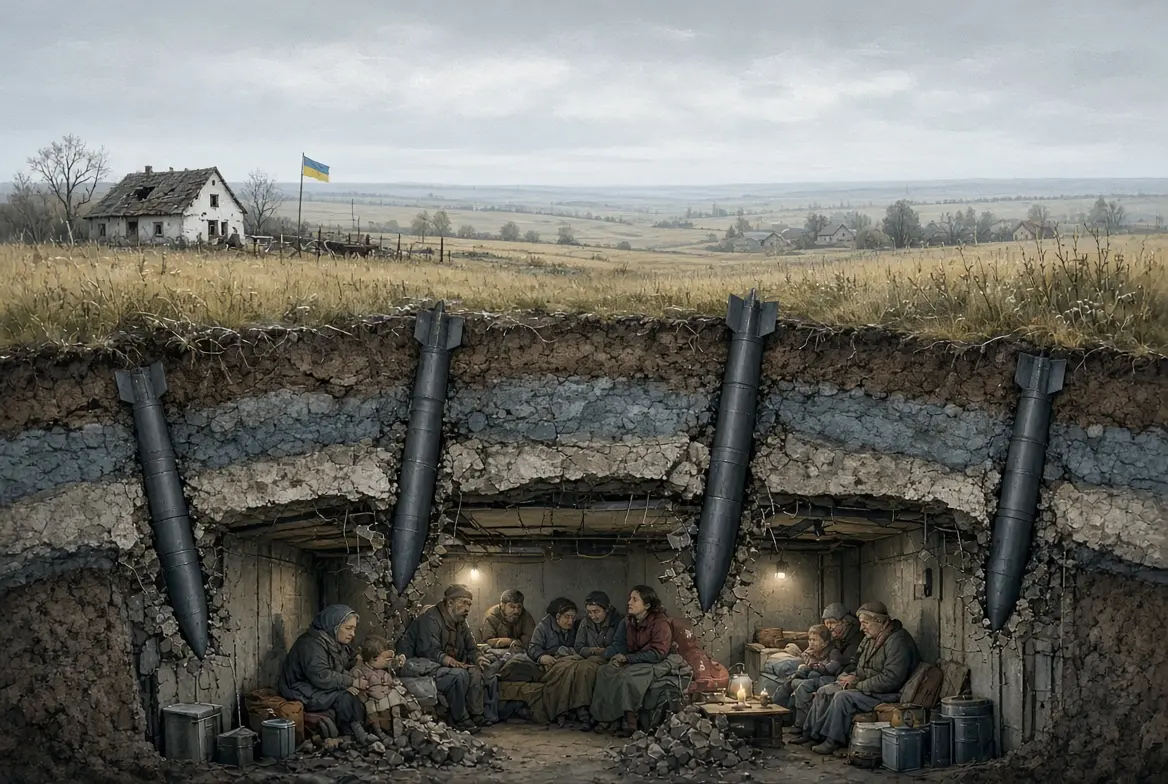
Russian bombs reached them even seven meters underground
Ukrainians are taking their schools underground to protect children, while Russia is attacking with bombs capable of destroying even fortified shelters. Ukrainian writer Andriy Kurkov starts from this unequal struggle in his Kyiv Post opinion piece published on November 15, which uses the tragedy at Komysh-Vakha to show the limits of civilian protection as long as Russian attacks continue.