
Musk has throttled Starlink in Ukraine again
The Russian attack drone comes in, the Ukrainian interceptor drone takes off after it, but above a certain speed the satellite service simply stops working. According to Ukraine, SpaceX's military communications system, Starshield, is being restricted again, while Elon Musk's company insists nothing has changed. Reassuring. Now someone just needs to explain to the soldiers fighting on the front that what they've been experiencing for days now, they should preferably not be experiencing.
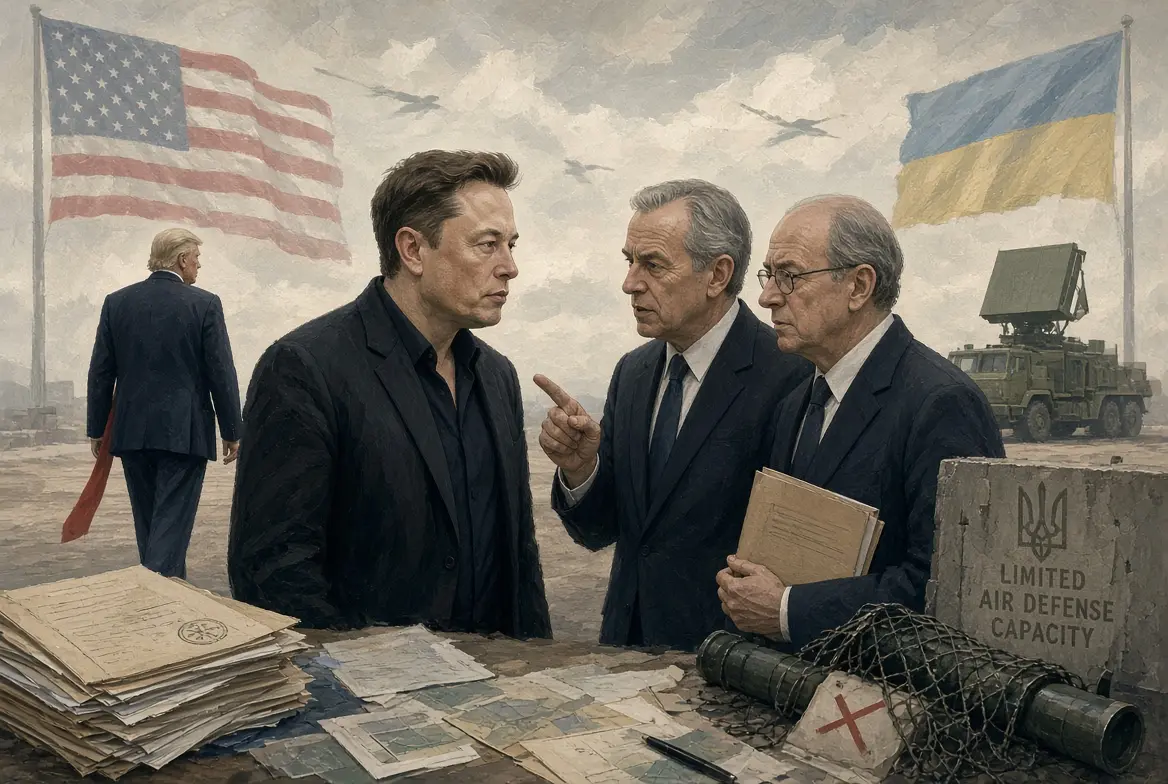
On November 12, at the European Political Community's summit in Dublin, Volodymyr Zelensky spoke about the reappearance of Starshield's earlier speed limit in occupied Ukrainian territory: the connection cuts off above 161 kilometers per hour, that is, one hundred miles per hour. This refers to the speed at which the device carrying the terminal is moving, not to a webpage loading more slowly. For an interceptor drone this is a rather unpleasant service quirk, since a Russian attack drone doesn't politely pull over while its pursuer sorts things out with customer support. The restriction makes intercepting jet-powered Shahed drones particularly difficult. According to Zelensky, near the front Ukraine cannot deploy aircraft for this task, so it has to rely on interceptor drones; if these cannot maintain the necessary speed, Russian attack drones have a greater chance of getting through. The problem also hampers medium-range Ukrainian operations against military targets in occupied territory. One would think that the whole point of a military communications system is to work precisely in such situations, but apparently that, too, is one of those old-fashioned expectations that the technological revolution has already outgrown.
Starshield is built on the well-known Starlink technology but is designed for government and national-security use. SpaceX itself advertises it this way: while Starlink is primarily a consumer and commercial service, Starshield serves government needs. In other words, this isn't a case of someone bolting a holiday-home internet receiver onto a weapon and then being surprised by the fine print. The military version is supposed to offer more predictable, more secure operation, and besides, this whole cycle has already played out once before. In October the restrictions lasted for days, after which Ukraine's defense ministry announced on October 24 that service had been restored, and that tests showed the connection remained stable even above 400 kilometers per hour. Now the same Ukrainians have to prove once again that in order to shoot down a Russian drone, one generally has to catch up with it first. That's not exactly rocket science, but apparently among Musk's circle there's still someone who gets it.
In the October dispute, Musk accused the Ukrainian military of violating Starlink's terms of use by employing the service for offensive drone strikes and killing people, and then announced that this loophole had been closed. Ukraine rejected the accusation. In the billionaire's wartime code of ethics, particular emphasis has in any case been placed on what the attacked country uses the connection for. Meanwhile, Russian aggression has continued uninterrupted, though unfortunately Putin has not attached any terms of use whose violation might warrant a suspension. In the current case, SpaceX told Axios that the claim is false and that nothing has changed. Zelensky, however, said that soldiers check the system daily on various sections of the front and run into the same obstacle every time; in his view, a purely technical explanation does not hold up, and the situation has political significance. He has instructed the defense and foreign ministries to coordinate with the company, the Pentagon and the US State Department.
According to a Radio Free Europe report published on November 15, the problem still persisted the previous day. Denys Siienko, a Ukrainian diplomat in Washington, said that the interceptor units affected cannot carry out their task near the front, and can only act against Russian drones later, over territory under Ukrainian control. This is not a mere annoyance but a lost opportunity to stop the attack earlier. The way responsibility keeps shifting in this affair is particularly telling. A November 13 letter from two US senators, Jeanne Shaheen and Chris Coons, recalls that Musk had previously pointed to the US military and, ultimately, to the president, while Defense Secretary Pete Hegseth cited SpaceX's own authority to impose restrictions, and Secretary of State Marco Rubio likewise redirected the question to the company. The world's most powerful military power and one of the world's richest men have jointly achieved the eternal pinnacle of bureaucratic runaround: try the other window.
Shaheen and Coons are now demanding that Musk preserve all related documents, messages, technical logs and configuration changes, including communications with the White House and the Pentagon. They are expecting a written answer by November 30 on who ordered the restrictions, when, and with what authorization. Finally, a few questions to which a smug post on X won't be a particularly satisfying answer.
Zelensky also warned of the territorial implications: if someone in America sets up the system in such a way that occupied Ukrainian territories are effectively no longer treated as part of Ukraine, that goes beyond a mere technical decision. In Kyiv, the restriction is therefore being viewed together with the pressure being applied over territorial concessions. A software border drawn on a map can, after all, have very real consequences on the ground. No technical report has arrived on Musk's current state of mind, but one has on the problem facing Ukraine's interceptor drones. And the air defense of a country under attack cannot operate like the social media account of a touchy billionaire, where access works fine in the morning, the terms of service are being waved around by the afternoon, and by evening it turns out that, actually, no one touched anything.
Ugar
Did you like this article?
Support our work with a small donation
Secure payment via Stripe • Min. 2 EUR
Gesta recommendations:

Cognitive Frontline, Part I/1: From the Protocols of the Elders of Zion to Today's Russian Propaganda, or the Lie That Outlived Its Own Exposure
A Russian forgery from the early twentieth century made its way across the Western world. Respected newspapers, influential businessmen and political movements lent it their names, and it kept spreading even after it had been exposed. The story of the Protocols of the Elders of Zion reveals how easily a society's existing fears can be turned into a worldview that, over time, comes to explain…
Musk Is Warned: Trump Will Leave, But the Documents Should Stay!
In a post-Trump era, which much of the world is awaiting with growing impatience, it may still matter who restricted Ukraine's satellite communications, why, and on whose orders, at a time when the country was under Russian air attacks. Political power has an expiration date, but electronic correspondence can have a backup copy. Two Democratic senators are now trying to make sure that by the time…

Two Months After Taking Command, Hamas Leader May Already Get to Check the Promises of Paradise
If the promises of seventy-two virgins can be redeemed, Samir Abu Younis may now have the chance to check the quality of service. The commander of Hamas's Rafah brigade was killed by an Israeli airstrike in the early hours of November 15 in the southern Gaza Strip; his death was confirmed by the Israeli military, the Shin Bet, and Hamas itself. No statement has been issued yet about the details…

Ships burn in Romanian territorial waters, while deterrence is being prepared for the next meeting
Just the usual: drones slam into commercial ships at the mouth of the Danube, the crews put out the fires, Romania scrambles fighter jets, then announces that it will raise the matter at the next meeting in Brussels. This time three ships provided the set for yet another performance of the security-policy operetta titled “Now Something Really Should Be Done.” The sailors working on the decks…

Putin's war against America: when politicians of the attacked country work for the aggressor
Russia did not need to invent the divisions within American society: it was enough to recognize them, deepen them, and then support political actors who, for their own interests, further erode the authority of democratic institutions. Reviewing David Corn's new book, historian Laurence Saint-Gilles argues that the Russian affairs surrounding Trump are interconnected episodes of a decade-long…